
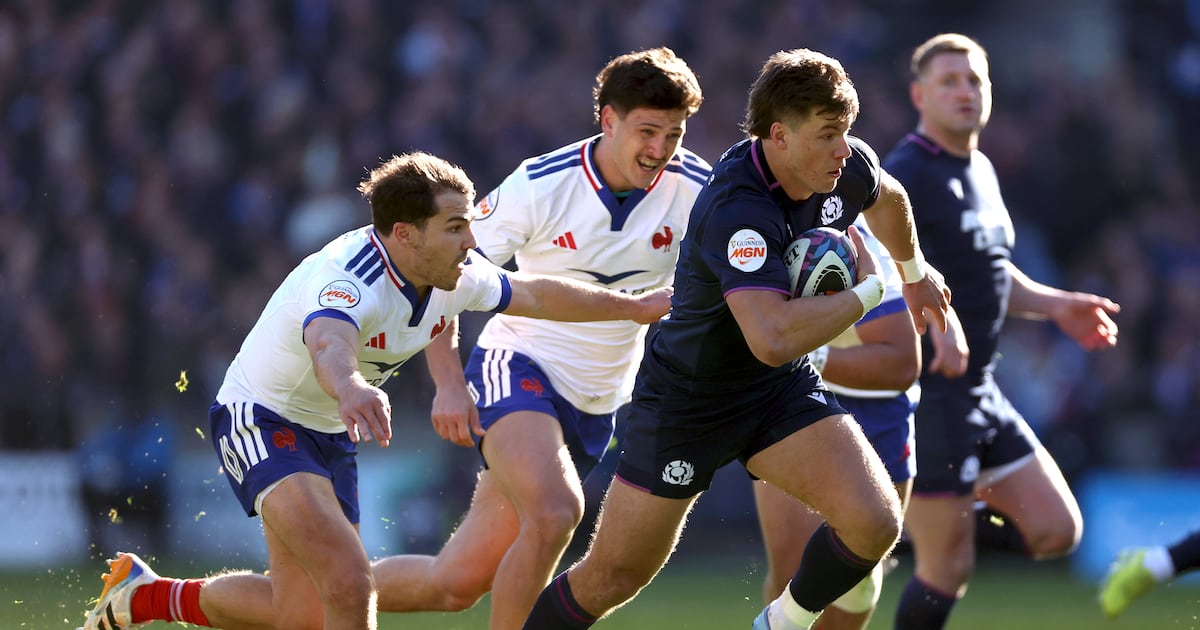
This year’s Six Nations has been captivating because teams are winning by harnessing the untapped potential of their minds to create physical domination over opponents.
Teams that have maximised their psychological and emotional power in the opening 20 minutes of matches are winning.
Consider the following games in this year’s tournament: France v Ireland; Scotland v England; Ireland v England; and Scotland v France. In each of these fixtures, the teams that dominated the opening quarter have gone on to dictate the match. The ones that lost the opening 20 minutes lost the game. There were no late-comeback wins.
Around 2010, I began to believe that the next great breakthrough in rugby performance was going to be found in strategies that maximised the players’ mental strength.
At that time, rugby was taking extraordinary strides forward in sports science. As the last vestiges of our amateur-era party-animals were tearfully sailing off to the bars in rugby’s Valhalla, a new breed of player emerged.
They were physically bigger, faster and more powerful than those who had gone before them. However, their knowledge of how to harness their psychological power had not improved from the days when cases of beer were being necked in the post-match showers.
Teams who are strong in body, spirit and mind are usually winners in elite sports. Rugby had mastered how to produce players with powerful bodies and teams full of spirit, but creating individuals with powerful minds was a weakness.
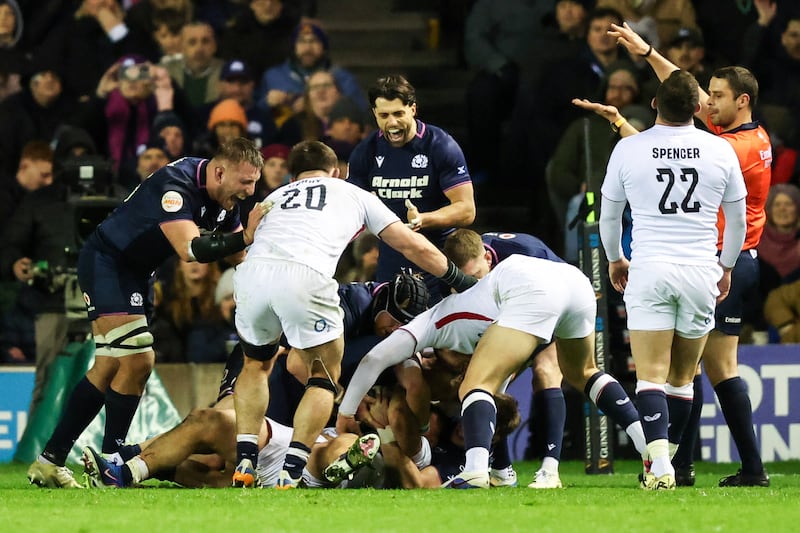 Scotland’s Matt Fagerson (left) and Adam Hastings celebrate as the final whistle is about to be blown in their Six Nations match against England at Murrayfield last month. Photograph: Ross Parker/SNS Group via Getty Images
While sports psychology had been part of rugby for decades, players remained sceptical and getting their buy-in was close to impossible. At that time, delivery of sports psychology was, at best, clunky. At worst, it was ineffective and ridiculously expensive, even for professionals teams.
As the South Africans began their obsession with dominating matches through all-out scrummaging, with the sole aim of gaining penalties, rugby’s sports scientists reacted by creating programmes that reduced the need for aerobic fitness and focused on players producing explosive power.
As France and England began mimicking the Springboks – tactics that exploited loopholes in rugby’s laws – the game transformed from a continuous 80 minutes of aerobic play into a stop-start series of highly physical, 30-second maximum efforts. These explosive bursts are then followed by several moments of nothing, as the new generation of behemoths stand around trying to draw oxygen into their aerobically-challenged lungs, preparing for the next scrum or maul.
 Do Scotland have a genuine chance at breaking their 11-match losing run to Ireland?
My theory was that teams who could harness the mental strength and aerobic fitness to play high-tempo rugby would heap aerobic fatigue in the defenders. As the saying goes, fatigue makes cowards of us all.
To achieve the mission of producing extended periods of dynamic, ball-in-hand rugby, players would need to master the knowledge of how to create extraordinary levels of mental strength.
Last week, Scotland proved that theory to be achievable. The Scots have demolished France and England – teams that have attempted to follow the Springboks’ obsession with power scrummaging – by playing the opening quarter of their matches at a blistering pace. Against France and England, the Scots played a high-tempo attack that kept the ball alive for long periods, while conceding very few penalties. This dragged their much larger opponents into aerobic fatigue and the ill-discipline that always accompanies it.
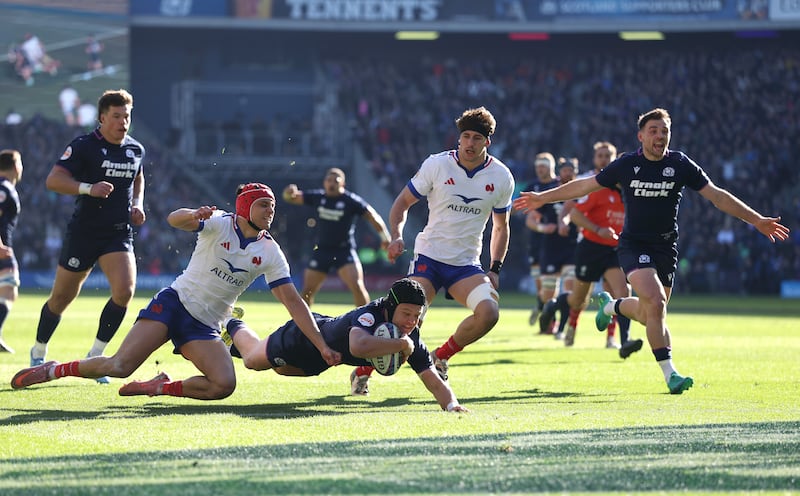 Darcy Graham dives over to score Scotland’s first try during their Six Nations victory against France at Murrayfield last Saturday. Photograph: Stu Forster/Getty Images
The opening passage of play at Murrayfield lasted a staggering 3½ minutes. During this period, Scotland twice ignored the opportunity to kick for touch and deliberately kicked to keep the ball in play. They forced the French to play themselves into fatigue. Even at that early stage, the Scottish tactics had Les Bleus forwards breathing so hard that any low-flying seagulls were in danger of being sucked into French lungs. At the scrum that followed that opening passage of play, the puffing French gave away a free kick and the Scots were off again.
Scotland mentally bullied the power athletes from England and France. Inexplicably, against Italy their mental strength was found wanting, while in Cardiff their concentration lapsed in and out of the match. They are a team afflicted with a split personality.
Unquestionably, Scotland are capable of beating Ireland. It is also possible they will get belted by a motivated Irish team.
The question surrounding the Scots this week is the same as last week – and every week with this inconsistent team – and it concerns their mindset. If the Scots turn up at the Aviva Stadium with the same levels of mental aggression displayed against the French, they will win.
Do not listen to the talk about their history in Dublin. Every match is a losing streak takes you one game closer to its end. Italy proved that last week as they ended a quarter-century of pain against England.
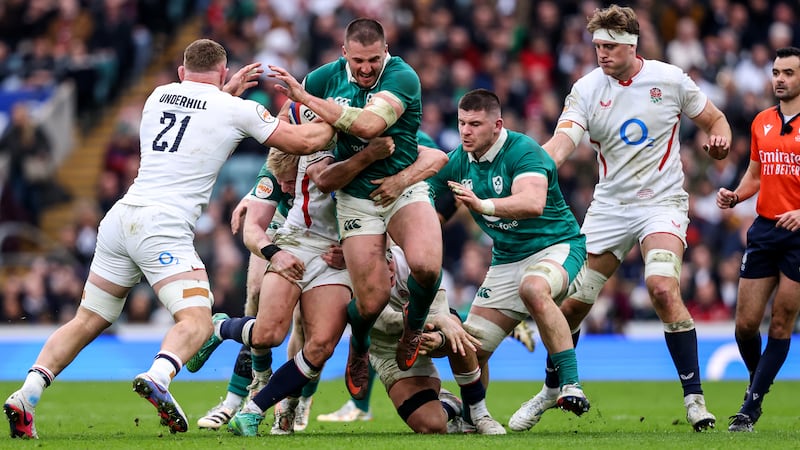 Stuart McCloskey powers forward against England, in a snapshot of the relentless approach that saw Andy Farrell’s men secure a record victory at Twickenham in last month’s Six Nations match. Photograph: Ben Brady/Inpho
The Irish need for consistency in psychological power is no different to the Scots. They mentally floundered against New Zealand in Chicago, South Africa in Dublin and against France in Paris, only to produce an emotionally-supreme performance against the old enemy in London.
While there is a Triple Crown up for grabs in Dublin, let us remember our rugby history and humbly acknowledge that the Triple Crown signified the huge achievement of being undefeated in the original tournaments in the 1880s. The Triple Crown was the Grand Slam of its time. To claim a Triple Crown without winning the championship reduces this wonderful piece of our history into a participation ribbon for teams that finish second or third.
To win the Six Nations with a Triple Crown is an honour that pays respect to players who forged the foundations of this great tournament.
Something else to consider is that until the 21st century, there was no physical Triple Crown Trophy. For more than 100 years, teams played for the honour of knowing they had won.
On Saturday, it should be France, Ireland and Italy who succeed. But do not be surprised if it is England, Scotland and Wales. It has been that type of tournament where every team is capable of beating each other.
It will be an epic day, full of sensational rugby, where the mentally strong will triumph.
Follow our rugby WhatsApp channel
If you want the latest rugby news, analysis and opinion then you should follow our dedicated WhatsApp channel. From Gerry Thornley to Owen Doyle and Gordon D’Arcy, we have every angle covered.
Find the channel here.