
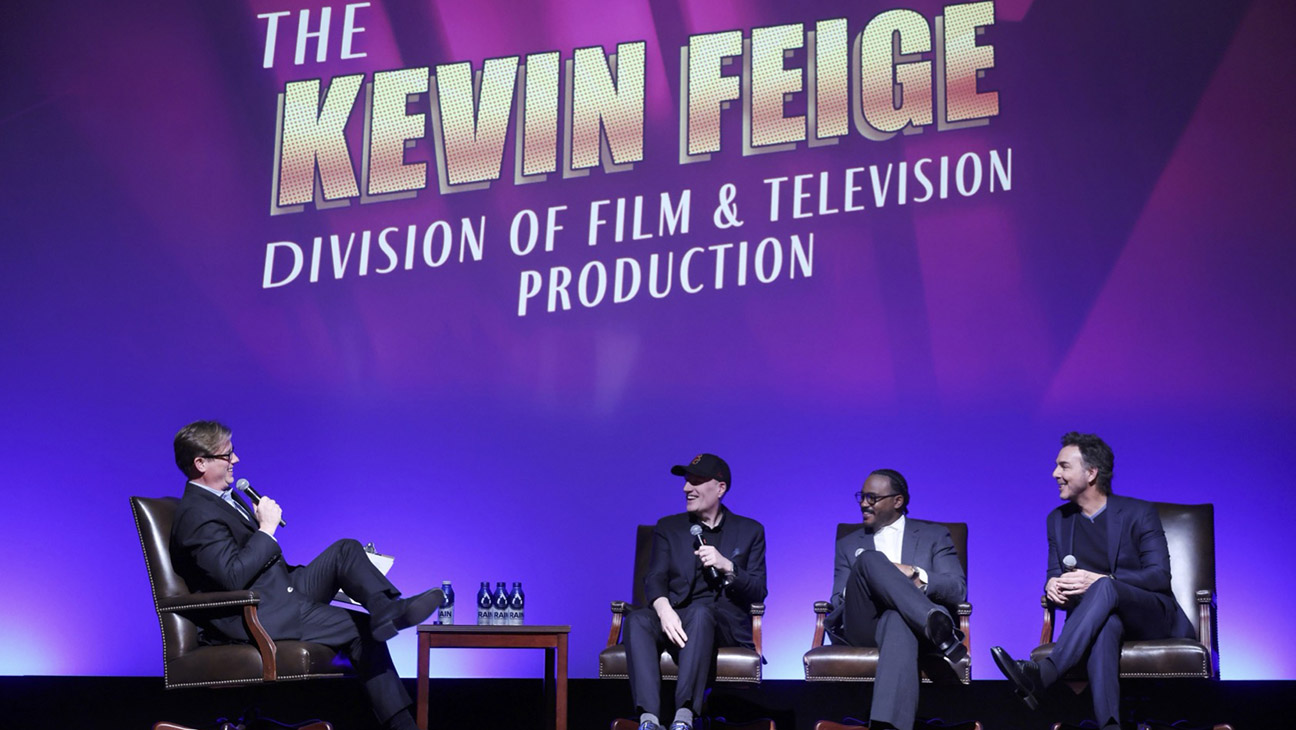
Drowning out the noise of the internet, learning to move forward after harsh test screenings, and reflecting on the days after the death of Chadwick Boseman were among the insights tendered by Marvel head Kevin Feige and filmmakers Ryan Coogler and Shawn Levy during a fete for Feige on Thursday night.
It was a unique peek behind the curtain at Marvel Studios as USC celebrated the dedication of the Kevin Feige Division of Film & Television Production at USC’s School of Cinematic Arts. All three of the Hollywood players — Feige, the most successful movie producer of all time; Coogler, the mastermind behind Oscar hopeful Sinners; and Levy, the Deadpool & Wolverine director now in postproduction on the latest Star Wars movie — are USC grads. And Feige, who graduated in 1995, is among the biggest donors and boosters of the school, which is nearing its centennial.
Feige’s endowment, hailed as transformational, will provide a lasting source of funding for faculty, students and programmatic support for the largest and the most well-known of the school’s seven divisions.
The importance of the accomplishment was underscored by the presence of Feige’s Disney family, with newly named CEO Josh D’Amaro, film studio head Alan Bergman, and newly named president and CCO Dana Walden sitting front and center, along with Avengers star Robert Downey Jr. and wife Susan Downey, the latter also a USC alum. Other bold-faced names included Marvel Studios co-president Louis D’Esposito, Marvel TV head Brad Winderbaum (a USC alum), media mogul Byron Allen, veteran film executive Michael Ireland, filmmaker Jason Reitman, producer Jason Shuman, and screenwriters Timothy Dowling and Alex Litvak.
The centerpiece of the evening, however, was the revealing conversation between Feige, Coogler and Levy.
Marvel has always had a back and forth with fans, going back to the days of the letters pages at the back of its comics, “but it can be wielded with such force now that you have to be beware,” Feige noted, referring to the power, sometimes dark, of fandom on the internet.
The volume of what is being said online, if you focus too closely on it, “will crush you,” he said, adding, “There are hours and hours of theories on YouTube, hours and hours on TikTok, hours on subreddits … You can read everything on everything and get a different point of view on it. You can go crazy. So, we don’t do that.”
Marvel finds the best way to get early audience feedback is at the movie theater at test screenings. It’s just like film students showing their films to peers for feedback, only, as Feige noted, “It happens when you’ve already spent almost $200 million on a movie and you screen it for people and they’re like, ‘What was that?’”
“And then the panic sets in,” chimed in Levy. “You panic, feel like shit, and then you go back to work.”
Feige admitted to not understanding early in his career that disappointing tests are something filmmakers at every level deal with.
“I thought we were the only morons that couldn’t do it perfectly the first time and had to really work at it to make it great. And turned out that Pixar would do the same thing. And turns out that most great filmmakers …” Feige stopped and turned to Coogler, asking, “Was Sinners perfect from the first cut?”
“No,” he said, chuckling, adding of the most nominated film in Oscar history: “I don’t know if it’s perfect [even] now, bro.”
Returning to the topic of the internet’s white noise, Levy said that if a filmmaker can’t mute it, they will get lost in that fog, which will affect a movie’s quality.
“And when you’re working on big franchise stuff, like Marvel and Star Wars, you’ve gotta know when to put it down, go quiet, and go back to what you had in your head and in your voice when you began,” he said.
The evening’s conversation veered into a look at Marvel’s process of hiring filmmakers, wherein Feige said that vibing with someone and asking if he could spend the next two years with them in an intense situation was almost more important than a person’s previous work.
And Coogler hilariously recounted seeing the first Iron Man movie on opening weekend in 2008 at the Arclight in Hollywood, during which he left to go use the restroom, only to find himself temporarily locked out of the theater by security because the filmmakers were there to greet the audience ahead of the screening.
“I see Feige, I see Downey, I see Jon [Favreau], and they had Stark Industry jackets and shit,” he recalled. Once back inside the theater, he remembered Downey cracking the audience up and then once the movie started, “It was magic. And it was my first semester at film school. I had just moved to L.A. And I thought to myself, ‘I can’t believe I’m here.’”
And Levy told of how Hugh Jackman’s participation in what became Deadpool & Wolverine unlocked the story for that movie. Nostalgia became the very visceral theme for the feature.
“It was heaven to sit there and go, ‘Who do people miss and they don’t even know how much they miss them?’ What would be the most delicious wish fulfillment for us as fans?”
Feige and especially Coogler have not spoken publicly much about the immediate aftermath of the death of Black Panther star Boseman, who passed away in 2020 after succumbing to cancer. But on Thursday, in front of the crowd of eager listeners, they opened up about those dark times.
Feige revealed that during his last in-person meeting with Marvel execs, Boseman expressed how much fun he was having voicing the character of T’Challa, the Black Panther, in the animated show What If …? He wanted to bring that fun vibe to the next Panther feature, which ultimately, he never got the chance to make.
That anecdote served to underscore Feige’s broader point about how he took Boseman, and in fact, took other colleagues and friends, for granted. He explained that on most movies, people work very closely for a period, and then may not see each other for years after the movie wraps. But with Marvel, there was always another movie to make, another Panther, or an Avengers, or an Iron Man around the corner.
“We will be back in there, that was always my expectation,” Feige said. “So the need to set a dinner or a lunch to say hi, I just never do. Because we’re busy and because we’re going to have a next time. And that hit me like a ton of bricks when I realized that there wasn’t going to be a next time.”
Coogler, meanwhile, revealed that in the time after Boseman’s death, Feige and Disney CEO Bob Iger flew to the actor’s home in Oakland, all while the COVID-19 pandemic was still at a high.
“They came to our apartment in lockdown … and we walked around the Richmond Arena and just talked. And that was the first real check-in,” he said. “And it wasn’t ‘Hey, what are we going to do about this franchise?’ It was about, ‘Hey, are you OK? How are you taking it?’ … It was real moment where you see the humanity beyond the corporate things and the financial responsibilities.”
Coogler called that period a profound experience and said he really tried to learn the lesson of not taking people for granted, to not fall into the “I’ll see you at the next thing” mindset.
“There was only one Chad, bro. And there was only one character that was really meant for him.”

Kevin Feige, Ryan Coogler and Shawn Levy at the Dedication of the Kevin Feige Division of Film & Television at the USC School of Cinematic Arts.
Steve Cohn/USC
Years before Feige worked with Coogler, Levy or Boseman, he grew up obsessed with the idea of attending USC after learning that his favorite filmmakers, George Lucas, Ron Howard and Robert Zemeckis, had attended the famed film school. Even as a teen attending a comic and sci-fi convention, he was as focused on obtaining a USC cap as he was finding reproductions of blueprints of Star Wars space ships.
“Well, it’s come full-circle, Kevin,” remarked film school dean Elizabeth Daley. “Because now students are applying to the school because it’s where Kevin Feige went to school.”
Her comment proved prescient. When a Q&A opened at the end of the evening, dozens of students scurried to mics to ask questions. The moments yielded more valuable lessons but also amusing moments, including a double take of laughter when a young Black student named Ryan Cooper from the Bay Area asked a question to Ryan Coogler from the Bay Area.
Asked to name a “What if …?” moment that changed the trajectory of his life, Feige mentioned about going to the school’s internship room and seeing an opening at Donner/Shuler-Donner Productions, the production company run by late Superman director Richard Donner.
“I loved, loved, loved Superman, one and two in particular. And that was the first and only résumé I’ve ever filled out. It was for that. And I faxed to them. If I had not done that, I don’t know. I don’t know.”
He also listed meeting then-Marvel honcho Avi Arad as one “What If” moment and Disney buying Marvel in 2009 as another key turning point.
As Feige closed the evening, he went back to that question, adding meeting his wife, Caitlin, to the top of that list.
“If I hadn’t met her, I would not have been able to do any of this,” he concluded.