
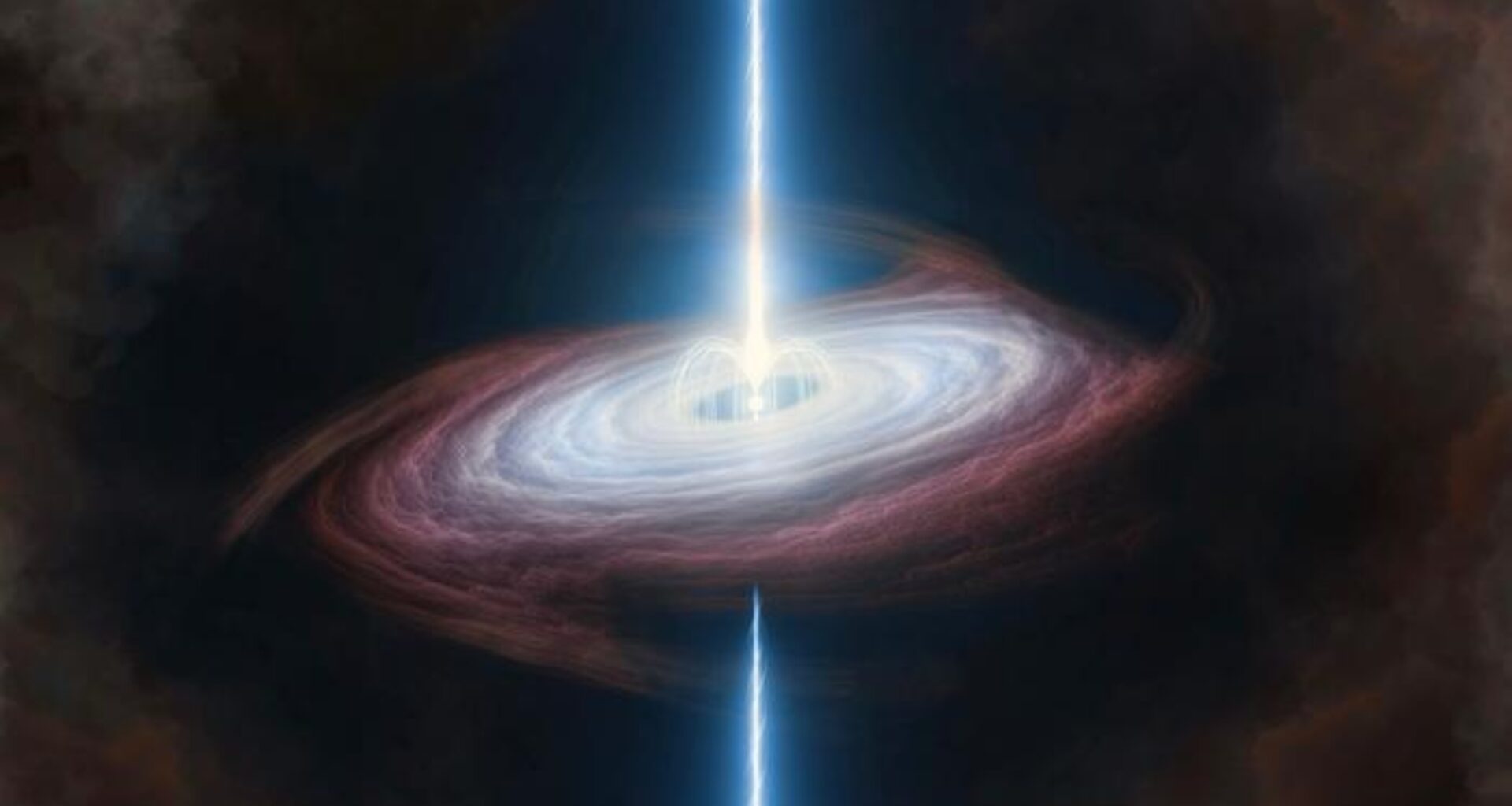
Magnetars are among the most powerful objects in the universe, but astronomers rarely get the chance to see one being born.
When massive stars die, they usually follow a familiar script. The star runs out of fuel, its core collapses, and the outer layers blast outward in a brilliant explosion called a supernova. Over time, the light fades as the expanding debris drifts into space.

But some stellar explosions refuse to follow that script. These events, called superluminous supernovae, burn far brighter than typical ones. They can shine ten times brighter than ordinary supernovae and remain visible for much longer.
For years, astronomers debated what could power such intense and long-lasting light.
A new observation has provided a clear answer. Astronomers have witnessed the birth of a magnetar inside one of these rare explosions.
The experts noticed a strange pattern in the fading light of the blast – a repeating signal they describe as a “chirp.”
The intense energy of magnetars
Superluminous supernovae puzzled scientists soon after researchers began spotting them in the early 2000s.
The explosions looked too bright to be explained by the usual collapse of a star’s iron core. Something inside the debris seemed to be adding extra energy.
Years ago, theorists suggested a possible culprit: a magnetar – a type of neutron star with an extremely strong magnetic field.
Neutron stars are already among the densest objects in the universe, formed when a massive star collapses. Magnetars push those limits even further.
These compact remnants measure only about 10 miles across, yet a newly formed magnetar can spin more than 1,000 times per second.
The magnetic field of a magnetar is hundreds to thousands of times more powerful than the field of an ordinary pulsar, another type of rotating neutron star.
The idea was simple. If a newborn magnetar sat inside the expanding debris of a supernova, its intense energy could slam charged particles into the surrounding material. That interaction could keep the explosion shining far longer and brighter than normal.
New clues in a powerful explosion
The magnetar explanation remained a theory for years. Researchers saw signs that supported it, but no one had observed clear evidence that a magnetar had formed inside a superluminous explosion.
That changed after a distant supernova appeared in late 2024. UC Berkeley graduate student Joseph Farah closely analyzed the event using observations from Las Cumbres Observatory’s global network of 27 telescopes.
The explosion, known as SN 2024afav, occurred roughly a billion light-years from Earth. Telescopes tracked the brightness of the supernova for more than 200 days.
At first the event behaved as expected. Its brightness rose and reached a peak about 50 days after the explosion. Then something unusual happened.
Instead of fading smoothly, the light dipped and rose several times. The pattern appeared as four bumps in the fading signal. Each bump arrived sooner than the one before it.
A signal that sped up over time
The unusual light pattern caught the attention of Farah and his colleagues. It suggested that something inside the supernova was periodically blocking or redirecting the light.
“What’s really exciting is that this is definitive evidence for a magnetar forming as the result of a superluminous supernova core collapse,” said Alex Filippenko, a professor of astronomy at UC Berkeley.
“The basis of Dan Kasen and Stan Woosley’s model is that all you need is the energy of the magnetar deep within and a good fraction of it will get absorbed, and that’ll explain why the thing is superluminous.”
“What had not been demonstrated was that a magnetar did in fact form in the middle of the supernova, and that’s what Joseph’s paper shows.”
The pattern also pointed to a deeper explanation involving gravity itself. The timing of the brightness bumps sped up in a way that matched a prediction from Einstein’s theory of general relativity.
“We tested several ideas, including purely Newtonian effects and precession driven by the magnetar’s magnetic fields, but only Lense-Thirring precession matched the timing perfectly,” Farah said.
“It is the first time general relativity has been needed to describe the mechanics of a supernova.”
When relativity enters the scene
The research team believes the supernova left behind a rapidly spinning magnetar surrounded by an accretion disk made from material that fell back after the explosion. The disk likely did not line up perfectly with the magnetar’s rotation.
General relativity predicts that a spinning object drags space-time along with it. In this case, the rotating magnetar would cause the disk to wobble. Astronomers call this effect Lense-Thirring precession.
As the disk wobbled, it likely blocked and reflected light coming from the magnetar at regular intervals.
Over time, the disk moved closer to the neutron star. That inward motion caused the wobbling cycle to speed up, producing the unusual pattern in the light curve.
“For years the magnetar idea has felt almost like a theorist’s magic trick – hiding a powerful engine behind layers of supernova debris. It was a natural explanation for the extraordinary brightness of these explosions, but we couldn’t see it directly,” said Dan Kasen, a theoretical astrophysicist at UC Berkeley.
“The chirp in this supernova signal is like that engine pulling back the curtain and revealing that it’s really there.”
Measuring the newborn magnetar
The observations allowed astronomers to estimate key properties of the object formed in the explosion. The neutron star appears to spin once every 4.2 milliseconds. That rapid rotation is a typical trait of young magnetars.
The magnetic field is even more extreme. Researchers estimate it to be about 300 trillion times stronger than Earth’s magnetic field. Such strength easily qualifies the object as a magnetar.
“I think Joseph has found the smoking gun,” said Andy Howell, a senior scientist at Las Cumbres Observatory. “He’s tied the bumps into the magnetar model and explained everything with the best-tested theory in astrophysics – general relativity. It is incredibly elegant.”
Filippenko emphasized the importance of seeing Einstein’s theory at work in this setting. “To see a clear effect of Einstein’s general theory of relativity is always exciting, but seeing it for the first time in a supernova is especially rewarding.”
Magnetars are only part of the story
The discovery does not mean every superluminous supernova comes from a magnetar.
Some explosions may still brighten when shock waves slam into gas surrounding the star. In other cases, the collapse of a star could create a black hole that powers the light.
“We don’t know what fraction of Type I superluminous supernovae might be powered by circumstellar material, but it’s definitely a smaller fraction than we previously thought, because this discovery clearly accounts for some of them,” noted Filippenko.
Future telescopes should reveal many more examples. The upcoming Vera C. Rubin Observatory will conduct a massive survey of the night sky, capturing countless exploding stars.
Farah expects that survey to uncover dozens of similar events with the same chirping signal.
“This is the most exciting thing I have ever had the privilege to be a part of. This is the science I dreamed of as a kid,” Farah said. “It’s the universe telling us out loud and in our face that we don’t fully understand it yet, and challenging us to explain it.”
The full study was published in the journal Nature.
Image Credit: Joseph Farah and Curtis McCully, Las Cumbres Observatory
—–
Like what you read? Subscribe to our newsletter for engaging articles, exclusive content, and the latest updates.
Check us out on EarthSnap, a free app brought to you by Eric Ralls and Earth.com.
—–