
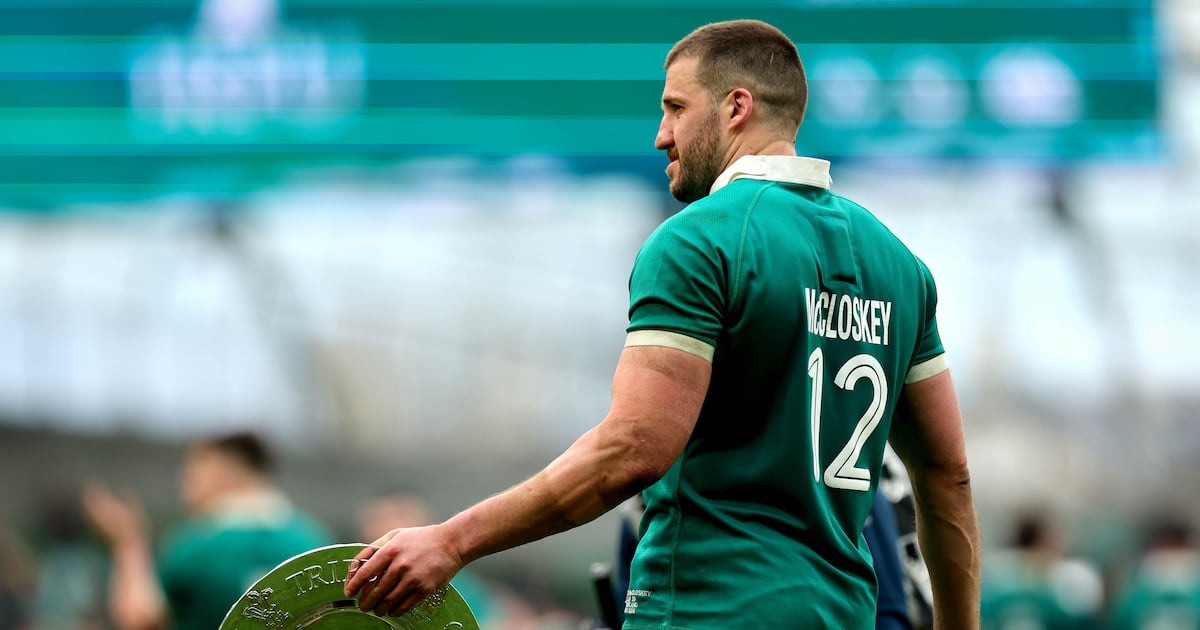
Sione Tuipolotu wore a bewildered expression, almost childlike in surprise, as he fleetingly considered how he came to be sitting with his backside facing due south on the Aviva Stadium turf. In that instant no doubt trying to reconcile being recast as a movable object that collided with the irresistible force that is Stu McCloskey.
The Scottish captain is not the first. McCloskey has been taking names in that respect for the past decade. Many have been dunted aside, forced to watch the 33-year-old Bangor man’s back disappear into the middle distance, whether in an Ulster or Ireland jersey.
McCloskey has been Ireland’s player of the tournament. He might not have collected the baubles associated with the individual match-to-match honours, but his Six Nations portfolio reveals an artist at the peak of his powers. The direct influence that he brings to bear in matches offers irrefutable proof of a burgeoning standing not just within the Irish squad, but the wider Test playing community.
There is quantity to go with that quality. He ran some impressive numbers but it’s more than the figures. When matters got untidy, unfocused, when progress had been halted, possession compromised and the Scottish defence repopulated and realigned, McCloskey stepped into the breach. He carried into multiple tacklers, gave his mates a target from which to reload and fire once again in attack.
It’s not just selfless, it’s physically punishing, those corridors are cluttered with big humans. It’s not for the faint or halfhearted. There are few easy metres in those circumstances. So, when examining the metrics, it’s worth bearing that in mind: 55 metres, 12 carries, 12 tackles, 12 passes, one turnover won, five defenders beaten.
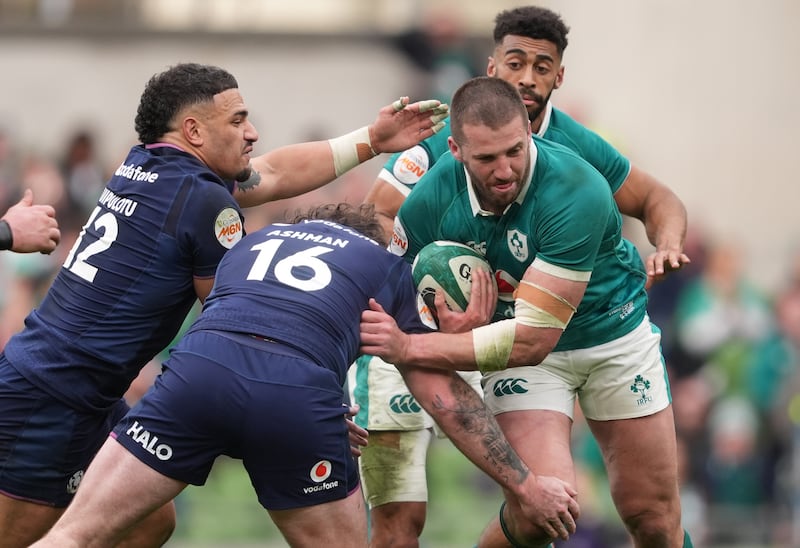 Ireland’s Stuart McCloskey is tackled by Scotland’s Ewan Ashman (centre) and Sione Tuipulotu. Photograph: Brian Lawless/PA
There is more tip of the iceberg stuff. His 25-metre pass for Rob Baloucoune’s try was a pearler. The set-up was excellent too, McCloskey looped around Garry Ringrose, his presence got the defence to bite in and check a little before the Irish centre unleashed a pass, whose trajectory and direction allowed his Ulster team-mate to accelerate immediately and then stretch beyond Darcy Graham and the try line.
That was his first try assist. The second demonstrated composure and vision. Tuipolotu spilled the ball, McCloskey, not for the first time in this tournament, employed a little basketball dink pass that took out the final defender and put the ball in the hands of Tommy O’Brien. The upshot was the right wing was left with an unobstructed run to the try-line.
Scotland targeted McCloskey with several kicks-off, a strange choice given that none of the chasers were able to put him on the deck at the first time of asking. In defence he closed space and time, thumped and scragged, and managed to scramble effectively too on occasion, when a colleague didn’t make a tackle.
It’s worth bearing in mind that of the four centres that started the game at the Aviva Stadium, McCloskey was the only one who didn’t wear the British & Irish Lions red shirt in the Test series win over Australia last summer. If there was a tour in the morning, he’d be on it.
Just ask Ireland and Lions head coach Andy Farrell. “And then obviously Stu McCloskey. He should definitely be in the running for player of the tournament.
“But for him to back it up five games on the trot is new, certainly in this format, but to perform and be consistently performing to that higher level is amazing, and it’s all because he’s playing in a squad that’s unbelievably close and connected to one another.”
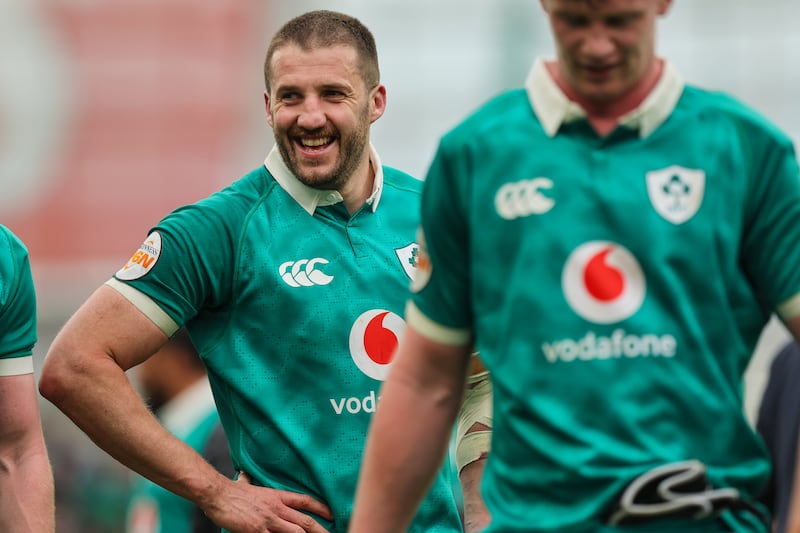 Ireland’s Stuart McCloskey celebrates after the match. Photograph: Ryan Byrne/Inpho
That element of trust is important. Garry Ringrose has played a supporting role. Ireland have worked their patterns around McCloskey’s strengths, his ability to break the gain-line but in this game, he broadened the remit to include a creative element.
He has an unparalleled offloading game in Irish rugby, but his range of passing has expanded as he has demonstrated tournament long. But what’s also vital are components like the timing to go with the physical dexterity. That part of his game has flourished in the Six Nations.
Jack Crowley would have appreciated McCloskey’s considerable and comforting presence, knowing that, if pressed, he had a willing acolyte to mitigate anything that took on a troublesome appearance; big or small.
The absence of Bundee Aki and Robbie Henshaw through suspension and injury at the start of the Six Nations meant that McCloskey had to shoulder an additional load/expectation especially as Jamie Osborne was required to fill in at fullback for the absent Hugo Keenan. He’s made light of that in the most compelling fashion.
McCloskey started his last nine caps for the national side, a run that began last summer in Georgia and Portugal, included Tests against New Zealand and Australia in November and now all five Six Nations matches, a standout in Ireland’s four tournament victories. A campaign to remember.
Follow our rugby WhatsApp channel
If you want the latest rugby news, analysis and opinion then you should follow our dedicated WhatsApp channel. From Gerry Thornley to Owen Doyle and Gordon D’Arcy, we have every angle covered.
Find the channel here.