
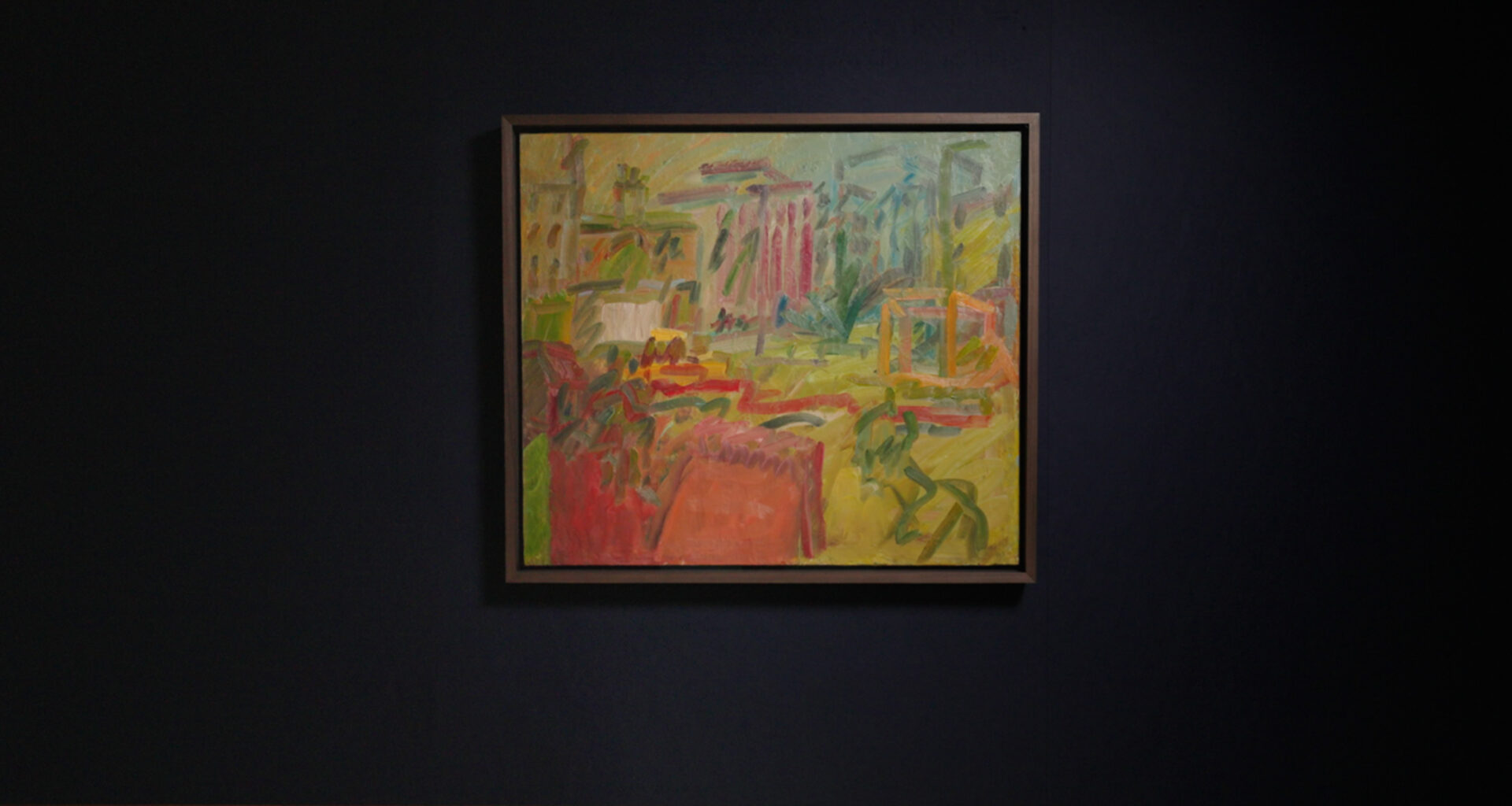
Frank Auerbach’s powerful painting Christmas Tree at Mornington Cresent (2004-05) captures a corner of London that was much more to him than an artistic motif. Situated close to his Camden Town studio, it formed part of the small constellation of north London sites to which he returned obsessively over the decades, anchoring his practice in a landscape shaped as much by memory as by observation. There is something of the faded boarding house about the area. The streets of Regency terraces have long since passed into the hands of the better off, yet the buses still rattle by, there is the odd tatty corner shop, and the stucco has a propensity towards the drab.
Auerbach moved here in 1954, after Leon Kossoff suggested he take over his studio — a cramped building behind a Victorian villa on Albert Street. For the next 70 years, this neighbourhood — situated between the cigarette factory and the Tube station — would shape Auerbach’s art. The radial streets became the subject of his radical visions, the area’s buildings appearing repeatedly in shifting forms.
In those days, there was an unsettled, ramshackle busyness to post-war London. Amid the boarded-up churches, and sites where traders operated between the bomb craters, were the beginnings of the welfare state, of which the tower block was the most visible manifestation — ascending out of an Aral Sea of Victorian brick and stained concrete. As London struggled to rebuild itself, Auerbach realised that this half-formed landscape had ‘not been properly painted’, not in the way Paris or New York had been. He resolved to become its Boswell — a chronicler of its uneven terrain in dense, sinewy strokes of paint.
‘London is not a planned city,’ he once observed. ‘As soon as anybody tries to set one style or set one architectural scheme in motion, they run out of steam and somebody puts something entirely incongruous next to it.’ This confusion fascinated the artist: with each incoherent shift in the city’s character, Auerbach recorded its wounds in slippages of paint.