
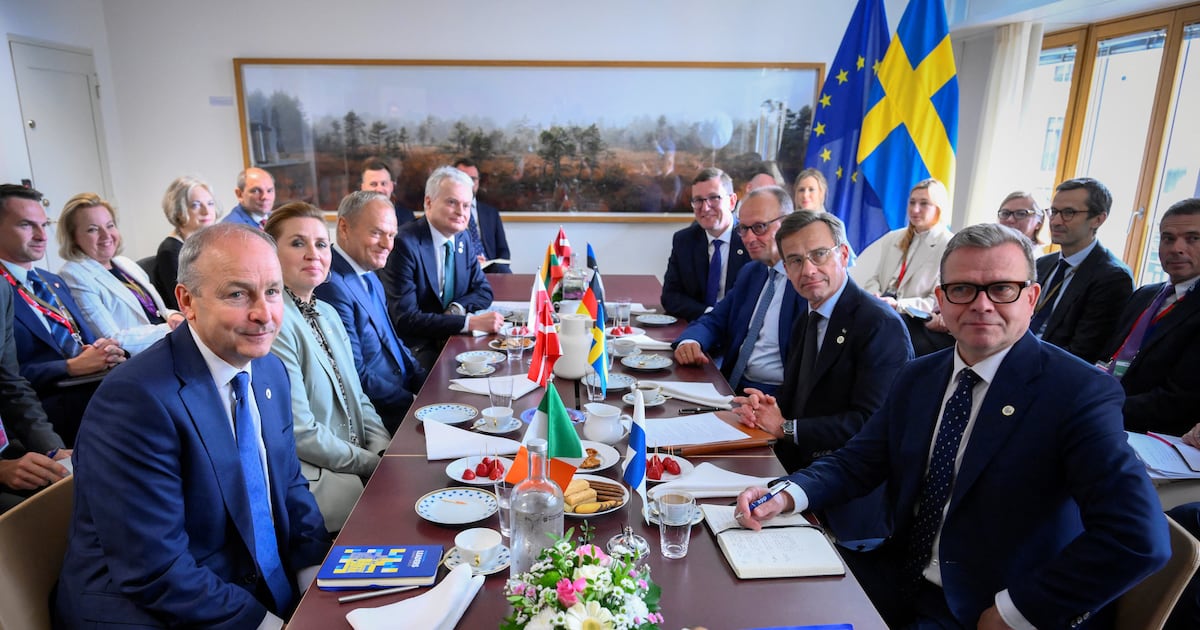
Ireland’s recent hissy fit at not being invited to a pre-EU summit meeting in Belgium speaks volumes as to where Dublin ranks in the minds of our fellow EU members. Ireland didn’t make the final cut of 19 “like-minded” countries brought together by Italy to talk about economic competitiveness at Alden Biesen castle.
And while the Taoiseach may have griped that he didn’t “get the necessity” of a private club convening separately, the reality is that Ireland – in our own minds at the heart of the EU – is actually located on the periphery of the EU’s decision-making radar.
Nowhere is that more relevant than in the struggle for Europe’s future currently being fought in Brussels. Here, it’s one small battle after another, the results of which are shaping the structure and powers of the EU for the decades ahead.
And that’s why only a multi-speed Europe – in which certain countries decide to move to closer integration, with others opting out – can save Ireland now.
Because Ireland’s vision of a unified EU27 progressing only at the pace of its most reluctant members is hopelessly out of date. It’s also a totally useless strategy for an EU desperate to reignite forward momentum to match the geopolitical moment.
Should the entire EU27 stop integrating because Ireland is worried about losing our sweetheart deals with US multinationals? Or because Europe’s rearmament doesn’t fit our cosy view of own “neutrality”?
Dublin’s approach is also isolating us from our natural allies in Europe. We are at risk of being seen to keep company with Viktor Orban’s anti-Ukrainian Hungarian government and Robert Fico’s increasingly illiberal Slovakia as thorns in the side of EU progress.
Dublin’s approach sums up two characteristics of Irish policy that have been allowed to fester for decades. First, is a continual overestimation of our importance in Brussels, a journey which reached its self-absorbed climax during Brexit. This was a moment where Ireland – when not lauding our essentiality to Europe – was deployed as a useful tool by France (aided inadvertently by the Brexiteers) to completely remove Britain from even minimal participation in EU initiatives. To this day, France continues to delay much needed British participation in the EU’s rearmament efforts.
Second is an unwillingness to admit to our true positioning in Europe. It’s ludicrous to suggest that Ireland has been anywhere near the centre of EU decision making for at least the last two decades. Despite years of Irish politicians waffling on about Europe, there is zero honesty as to where we actually stand.
Ireland is a peripheral, small island member of the EU. We remain a neutral state with no real military capacity (even to protect vital undersea infrastructure). Along with Cyprus we are the only member of the EU not in the Schengen free travel area (due to prioritising our Common Travel Area with the UK).
We are an Anglo-American style economy with a relatively low-tax, low-benefits social security model which is of British Beveridge design. The majority of continental Europe shares a Bismarckian (German) higher-tax, higher-benefits model which is also characterised by a much bigger role of the state in service provision. Ireland and Denmark are the only EU members that don’t issue national identity cards.
The truth is Ireland has long been an outlier in the EU. We’ve just never had the courage to admit it. But our ability to indulge this fantasy is coming to an end.
Because on almost every defining issue for the EU, Ireland is now on the wrong side of the wider political moment. Compared with deepening defence capabilities to deter Russia, implementing financial market integration to drive higher investment and enforcing the EU’s digital laws against US pressure – the Tánaiste’s concerns that a two-speed approach could deepen divisions within the single market – seems quaint and parochial.
The reality is that Ireland is shooting itself in the foot with our continuous opposition to a multi-speed Europe. This is a layered EU that is already emerging through the E6 economic group of large economies (Germany, France, Italy, Spain, the Netherlands and Poland) and the nuclear deterrent group (Germany, France, Poland, Denmark). The E6 have already called for the centralised EU supervision of financial markets despite Ireland and Luxembourg’s well-established resistance.
That’s why Ireland should embrace a multi-speed approach to European integration. It is the only mechanism by which Ireland can balance its national priorities (even if we don’t know exactly what they are) against the impact of further European centralisation. It is the grown up way to manage our actual socio-economic model with the Franco-German objective of a deeper European Union.
Nobody in Brussels says Sweden is not a key part of EU decision-making despite it choosing not to join the euro currency. Similarly, Denmark – whose migration and integration policies are increasingly mimicked across Europe – has long opted out of both the euro and EU co-operation on justice and home affairs.
But for this strategy to work Ireland needs to stop pretending it needs to be (or should be) at the heart of every EU policy. A multi-speed Europe will give Dublin the flexibility to navigate the EU’s centralising future – a critical need for Ireland, given our atypical European economic model and embedded position in the wider Anglosphere.
The days of our idle dreams about Europe are over. Or else Alden Biesen won’t be the last party we get jilted for.
Eoin Drea is a senior researcher at the Wilfried Martens Centre, the official think tank of the European People’s Party of which Fine Gael is a member