
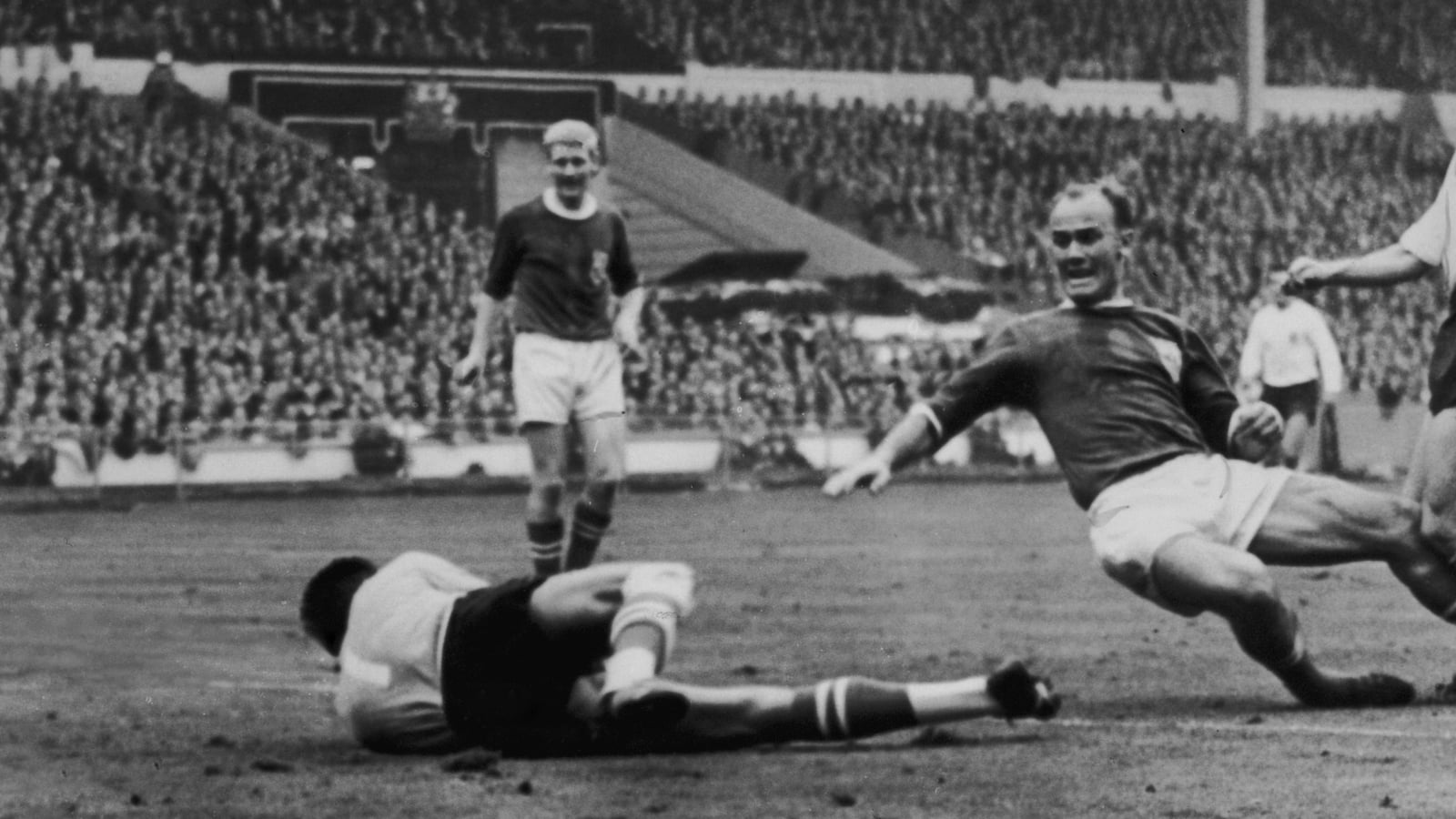
With nothing much on the game from an Irish perspective, John Giles, Noel Cantwell and Tony Dunne were all unavailable due to club commitments.
Giles’ patchy attendance record at internationals in this period was a particular bugbear of FAI officialdom. He said in his autobiography that disillusionment had set in with the national set-up after he discovered that the 1966 World Cup play-off against Spain had been moved to Paris after the association were thrown a few bob for agreeing to the switch.
“Weighing it all up, I didn’t need much encouragement or excuse to miss a few matches,” he wrote. “I wouldn’t be serving my country in any way by going along with this racket.”
The midfield consisted of Dunphy, Eamonn Rogers (Blackburn Rovers), Jimmy Conway (Fulham) and Ollie Conmy (Peterborough United) – the latter being the last Mayo man to play for Ireland.
Alan Kelly Snr was in goal in front of a defence which consisted of full-backs Mick Meagan and Joe Kinnear, with Hurley and John Dempsey as the centre-halves, while O’Connor made his debut alongside Ray Treacy up front.
A Dempsey own goal early in the second half caused the Czechs to relax.
“The pitch was icy, barely playable… when the Czechs took the lead, our goose seemed cooked. Needing only a draw, they stopped pushing forward,” Dunphy wrote.
“Eamon Dunphy crossed the ball, and Ray Treacy scored a brilliant header to make it one-all,” O’Connor recalls.
“In the 86th minute, I couldn’t believe it when Ray got the ball off their centre-half Popluhar, who was a huge name at that time.
“Ray stole the ball off him. I was coming in [to the box]. I wouldn’t have scored many headed goals in my career. But I got my head to the ball. There was a stunned silence, I would say.
“It was a long four minutes after that but we ended up winning 2-1.”