
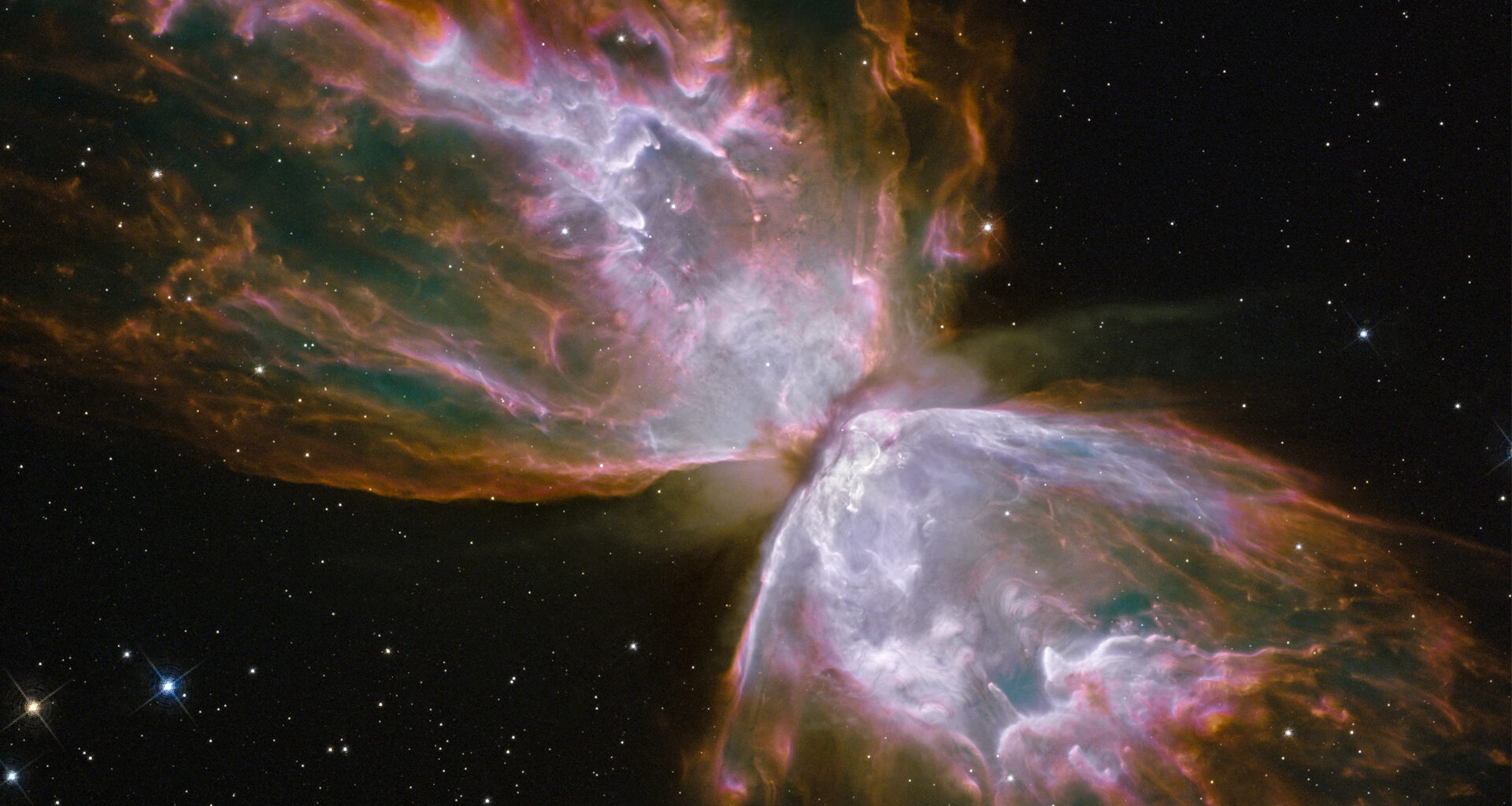
The death of a star is usually thought to be a violent and hostile place, filled with scorching radiation that destroys fragile molecules. However, new observations from the James Webb Space Telescope (JWST) suggest that dry ice can survive in such conditions.
Astronomers studying the dramatic NGC 6302 have detected frozen carbon dioxide (dry ice) embedded within its dusty structure. The nebula lies about 3,400 light-years away in the constellation Scorpius, and the finding marks the first confirmed detection of dry ice in any planetary nebula.
“We report a surprising discovery: the clear spectral signatures of cold CO2 gas and the presence of CO2 ice features, marking the first detection of CO2 ice in a PNe (planetary nebula),” the researchers note in their study.
A chemically rich cosmic butterfly
Planetary nebulae form when Sun-like stars exhaust their nuclear fuel and shed their outer layers, leaving behind glowing clouds of gas and dust surrounding a hot stellar core. These expanding shells play a key role in enriching the interstellar medium with heavy elements and molecules that later help build new stars and planets.
However, the harsh radiation inside such nebulae normally destroys fragile compounds, making the survival of volatile ice extremely unlikely. The new observations reveal that under the right conditions, even these hostile stellar graveyards can preserve frozen molecules.
The study authors from the University of Western Ontario targeted NGC 6302 because it already showed signs of unusual chemistry.
Often called the Butterfly Nebula or the Bug Nebula, this object displays a striking structure involving two bright gas lobes extending in opposite directions, separated by a thick, dusty ring—known as a torus—around the central star. The entire nebula stretches to a radius of at least 1.5 light-years.
“The Butterfly Nebula (NGC 6302, a complex bipolar PN) has emerged as a particularly intriguing laboratory for investigating complex chemical pathways in PNe due to its extreme environment and surprisingly rich chemistry,” the study authors said.
Earlier studies had hinted that the nebula’s environment supports surprisingly complex chemistry. Astronomers previously detected the methyl cation (CH₃⁺) there, a molecule that plays an important role in organic chemical reactions in space.
Researchers also identified widespread polycyclic aromatic hydrocarbons (PAHs), large carbon-based molecules often found in cosmic dust. Together, these discoveries suggested that NGC 6302 might be an ideal natural laboratory for exploring the chemical pathways that occur as stars reach the end of their lives.
Due to this chemical richness, the team decided to examine the nebula in greater detail using the Mid-Infrared Instrument on JWST. Infrared observations are especially useful for studying molecules hidden inside dusty environments, since different substances absorb light at specific wavelengths that act like unique fingerprints.
Spectral clues pointing to frozen carbon dioxide
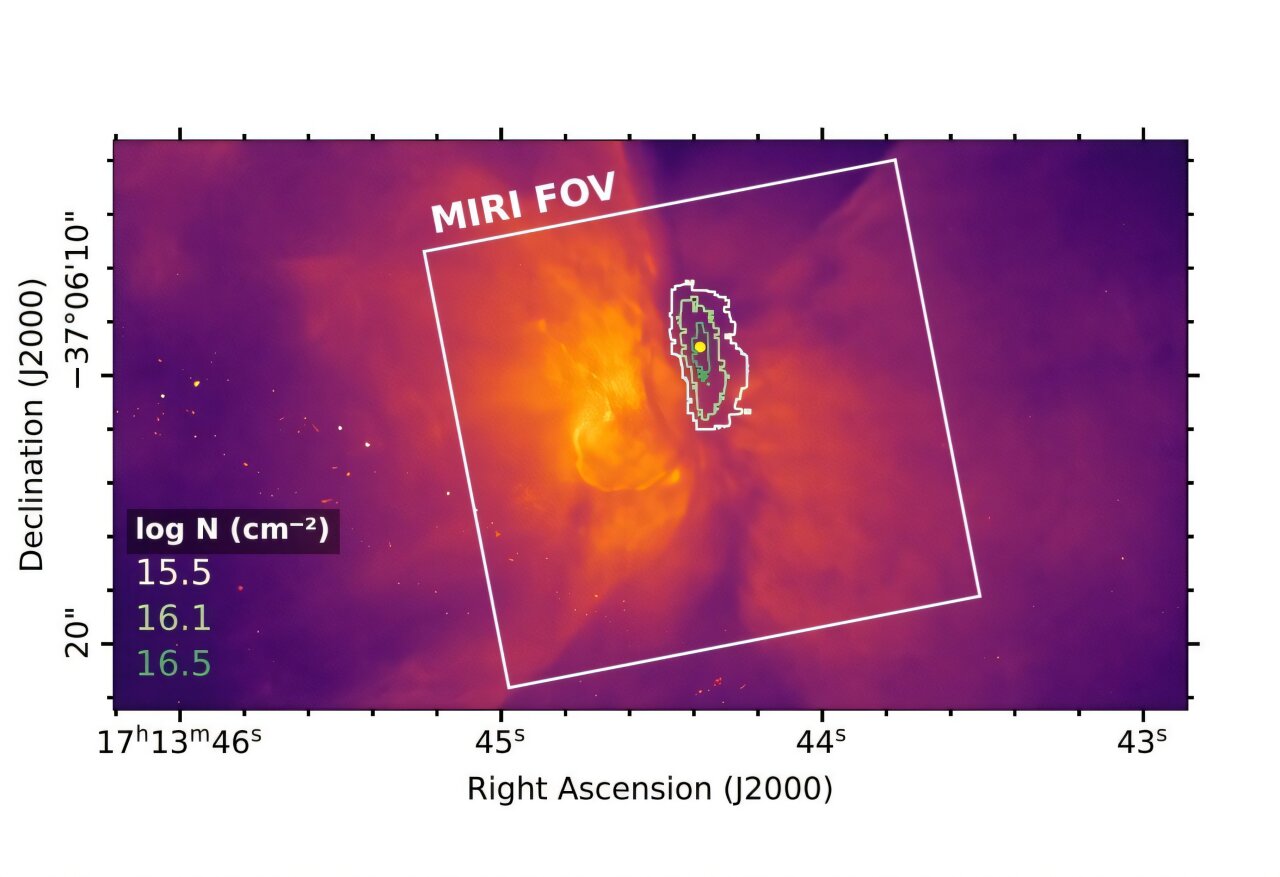 An image showing the location of dry ice in NGC 6302. Source:
arXiv:2602.22366
Using Webb’s medium-resolution spectrometer, the researchers observed the central region of the nebula, including the star, the dusty torus, and the inner sections of the bipolar lobes. When the infrared spectra were analyzed, the team first noticed clear absorption features between 14.8 and 15.2 micrometers, a signal produced by carbon dioxide gas.
“We identify two key signatures of CO2 ice: (1) a shallow, broad absorption between ∼14.9-15.15µm, and (2) a second absorption between ∼15.2-15.3µm. This characteristic double-peak structure matches laboratory CO2 ice spectra and is clearly distinct from the single, deeper clinoenstatite band at 15.4 µm or its weaker features,” the study authors explained.
This matched the spectral fingerprints of solid carbon dioxide, confirming the presence of dry ice within the torus. The detection is particularly remarkable because carbon dioxide ice evaporates more easily than water ice.
Astronomers typically find such volatile ices only in very cold and shielded environments, such as dense molecular clouds, the envelopes surrounding young stellar objects, or the disks where planets form.
Planetary nebulae, on the other hand, are exposed to intense ultraviolet radiation from their hot central stars, conditions that should quickly destroy or vaporize these fragile materials.
The observations suggest that the dense dusty torus in NGC 6302 may act as a protective shield, allowing frozen carbon dioxide to survive despite the harsh radiation nearby.
The study authors also found that the ratio of gaseous carbon dioxide to ice differs significantly from what is seen in star-forming regions, indicating that the processes controlling ice formation or alteration in planetary nebulae may be very different.
“The gas-to-ice ratio differs markedly from that observed in young stellar objects, pointing to distinct ice formation or processing mechanisms in evolved stellar environments,” the researchers said.
A new window into chemistry around dying stars
Finding dry ice inside the Butterfly Nebula hints that the final stages of stellar evolution may host a richer chemical environment than previously thought.
If frozen molecules can survive within these dusty structures, they may later be released into the interstellar medium as the nebula disperses, contributing complex material to future generations of stars and planetary systems.
The researchers suggest that more high-resolution observations will be needed to determine whether this phenomenon is common. Such work may help astronomers piece together the full chemical story of dying stars—showing that even in their final act, they continue shaping the molecular ingredients of the cosmos.
The study is published in arXiv.