

Neil Jordan looks well. He leans in to catch the odd missed word, but, , now 76, he is still light on his feet and thoughtful in his conversation. Nobody talks quite like him. Apparently random ideas still pop out of nowhere. Questions are answered by sometimes puzzling counter-questions. Digressions progress to the bottom of the garden and back up hidden paths.
We meet at the Royal Marine Hotel in Dún Laoghaire on another foul day. Even the statue of Roger Casement appears to be glowering furiously at the latest swell of rain sweeping across the Irish Sea. Admirably, our most garlanded film director still likes to spend such days at his local cinema.
“Yeah, I go to the cinema. I go to my local cinema, which is the IMC in Dún Laoghaire,” Jordan, long resident in Dalkey, tells me. “I am normally sitting in a totally empty hall. On a rainy day like this, what are you going to do?”
What did he last go and see?
“I went to see a movie called … Umm … Criminal Number One?”
I think he means Crime 101 with Barry Keoghan and Chris Hemsworth.
“The movie I want to see, there was nobody in it. But the cinema was packed with younger people going to see Wuthering Heights. I mean, jammed! So, I think it’s silly to make predictions.”
He means it is silly to make predictions about the death of movies. Jordan, like the rest of us, despairs about much in the world, but he is stubbornly optimistic about the Seventh Art.
Why would he not be? The history of cinema is awash with great directors who have struggled to get projects made, but, since emerging with the extraordinary Angel in 1982 – when Irish features were as rare as Irish space probes – Jordan has rarely gone longer than three years without releasing a film.
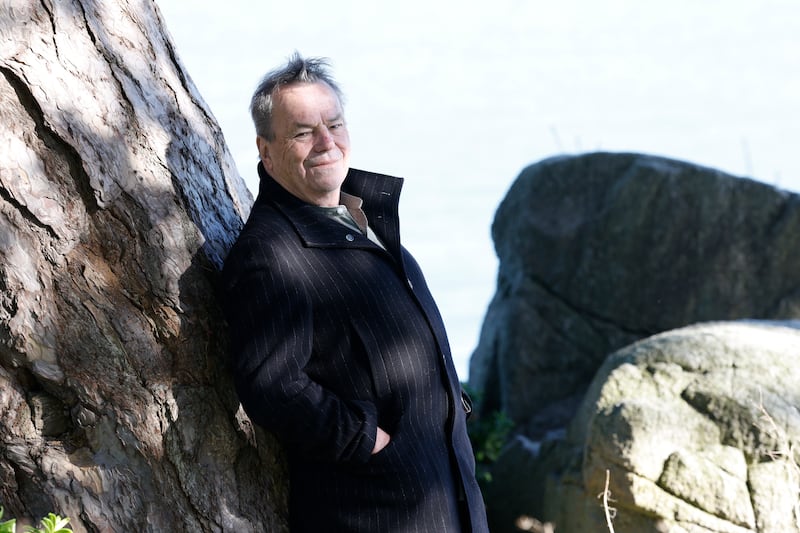
 Neil Jordan is stubbornly optimistic about the Seventh Art, cinema. Photograph: Nick Bradshaw/The Irish Times
Classics such as The Company of Wolves and Mona Lisa in the 1980s. Hits such as The Crying Game and Michael Collins in the 1990s. Right up to recently, intriguing oddities such as Byzantium with Saoirse Ronan and Greta with Isabelle Huppert. All that while creating TV shows such as The Borgias and Riviera.
How has he managed it?
“Well, initially, when I started, it’s almost like we were a band of brothers,” he says. “It was like: what are we going to do next? You make one movie, and everyone’s hanging around saying: ‘Okay, what do we do now?’ And you write another one. You make another one. There’s that feeling to it. But it has become more difficult.”
And then there is the fiction. Jordan started out as a novelist and short story writer. As long ago as 1976, Night in Tunisia, his debut collection, won rakes on its way to the Guardian Fiction Prize. He has never given up on prose. Novels such as Sunrise with Sea Monster from 1994, Mistaken from 2011 and The Ballad of Lord Edward and Citizen Small from 2021 have punctuated his progress through the film jungle.
We are ostensibly meeting up to discuss an extraordinary speculative novel entitled The Library of Traumatic Memory. I recommend it to those who enjoy the philosophical science fiction of European authors such as Stanisław Lem and the Strugatsky brothers.
“I was toying with an idea that I was doing with Amazon in the early days of the streaming stuff,” he says. “I had a notion of a medical corporation – it was based in America – that was getting designs from the future. So the basic idea is there. I messed around with it. I wrote some things. But it became a bit too complicated. So, I forgot about it.”
Oddly, southwestern Irish landscapes eventually reignited the notion.
 Jordan’s The Library of Traumatic Memory – like all the best speculative fiction – touches on concerns of the present. Photograph: Nick Bradshaw/The Irish Times
“I have a house down in Beara,” he says of the peninsula that borders west Cork and Kerry. “And there’s a huge, gaunt, very haunting mansion called the Puxley Mansion. It was built on the fortune of the copper mines. It is like a Gothic blot on the Irish landscape.”
Explaining how these two notions came together would require … well, a book the length of The Library of Traumatic Memory. For its first half, the novel alternates between the Beara Peninsula in 2084, where a “librarian” named Christian Cartwright maintains a collection of painful memories extracted from traumatised patients, and the adventures of an architect ancestor in 18th century Europe. The book abounds with conspiracies and mysterious deaths. The future bleeds into the past (and vice versa). Along the way, the text – like all the best speculative fiction – touches on concerns of the present: artificial intelligence, technological lunges for eternity and the continuing appeal of Billie Eilish.
“It’s the whole AI thing. Isn’t it? That Elon Musk urge for endless survival. It’s all there. Isn’t it?”
What are his feelings about AI? Few in the entertainment industry have come close to digesting all the dangers and all the possibilities.
“I don’t think it’s that interesting, really,” he says. “The siphoning of plots through focus groups? These Large Language Models that the studios use? That’s just another version – a more efficient version – of what they’ve been doing over the last 30 years. Have you seen that little video with Tom Cruise and Brad Pitt?”
If you let your imagination wander into the future then anything can happen
— Neil Jordan
I have indeed seen the AI clip – by Oscar-nominated Irish film-maker Ruairí Robinson – of Cruise and Pitt (stars of Jordan’s Interview with the Vampire) duking it out on a rooftop. Much of the online world went bonkers on its release. Are filmmakers obsolete?
“Is it important that the programme can execute that in 20 minutes rather than six weeks? The point is they’re both unreal. And cinema has been unreal for quite a while.”
The book allows Jordan some wider speculation about alternative futures. I was fascinated by one line noting “the deferral of all hopes for a United Ireland in the revived North Sea Empire”. A map, published in the front of the book, suggests that empire includes all Scandinavia, a swathe of mainland Europe beneath – partitioning France from west to east – and both Britain and Ireland. You what now?
“It’s about the absurdity of national boundaries – like the EU, which is seen to be changing by the minute,” he says, amused. “If you let your imagination wander into the future then anything can happen. I wanted to write a science fiction thing that was not about space travel and spaceships.”
Jordan was born in Ross’s Point, Co Sligo to a painter mother and an academic father. They later moved to Clontarf and, in Ireland’s less swinging late 1960s, he found himself at University College Dublin. There is a temptation now to treat that period as one of unremitting gloom and oppression, but Jordan looks back on it with qualified nostalgia. Shortly after leaving college, he and Jim Sheridan were breaking rules on the stage of the Project Arts Centre. They were filling creative vacuums.
 Jordan admits that it is now harder than ever to get films made. Photograph: Nick Bradshaw/The Irish Times
“It felt like the kind of country where there was no alternative but to write – to imagine things,” he says. “There were no jobs. I thought it was rather wonderful, actually. It was great. This was the late 70s and 80s in Dublin. Everybody was on board. Everybody was scribbling. My closest creative associate would have been Jim Sheridan. Jim was setting up the Project. Brian Friel produced the first of the Field Day plays. We saw Stephen Rea, Liam Neeson. What new stuff would happen?”
Well, not films, surely. It was one thing to stage a play at the Project. It was altogether another to produce a feature film that could plausibly screen in big festivals or in mainstream cinemas. Indeed, Jordan suggests that some of his contemporaries felt the very idea a bit vulgar.
It felt like the kind of country where there was no alternative but to write – to imagine things
— Neil Jordan
“The literary community here was outraged by the fact that I was doing this,” he says. “I remember speaking to Brian Friel and Seán Ó Faoláin and people. They thought it’s something you should never do. I suppose they thought of it as selling your books to Hollywood or something. But it was slightly different to that.”
The route to Angel was a windy one. It began with Jordan securing work as a “creative associate” on John Boorman’s Excalibur. He shot a documentary on the making of that Arthurian epic and, later, showed Boorman the script for Angel, the story of a showband saxophonist who gets caught up in villainy during the Troubles. Boorman signed on as producer, and the film, supported by a fledgling Channel Four Films, ended up as a critical smash.
It is hardly worth relitigating the controversies that surrounded the funding of Angel. Not everyone was happy a relatively inexperienced director received cash from the recently constituted Irish Film Board. Letters were written. Bar counters were bashed.
“It was that kind of time in Ireland,” he says. “Any interesting project became a source of argument. They’d repeat the Sean O’Casey experience at The Abbey.”
At any rate, Jordan was off. Next came The Company of Wolves, his delicious adaptation of Angela Carter’s fairy stories, and, in 1986, the hugely affecting gangster flick Mona Lisa. I was amused to find mention of that film in The Library of Traumatic Memory. Christian, hearing a Jaguar motorcar, finds himself remembering “that ancient motion picture known as Mona Lisa”. Is this Jordan’s way of saying that film is the most likely of his to last?
“No. I was originally it was going to put in The Italian Job,” he says. “And then I realised The Italian Job didn’t have a Jaguar. Bob Hoskins in Mona Lisa drives a Jaguar. It was a bit indulgent, but I decided that was justifiable.”
As noted earlier, it has been a singular career. There have been disappointments – he particularly regrets the failure of his 1989 comedy We’re No Angels – but he invariably hit back with an unlikely success. The Crying Game, from 1992, secured him an Academy Award for best original screenplay. A kind of domestic apotheosis came when, a few years later, Dublin ground to a respectful halt for the making of Michael Collins.
[ Film director Neil Jordan and the Éamon de Valera connectionOpens in new window ]
“You can see a Dublin that no longer exists,” he says. “They allowed us, on a Sunday, to stop the entire traffic of the entire city, so I could place a camera facing across the river towards the Four Courts with Liam Neeson wondering whether or not he’s going to tell them to start bombarding at this place.”
He admits that it is now harder than ever to get films made. As we speak, he is hoping to get a properly big project off the ground.
“Rather than struggle to get a $10-12 million project off the ground, why not struggle to make a $200 million movie?” he says.
Can he tell me about it?
“It’s called Dirt Bike Ride. It’s about a bunch of circus dirt bike riders and they end up in cavalry units. Ha, ha, ha!”
He is properly cackling at his own audacity.
“I’m sorry. It’s a big sell. But I’d love to make it. I think I will make it.”
I wouldn’t bet against him.
The Library of Traumatic Memory by Neil Jordan is published by Head of Zeus. He will be reading at the Cúirt International Festival of Literature, Galway on April 24th. He’ll also be at Listowel Writers Week in June.