
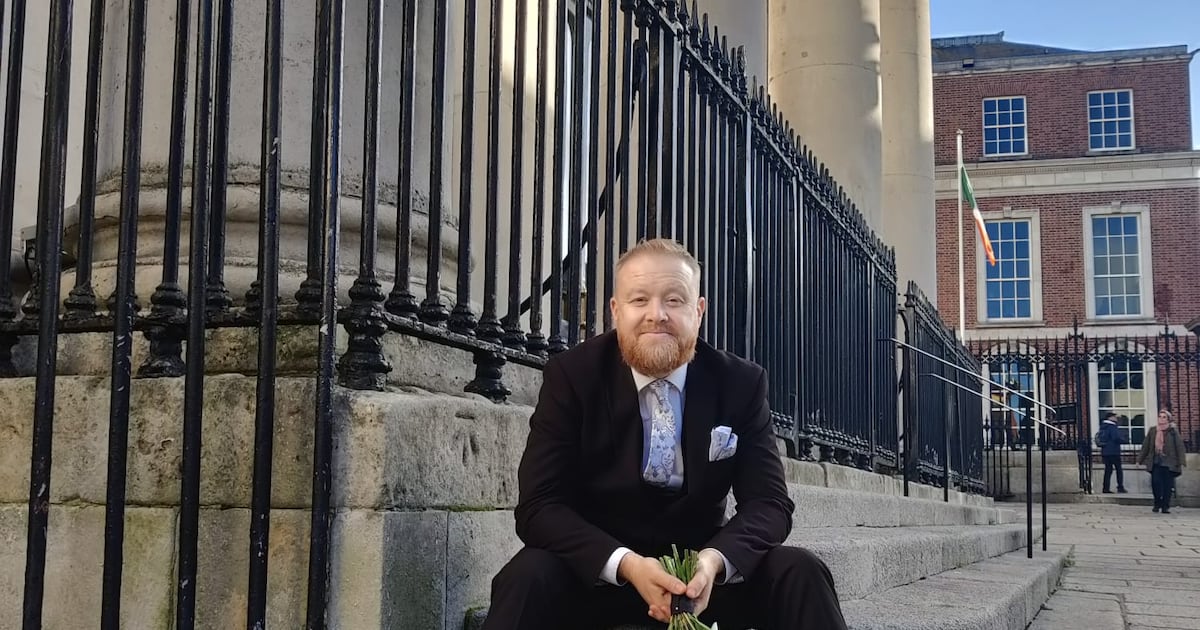
In 2023, Robert Flanagan was in and out of his local GP due to changes in his bowel movements and blood when he used the toilet. His doctor diagnosed him with piles and prescribed treatment, but the symptoms kept recurring, and he was referred to Tallaght Hospital for tests.
Eventually, near the end of that year, the pain became so intense that he decided he could no longer remain on the waiting list and, instead, paid privately to be seen at the Beacon Hospital.
The now 48-year-old had a colonoscopy in January 2024, after which he was told he had stage four colorectal cancer, which had spread to his liver.
“I had no worries going in. There was nothing in the back of my mind that this could be serious. It was really the last thing I was thinking of,” he said of his shock when he received the diagnosis.
The Dubliner, who now lives in Portlaoise, said he and his wife Caren wanted to make sure that his cancer disrupted his three children as little as possible.
“I live in Portlaoise, but all my treatment is in Tallaght Hospital. When I was first diagnosed, our children were 13, 11 and five and we’re a one-car family. But we wanted to minimise disruption to the kids. So my wife would need the car to get the kids to school. I looked at public transport, but that wasn’t really an option, or I looked at staying with my parents in Dublin the night before, but that would have meant another night away.”
Instead, Flanagan learned about the Irish Cancer Society’s travel programme, which seeks to assist those with cancer diagnoses travelling to their treatment.
“Those free lifts to hospital meant, among the chaos of my cancer diagnosis and treatment, that a little bit of normality could carry on at home. I’m forever grateful for those lifts,” he said.
“In the beginning, I was using it once every two weeks, probably for about 1½ years. But now my treatment is just an oral tablet I can take at home. I might have to go back and forth [to the hospital] for tests sometimes, and there is a chance I will rely on the service again in the future.”
On Monday, the charity will publish its 2025 impact report, which found the organisation provided almost 30,000 free lifts to and from cancer treatment last year, more than 14,300 free counselling sessions, as well as close to 6,000 free nights of night nursing for those at the end of life.
Speaking in advance of Daffodil Day on March 20th, Irish Cancer Society chief executive Nikki Gallagher said it urgently needs to raise about €30 million this year to continue to deliver its services to patients.
“One in two of us will get a cancer diagnosis in our lifetimes. It’s estimated that 44,000 people will be diagnosed with cancer this year in Ireland and we aim to be there for every one of them,” she said.
“With just 5 per cent of our funding coming from the State, we rely on the incredible generosity of the Irish public to deliver our vital free supports and services. We simply cannot be there to support patients and families like Robert’s without that amazing support.
Gallagher added that the charity is aiming to raise more than €6 million this Daffodil Day.
“We’re asking communities in every corner of Ireland to go yellow this Daffodil Day, to buy a pin and wear it in solidarity with those who have been affected by cancer. The more we raise, the more we can be there for patients and their families when they need us the most.”