
Nato countries have rejected the call by US president Donald Trump to send warships to escort shipping through the Strait of Hormuz.
The US-Israeli war on Iran is in its third week, largely shutting the strait, through which 20 per cent of the world’s oil and liquefied natural gas flow, raising energy prices and fears of inflation.
British prime minister Keir Starmer said he was working with allies on a viable plan to reopen the waterway – but insisted it would not be a Nato mission.
A similar message came from German chancellor Friedrich Merz.
“We lack the mandate from the United Nations, the European Union or Nato. It was therefore clear from the outset that this war is not a matter for Nato,” he said, stressing that Germany was not consulted by either the US or Israel before they began their campaign.
The rejection came despite Trump’s threat that Nato faces a “very bad” future should its member states fail to help secure passage through the strategic waterway off the Iranian coast.
Speaking at the White House on Monday night, Trump said several countries had agreed to deploy assets to ensure the Strait of Hormuz is open, but agreed that some countries were not enthusiastic.
“The level of enthusiasm matters to me,” he said. “For 40 years we’re protecting you, and you don’t want to get involved for something very minor?”
[ Trump’s appeal for help on the Strait of Hormuz goes unansweredOpens in new window ]
Trump also said the US has hit 7,000 targets and sunk more than 100 ships so far. “They have been literally obliterated. The US and Israel are doing what should have been done many years ago”, he said.
Iran’s foreign minister Abbas Araghchi said the Strait of Hormuz remained open. “It is only closed to our enemies, to those who carried out unjust aggression against our country and to their allies,” he said.
The fighting continued on day 17 of the war. The US and Israel hit more regime targets across Iran while Tehran responded with rocket and drone strikes at Israel and Arab Gulf states.
The Israel Defense Forces (IDF) announced that an air-force strike in Tehran had destroyed a “space-related compound” used to “develop attack capabilities against satellites, posing a threat to Israel’s satellites and to space assets of other countries around the world”.
Araghchi said Tehran had not asked for a ceasefire or exchanged messages with the US, according to Iran’s semi-official Student News Network.
In a post on X, Araqchi also said some “neighbouring states” that host US forces and permit attacks on Iran were also actively encouraging the killing of Iranians.
He said 200 children were among the hundreds of Iranian civilians killed in US or Israeli bombings.
Iran’s Mehr news agency said five people had been killed and seven wounded in overnight strikes on Markazi province in central Iran. Fars News Agency reported that several civilians had been killed in a strike near Tehran’s Martyrs’ Square, without giving figures.
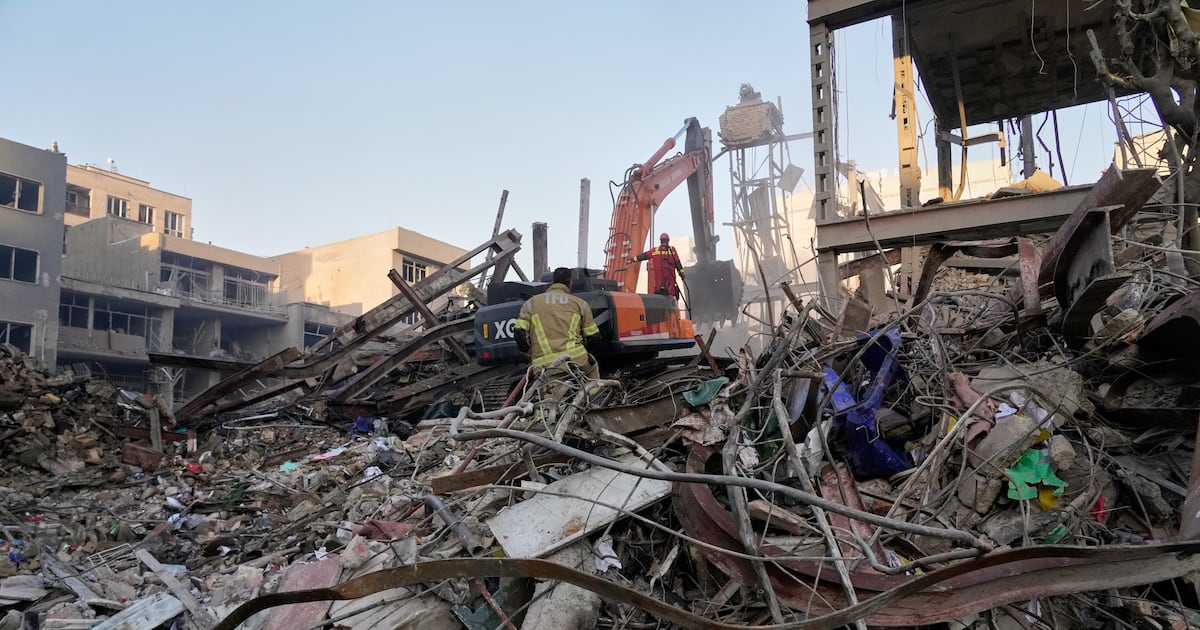
Rescue workers in Tehran worked to pull people from the wreckage of a building in what an Iranian Red Crescent aid worker said was an entirely residential alleyway.
Israel’s war with Iran’s most powerful proxy, Hizbullah, has significantly escalated.
Israel’s minister for defence, Israel Katz, confirmed that the IDF has begun a large-scale ground operation in Lebanon “to remove threats and protect residents of the Galilee”.
The Israeli military has framed the ground offensive as a defensive effort to protect northern Israel from Hizbullah attacks, which it says have averaged at least 100 rockets and drones a day and have reached as far as central Israel.
More than 880 people in Lebanon have been killed, according to Lebanon’s health ministry, and more than 800,000 have been driven from their homes, many from the south as well as from areas near the capital, Beirut.
Katz said the hundreds of thousands of Lebanese Shia residents expelled from south Lebanon will not return to their homes south of the Litani river until the safety of residents of northern Israel is guaranteed.
“We have instructed the IDF to act and destroy the terror infrastructure in villages near the border in Lebanon to prevent threats and Hizbullah’s return to the scene, just as was done with Hamas in Gaza,” he said. “We have promised security for residents of the north – and we will ensure this.”
Attacks from Iran and Hizbullah have killed 12 people in Israel since the war began, according to the national medical service.
A survey by the Jewish People Policy Institute, released on Monday, found a clear majority of Israelis support the war. According to the survey, 72 per cent of Israelis believe the decision to attack Iran was correct, while 13 per cent believe it was wrong and 14 per cent say it is too early to have an opinion.
Support is especially high among Jewish Israelis, with 85 per cent saying the decision was correct. Among Arab Israelis, opinions are more divided.
However, public opinion polls show the war has not led to any shift in support for prime minister Binyamin Netanyahu and his coalition. – Additional reporting: Reuters