
The voice of IRA bomber and hunger striker Dolours Price, who died lonely and alone in January 2013 aged 62, filled the high-vaulted cavern of court number 16 in London’s Royal Courts of Justice.
Her life and actions have featured again and again in the civil action being taken by three victims of IRA bombings in England against the former president of Sinn Féin, Gerry Adams.
Coming from a speaker high up on a staircase in the court, the gravel tones of Price, during an interview with The Sunday Telegraph a year before her death, told of how the IRA had intended to bomb London in early 1970s.
In the end, she was part of an IRA group that bombed the Old Bailey and three other places in London in 1973, but they had intended to “burn Oxford Street to the ground” the year before.
During a meeting in Belfast with Adams and others, she had argued that the British could tolerate violence in Northern Ireland for years: “They can they can play this game for another 20, 30 years. So, why don’t we go to them?”
A “good bombmaker” put together incendiaries which she and her sister Marian brought to London by ferry, which were to be planted in Oxford Street shops by the Prices and “six girls who were to follow us across.”
“They would go up and down Oxford Street and burn, burn Oxford Street,” she said in the interview, but the 1972 plan was dropped because the acid in the incendiaries leaked, and the incendiary devices were eventually dumped in the Thames.
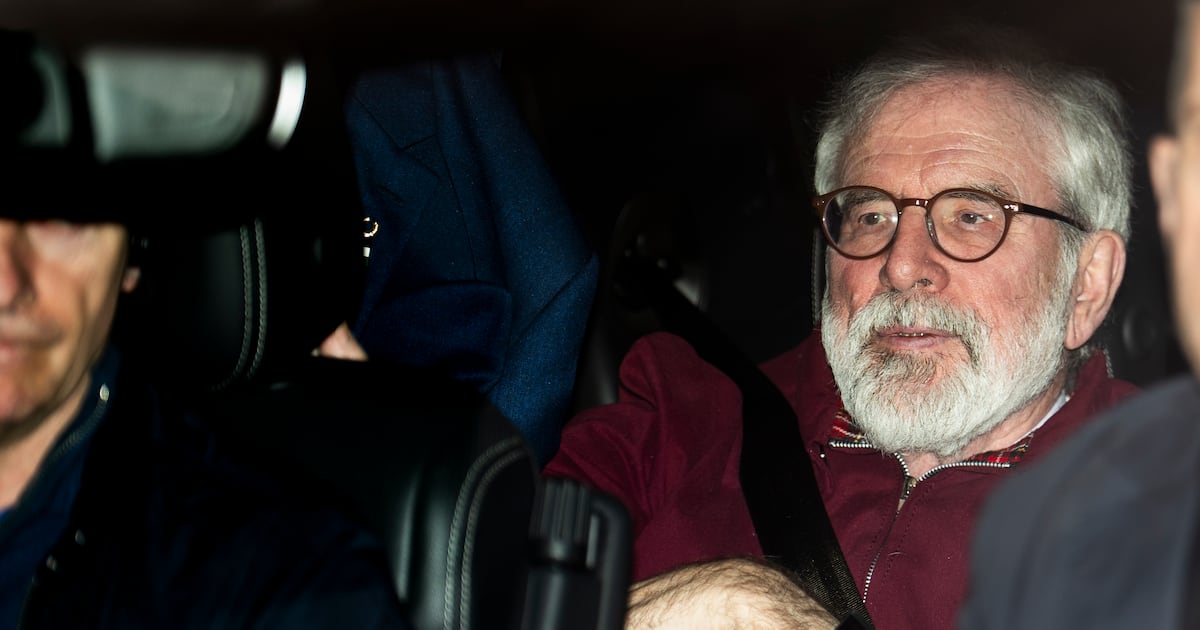
Throughout the playing of the recording, Adams, dressed in a grey suit, lilac shirt with a Free Palestine badge on his lapel, sat in the row behind his counsel, Edward Creaven and James Robottom and quietly stroked his beard.
On Thursday, former RUC and PSNI officer Tim Hanley, who arrested Adams in 2014 on suspicion of complicity in the killing of Jean McConville, related how he had visited Price in her home the year before she died.
By the time he spoke to her, he said, she had a drink and drug problem, was jealous of her sister’s greater fame, and had been “drinking on the morning” that he met her in her house.
She said she had been brought to a house in Belfast ahead of the 1973 bombings and was told by Adams that he wanted the team to go to England, but he warned them “that it was a hanging job” if they got caught.
She felt bitter towards Adams over the direction he had taken Sinn Féin and the IRA, he said, adding that he believed Price was “unhappy and lonely”, and filled with regrets “about what it had all been about”.
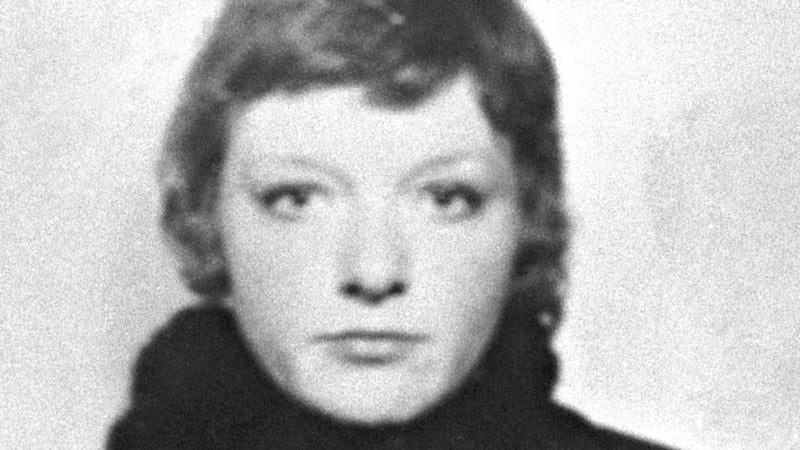 A photograph dated May 1972 of Dolours Price. Photograph: PA/PA Wire
Throughout her interview, Price justified the IRA team’s 1973 bombings, insisting that they had given the British an hour’s warning and details of the car and where it was parked.
“Now as far as we were concerned, short of defusing the things ourselves, we were being very fair. We were being fair, we were there to make a gesture,” she said.
Throughout the civil action, the claimants have not put forward witnesses who could say they were in the room with Adams when decisions were taken by the IRA, or who could swear to his involvement.
The case against Adams is being taken by three victims of IRA bombings in England.
In the recording, Price insisted she had “presented” her plan to bomb England to Adams at a fateful meeting in Belfast in 1972, alongside her sister, Marian.
She had arrived late for the meeting in the house on Leeson Street near Dunville Park. “I walked in and I sat on the arm of Adams’s chair. He was in this armchair and I sat on the arm.
“He said: ‘Right, lads, here’s the story. This is a dangerous operation, but a big operation. Dangerous,” Price said. “He says: ‘This could be a hanging job.’ I thought hanging nearly was gone. But, anyway, he said this could be a hanging job.”
Then, she said, he gave those who did not want to be involved the freedom to leave the house “in 10-minute intervals”. The majority ran out of the house as quickly as they could, she said derisively.
“One man nearly knocked me down on the way out the door. I was sitting there on the chair. I said: ‘Hey, lads, don’t knock me down in the rush’. Swear to God, they ran out the door.”