
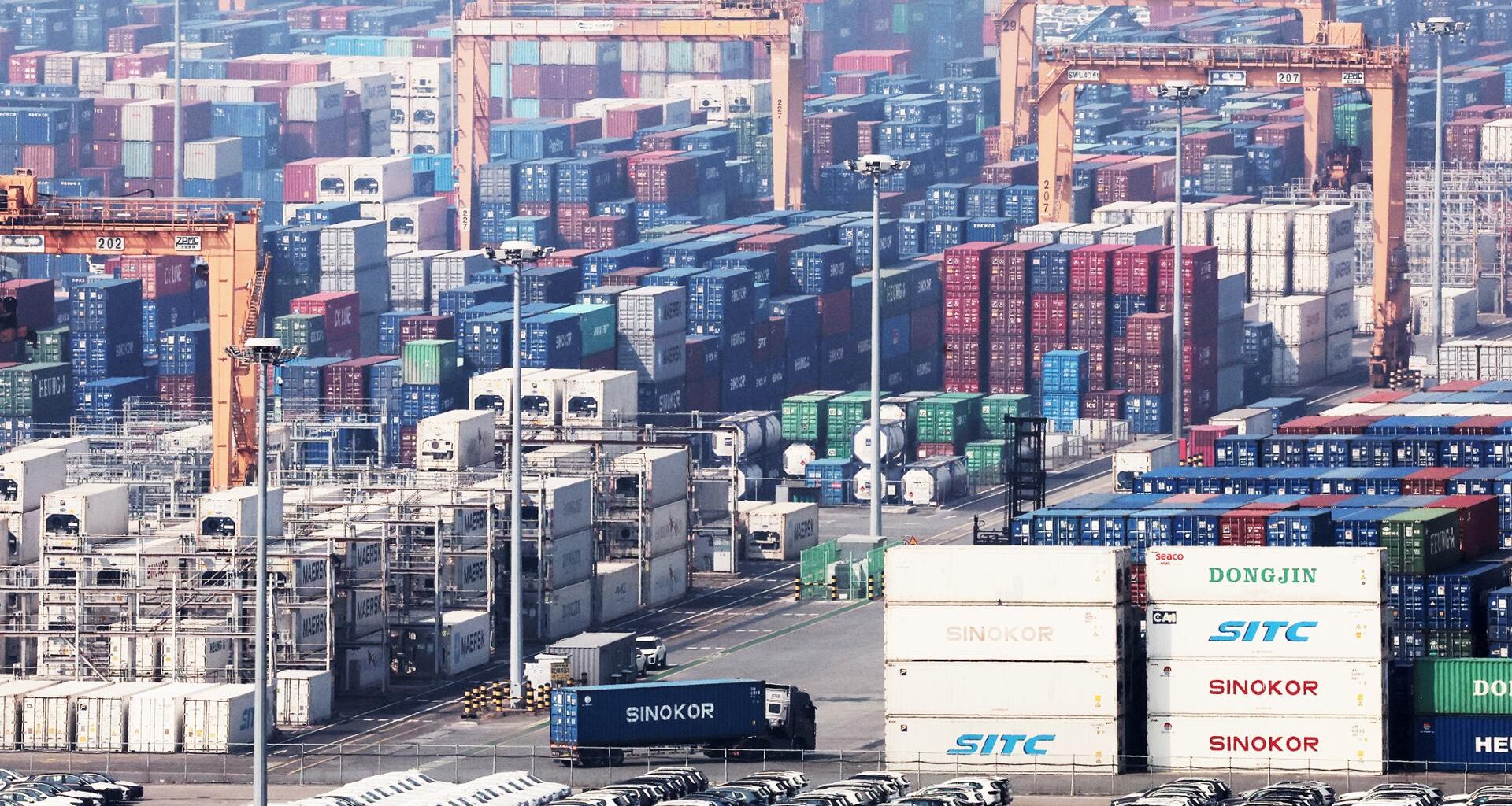
Containers are stacked at a port in Pyeongtaek, Gyeonggi Province, Thursday. Yonhap
The ongoing U.S.-Israel war against Iran could push Korea’s economic growth rate toward zero percent if the conflict drags on for a year, a report showed Tuesday, underscoring the risks facing Asia’s fourth-largest economy stemming from the Middle East crisis.
According to a report by NH Financial Research Institute, if the Iran conflict persists, Korea could face rising inflation alongside contracting exports and consumption, raising the risk of stagflation.
The report estimated that Korea’s gross domestic product (GDP) growth this year would decline by about 0.3 percentage points if the war lasts three months, and that it could fall to the zero percent range if the conflict continues for a year.
The forecast casts a shadow over the government’s target of about 2 percent GDP growth for 2026, up from an estimated 1 percent in 2025.
“Under a scenario of a prolonged conflict, mounting inflationary pressures and their side effects could shift the Bank of Korea’s policy focus from cushioning the economic slowdown to curbing inflation, potentially leading to interest rate hikes and a prolonged high interest rate environment,” the report said.
The outlook comes as tensions escalate after U.S.-Israeli strikes began on Iran on Feb. 28. Iran’s disruption of shipping through the Strait of Hormuz has led to a spike in global oil prices, raising concerns for Korea, which relies heavily on crude imports from the Middle East.
In a separate report released Thursday, Shinhan Securities warned that Korea could face significant economic fallout if Tehran repeatedly disrupts shipping through the strait and engages in a war of attrition.
“In that case, Korea would face a double whammy of surging oil prices and weakening won,” the report read, adding that economic growth could fall by up to 0.8 percentage points, pushing annual growth to the low 1 percent range.
Another report by Hyundai Research Institute earlier this month also said volatility in global oil prices is adding significant uncertainty to the Korean economy.
If crude prices average $100 per barrel, the nation’s economic growth would fall by at least 0.3 percentage points, the institute estimated. In an oil shock scenario where prices rise to $150 per barrel, growth could decline by at least 0.8 percentage points.
Similarly, global analysts have flagged Asian countries’ vulnerability to rising energy prices.
According to a Morgan Stanley report released March 2, every sustained $10-per-barrel increase in oil prices could directly reduce Asia’s GDP growth by 0.2 to 0.3 percentage points.
The investment bank identified Thailand, Korea, Taiwan and India as among the economies most exposed to risks related to higher oil prices due to their wider oil and gas deficits.