

Real interest rates on federal debt averaged just 0.9% over the past 15 years, while real GDP growth averaged 2.2%. That buffer is now evaporating, according to the CRFB.
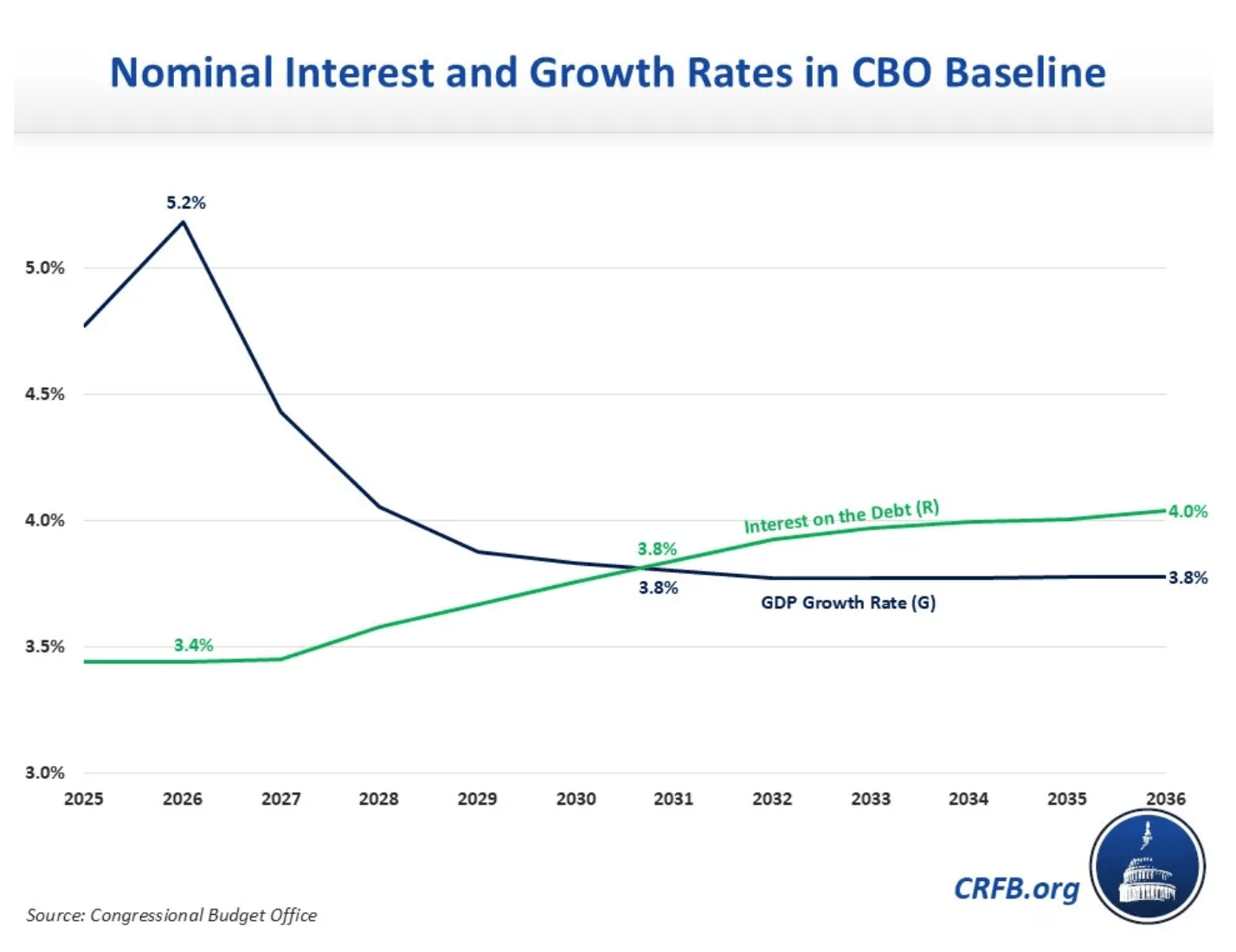
Since 2023, most newly issued Treasury debt has carried yields between 4% and 5%—rates that exceed the economy’s long-term expected growth rate. As older, cheaper debt matures and gets rolled over at these higher rates, the average interest cost on the entire federal debt stock is creeping upward. CBO now projects that by 2031, both R and G will hit roughly 3.8% nominally—and then diverge, with R pulling ahead.
The spiral mechanism
The CRFB describes what comes next as a self-reinforcing feedback loop. Higher debt pushes interest rates up and slows economic growth. Slower growth reduces tax revenues. Reduced revenues widen deficits. Wider deficits add more debt. More debt pushes rates higher still. “Over time,” the group warns, “this could lead to accelerating growth in the debt, which could eventually be too rapid to correct, absent a major disruption or crisis.”
Even CBO’s relatively optimistic “baseline” scenario—which does not model additional tax cuts or spending increases—projects the national debt will balloon to an unprecedented 175% of GDP by 2056. By that year, CBO estimates the interest rate will reach 4.2%, against a GDP growth rate of just 3.5%—a gap of 0.7 percentage points. Closing that gap alone, the CRFB calculates, would require roughly $2.7 trillion in annual spending cuts or tax increases—in 2056 alone.
The political wildcard
The CRFB’s warning carries an implicit rebuke of Washington’s current fiscal trajectory. If lawmakers continue enacting tax cuts and spending increases—as they did in the One Big Beautiful Bill Act, which CBO estimates will add $4.7 trillion to deficits through 2035—the spiral “could arrive sooner and with greater intensity than projected.”
The national debt is expected to cross $39 trillion within days, up more than $2.6 trillion in the past year alone. But as the CRFB makes clear, the real danger isn’t the next trillion. It’s the arithmetic of what happens when a country can no longer grow its way out of its debt—and the window to act before that moment closes in just five years.
For this story, Fortune journalists used generative AI as a research tool. An editor verified the accuracy of the information before publishing.