
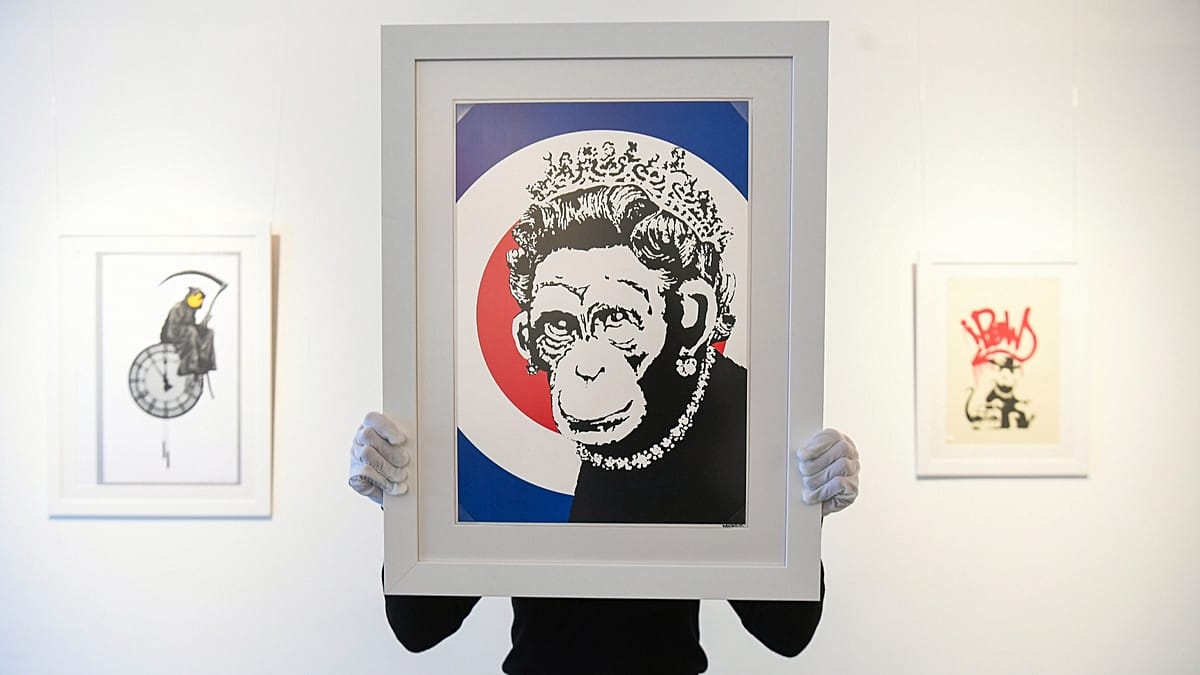
The secret behind the world’s most famous street artist’s anonymity has been the source of speculation for decades. Now, a new report claims to finally reveal Banksy’s identity.

ADVERTISEMENT
ADVERTISEMENT
An in-depth investigation by journalists at Reuters claims to have unmasked the celebrated Bristol-based graffiti artist and highly influential activist.
The report’s “beyond dispute” evidence is based on a trip the artist made to Ukraine in 2022, photographs posted by former associates, and a handwritten confession note from an arrest in New York in 2000.
Drumroll…
According to the report, Banksy is in fact Robin Gunningham, 51, from Bristol – although the investigation states he changed his name to the more common name David Jones some years ago, in order to avoid identification.
However, the artist’s lawyers insist that Banksy’s identity remains a secret.
In response to the Reuters story, Banksy’s lawyer Mark Stephens wrote that his client “does not accept that many of the details contained within [the] enquiry are correct”.
Stephens also said the story “would violate the artist’s privacy, interfere with his art and put him in danger”, as “working anonymously or under a pseudonym serves vital societal interests.”
He added: “It protects freedom of expression by allowing creators to speak truth to power without fear of retaliation, censorship or persecution.”
Reuters concluded that “the public has a deep interest in understanding the identity and career of a figure with his profound and enduring influence on culture, the art industry and international political discourse.”
One of the most famous artists of our century rose to prominence through a series of graffiti pieces that appeared on buildings across the UK, marked by their satirical and anti-establishment themes.
One of his / her / their most famous works are “Girl With Balloon”, which was at the center of a brilliant stunt in 2018, when a framed copy of the work was shredded after being sold at auction by a mechanical device Banksy had hidden within the frame. Banksy later gave the altered piece the name “Love Is In The Bin”.
Banksy has produced work in countless locations, including Ukraine and the West Bank, showing his apparent sympathy with the Palestinian cause.
A recent work sprayed on the side of the UK’s Royal Courts of Justice showed a judge beating a protester with a gavel, which some have interpreted as signalling sympathy with pro-Palestinian activists arrested for supporting Palestine Action – a proscribed group in the UK.
Banksy has always chosen to keep his / her / their identity unknown, a way of continue to work without the constraints of fame. It’s an anonymity which also served as a means of protection from police prosecution.
There has been much speculation over the years as to who the infamous street artist could be. The theories are numerous. Many believed that Banksy could be Robert del Naja, the founder of Massive Attack, who is also a graffiti artist.
Others theorised that Banksy could be Jamie Hewlett, the co-founder of the band Gorillaz; Neil Buchanan, the host of several children’s art shows on British television, who during the pandemic, was forced to release a statement denying his involvement with the Banksy persona; and the possibility it could be a collective of artists as opposed to a one man band.
Recent speculation included that Banksy could be a collective led by a woman, and three years ago, a lost BBC interview with Banksy resurfaced, seemingly confirming Banksy’s name was actually Robert “Robbie” Banks.
Robin Gunningham? Robbie? Robert?
While Reuters is right in saying that the public has a “deep interest” in the artist’s identity, part of the appeal resides in the riddle. Once you solve it, you inadvertently dent the artist’s tantalizing elusiveness and his / her / their sense of unpredictability, as well as endanger his freedom of movement and expression.
Banksy could be anyone, and maybe that’s the point. Continued speculation as to who is behind the artwork is for the best.