
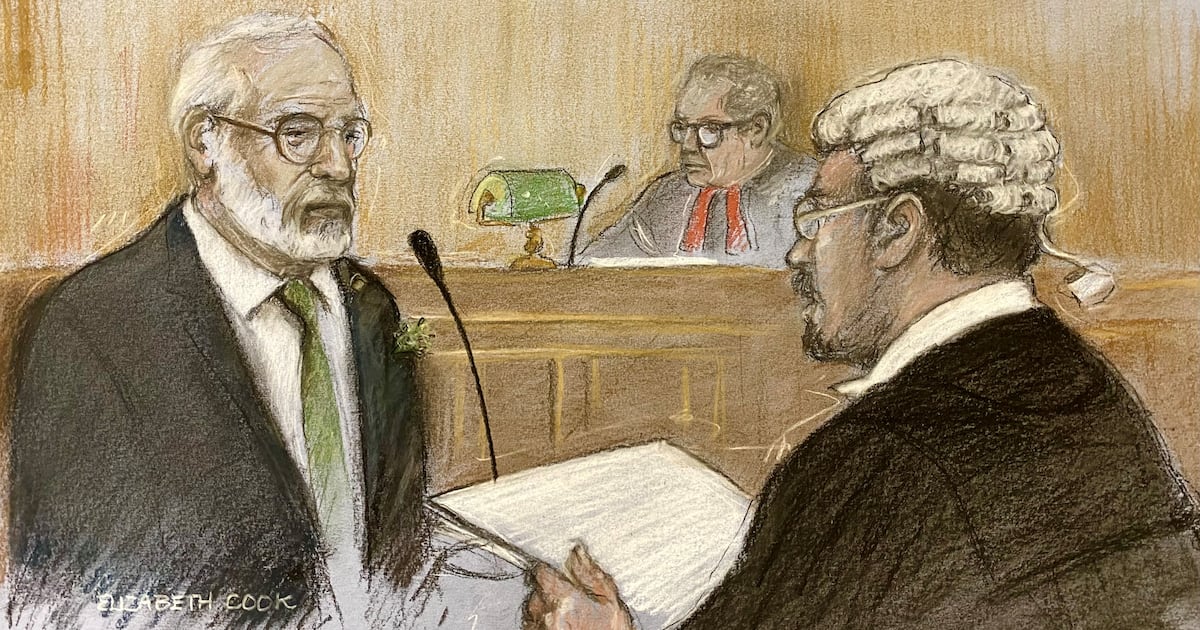
Former president of Sinn Féin, Gerry Adams “pushed” the IRA into attacks in England in the 1990s in a bid to pressure the British government in negotiations, the High Court in London has heard.
Bombings in Canary Wharf in London and Manchester in 1996 were used as leverage to force Downing Street to open talks with Sinn Féin, barrister Max Hill claimed during a civil case against Adams.
“No, that is not true,” Adams replied, insisting that he was “focused” on his work to bring about a “permanent end to the conflict”.
The case against Adams is being taken by three victims of IRA bombings in England: John Clark, who was injured in the 1973 Old Bailey bombing; Jonathan Ganesh, who was hurt in the 1996 London docklands bombing; and Barry Laycock, who was left with life-changing injuries from the 1996 Manchester Arndale bombing.
The three men are suing Adams for “vindicatory” damages of £1 (€1.16), alleging he was “directly responsible” for the attacks.
During often testy exchanges, Adams clashed frequently with Hill, a former UK director of public prosecutions, telling him at one point to stop referring to Britain as “the mainland”.
“I live on the mainland … This [Britain] is our nearest offshore island,” Adams said who repeatedly denied that he had ever been a member of the IRA.
During several hours of questioning, Hill, who was brought into the claimants’ legal team solely for the task of facing Adams, repeatedly insisted he was a member of the IRA. He said Adams’ denials that he did not know leading IRA figures, such as Ivor Bell, were in the IRA were not credible.
Denying that he had ever been a member of the IRA, or its Army Council, Adams early on said he had noticed that Laycock, one of the claimants and one of those injured in the 1996 Manchester bombing, was in the court.
“I never held any role or rank within the IRA. I repeat that I had no involvement whatsoever in the authorisation, planning or conduct of the bombings in which the claimants were sadly injured,” he said.
In his witness statement, he said the claimants argued he had an “affiliation with” and a “leadership role” within the IRA and that this made him “party to a common design” with others to bomb Britain.
“These allegations are untrue,” said Adams. “I was never a member of the IRA or its Army Council. I was never the commanding officer or OC of the 2nd Battalion of the IRA’s Belfast Brigade.
“Indeed, I have never held any rank or role within the IRA, including on the IRA’s Army Council. I have never held a command-and-control role in the IRA and have never been a senior, let alone most senior figure, in the IRA.”
Continuing, he said he had “no knowledge” of “the structure or decision-making processes of the IRA”, or that he had had anything to do with the drafting of the IRA’s disciplinary code, the so-called Green Book.
Under questioning from Hill, Adams denied that his membership of an IRA delegation that went to London in 1972 to meet then-Northern Ireland secretary, Willie Whitelaw, showed he was a senior figure.
Hill countered by saying Bell, a leading IRA figure, has said Adams had to be released from internment to travel to London. This happened even though the Ballymurphy-born Adams was just 23 at the time and not well known, Hill added.
However, Adams insisted “no one was surprised than me” when he was included in the talks, where everybody else – including Martin McGuinness – were known members of the IRA.
“I attended in my capacity as a representative of Sinn Féin, along with Dáithí Ó Conaill, the vice-president of Sinn Féin. The talks were also attended by Myles Shevlin, a Dublin-based solicitor who was there to offer legal advice,” he said.
“I recall that Seán Mac Stíofáin, Seamus Twomey, Ivor Bell and Martin McGuinness were also present at these talks. To be clear, I was not consulted about, and I played no part in selecting, the attendees at that meeting.
“I was not informed of, and I did not discuss with any of those persons, their status, except that they were there as peace negotiators seeking an end to the conflict,” Adams said in a lengthy witness statement.
“I played no role in the resumption of hostilities that occurred in 1972 after that meeting and I did not have any advance knowledge of the IRA’s decision to end the ceasefire,” he said.
Questioned about Say Nothing, the book written by Patrick Radden Keefe about the kidnapping and murder of Belfast widowed mother-of-ten Jean McConville, Adams described the New York-based writer as “an opportunist”.
The book was based on the Boston College Tapes that were created by people who were known opponents of his attempts to create a political way of ending the Troubles, Adams said.
“Well-publicised malicious allegations have been made against me in relation to Jean McConville. I reject these. I believe that the killing of Jean McConville and the secret burial of her body was wrong and a grievous injustice to her and her family,” he said.
He rejected the interview given to Boston College by Dolours Price claiming he had been OC of the IRA’s “Belfast Brigade” and said he had personally ordered the bombings, warning volunteers that “it is a hanging job”.
Pointing to more than 60 years of membership, Adams said he had joined in 1964 after the RUC raided an election office in the Divis Flats in west Belfast where an Irish tricolour was being flown.
He quickly gained an understanding of the discrimination faced by Catholics in Northern Ireland, giving up school and the chance of university to become a political activist.
“To be clear, membership of the political party Sinn Féin does not equate to membership of the IRA. Sinn Féin is a political party that seeks a whole range of political objectives, including an end to partition and Irish unity.
“Throughout my life, opponents of Sinn Féin have repeatedly sought to conflate Sinn Féin with the IRA. As I have always stated, Sinn Féin and the IRA are separate organisations,” he said.
He said he had been “very moved” by Laycock’s testimony in the case last week, though the judge intervened to instruct Adams only to answer questions from counsel, rather than addressing anyone in the court.
In his witness statement, Adams said he wished to emphasise “I am very conscious that the Claimants have suffered significantly as a result of bombings in England in 1973 and 1996, in which they were innocent victims”.
Though he denied that he was responsible for the bombings, he said “nothing in this statement should be taken as criticism of the claimants, or as any attempt to deny or diminish their awful experiences”.