
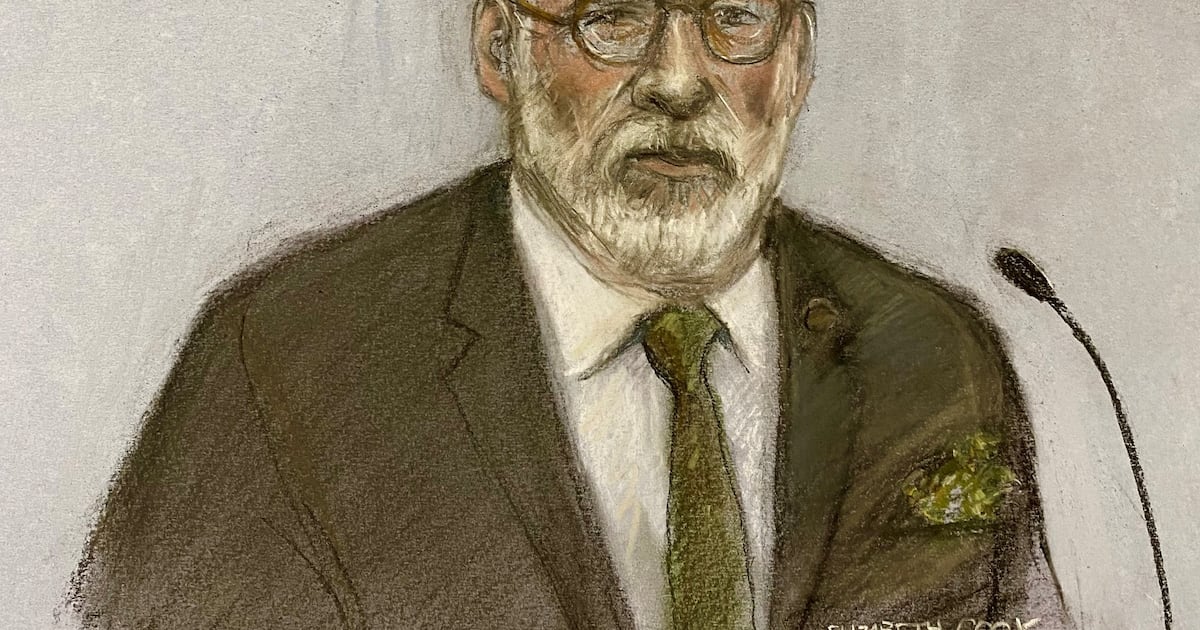
Main PointsFormer Sinn Féin leader Gerry Adams testified for the second day today at the Royal Courts of Justice in London in a case alleging he is liable for IRA bombs between 1973 and 1996.Adams (77) strongly denies any involvement and has repeatedly rejected claims he was ever in the IRA.This is a civil trial before a judge of the High Court, so a ruling will be reached based on the “balance of probabilities”.Key Reads
Ellen O’Riordan – 54 minutes ago
Adams has left the witness box after being cross-examined for nearly two days in London’s high court. Neither the judge nor his legal team had any further questions to ask him.
Adams’s legal team have said that marks the end of the defence’s case, which should pave the way for the start of barristers’ closing submissions.
Ellen O’Riordan – 59 minutes ago
Hill, barrister for the three claimants, asks Adams about Des Long, a former IRA man who, Adams says, was for a time on the Sinn Féin Ard Chomhairle (national executive).
Adams says Long became “anti peace process” and “bitter”.
Hill says Long admitted to being part of the IRA Army Council and claimed Adams was a senior member of such.
Adams replies: “Whatever he is telling about himself, he is telling all untruths about me.”
Hills suggests Long was placing Adams “accurately” as a leader of the Army Council.
Adams: “Well, you are wrong.”
Ellen O’Riordan – 1 hour ago
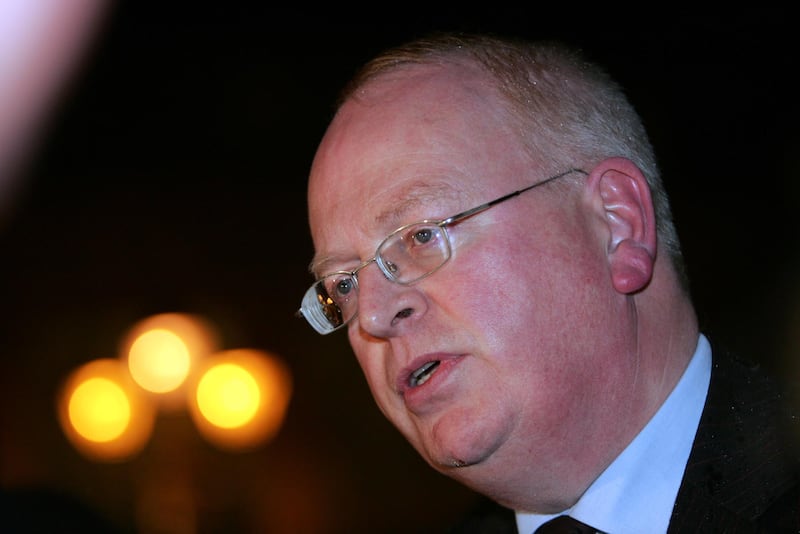 Then tánaiste and minister for justice Michael McDowell, pictured in 2006. File photograph: Eric Luke
Turning to 2005, Hill, barrister for the three IRA bomb victims, says Michael McDowell, then Irish minister for justice, was “very clear” that Adams was at that time Sinn Féin leader and on still on the IRA’s Army Council.
“Well, he is wrong,” Adams responds.
Is Adams suggesting McDowell “made that up”, Hill asks.
Whether he made it up or was repeating a line given to him, Adams says he is not sure. He adds that McDowell is a “known critic” of Sinn Féin.
Ellen O’Riordan – 1 hour ago
Hill suggests Adams surrounded himself even into the 2000s with IRA men, including those convicted of murder.
Adams says: “Well, yes. There were others who were not former prisoners.”
Ellen O’Riordan – 1 hour ago
Hill asks Adams about a claim by Peter Rogers, an IRA gunman who served 18 years of a life sentence for murder of Garda Seamus Quaid in Co Wexford in 1980.
Hill says Rogers alleged he met with Adams and Martin McGuinness, a high-ranking IRA leader before becoming Sinn Féin deputy first minister of Northern Ireland, in late 1980 to discuss the transportation of explosives to England.
Rogers claimed Adams questioned him near Trinity College in Dublin about the delay in transporting the devices, says Hill. Rogers allegedly told Adams the explosives were in poor condition, to which Adams said they needed to be transferred and the sooner they were the better.
Hill asks Adams is this true or near the truth.
It is a “total fabrication”, Adams replies.
Adams says he did not know Rogers as an IRA volunteer but knew his family. He says he agitated for his release from prison as part of the Belfast Agreement. This, Adams says, was “controversial”.
Ellen O’Riordan – 2 hours ago
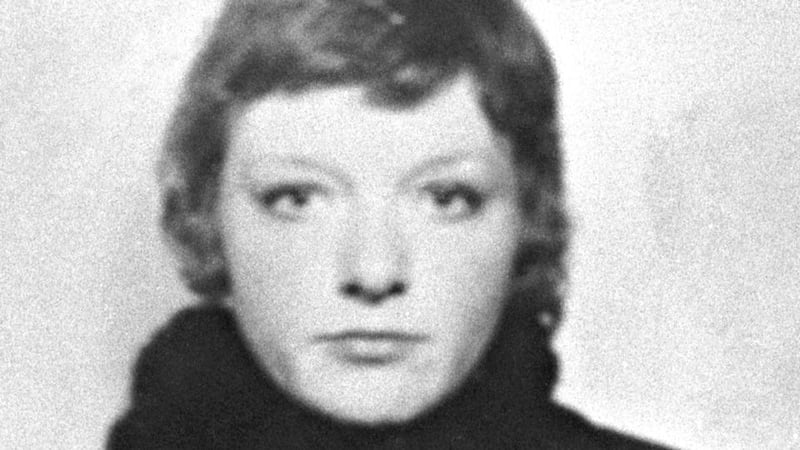 A file photograph from May 1972 of prominent Republican and former IRA member Dolours Price. Photograph: PA/PA Wire
Adams denies claims made by Dolours Price, one of the people convicted for her role in the Old Bailey bombing of 1973. This explosion, which was the first Provisional IRA bombing in Britain, is one of three at the centre of the court case.
One of the claimants, John Clark, was injured when he responded as a police officer to a warning that a bomb was due to detonate outside the court at 3pm. The device exploded at 2.50pm, and shrapnel lodged in Clark’s head and hand.
In her later years, Price claimed the idea of the Old Bailey bombing was discussed at a meeting involving Adams and several IRA volunteers. Hill, barrister for Clark and the other two plaintiffs, says Price alleged Adams “extended an invitation to those who wished to stay in the room and become the bombing team”.
Adams says this is “not true”.
Ellen O’Riordan – 2 hours ago
If you are just joining, former Sinn Féin leader Gerry Adams continues to be questioned in the witness box in London’s High Court.
He is defending himself against a claim brought by three victims of IRA bombs in Britain in 1973 an 1992. The three allege he was “so intrinsically involved” in the IRA that he is “as culpable for the assault … as the individuals who planted and detonated the bombs”.
Adams denies any involvement in the bombings and has repeatedly denied he was ever in the IRA or on its Army Council.
So far on Wednesday, Max Hill, barrister for the claimants, has questioned Adams about his associations with Brendan Hughes and other IRA men. Adams says he and Hughes were friends but the late IRA officer commanding ended up a “disappointment”.
Adams was questioned about his prior knowledge of the 1996 London Docklands bombing, which killed two and injured many others, including one of the claimants. Adams said he did not know about it ahead of time and was “stunned” when it occurred. It could have “heralded the end of efforts” for peace he was part of for decades, but thankfully it did not, he said.
“You made a decision to bomb again,” counsel told him
“That’s not true,” Adams responded.
He is due to resume his evidence, under cross-examination, at 2.05pm.
Ellen O’Riordan – 3 hours ago
The court has paused for lunch and will resume at 2.05pm. Adams was warned not to discuss the case with anyone over lunch as he is still under cross-examination by barrister for the claimants, Max Hill.
Ellen O’Riordan – 3 hours ago
Still questioning Adams about the 1996 London Docklands bombing, Hill suggests he was behind it to bolster his political strategy. “You made a decision to bomb again.”
Adams says: “That’s not true.”
Hill: “You were bombing your way into the conference room.”
Adams: “No, that is not true.”
Ellen O’Riordan – 3 hours ago
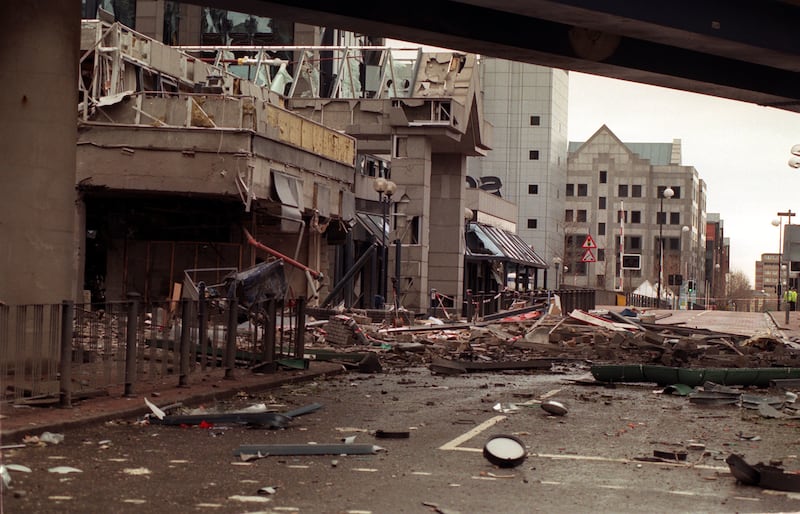 Debris lays strewn across the scene of the IRA bomb blast in London’s Docklands in 1996. File photograph: PA Adams ‘stunned’ by 1996 London Dockland bombing, which could have undermined peace efforts
Adams is asked about an IRA bombing in London on February 9th, 1996.
One of the claimants, Jonathan Ganesh, was working as a security guard at South Quay Docklands, outside Canary Wharf in London, when the bomb detonated, killing two and injuring many others.
Adams says the 1996 explosions “brought an end to the IRA ceasefire and potentially the end to a peace strategy, which I and others worked at for 30 years or more”.
“I was stunned by what had happened,” he says. “This may well have heralded the end of efforts that were being made but, thankfully, it didn’t. We were resilient, we regrouped and engaged.”
Hill, barrister for Ganesh and two other IRA bomb victims, asks: “Did you know in advance about the Canary Wharf explosion?”
Adams says he did not.
Ellen O’Riordan – 3 hours ago
History ‘vindicates’ Adams’s 1994 position, he tells court
Hill questions Adams about his response to the December 1993 Downing Street Declaration issued jointly by the British and Irish governments.
The declaration said Britain had no “selfish, strategic or economic interest” in Northern Ireland and supported self-determination based on consent.
Hill says Adams interpreted, in January 1994, that the declaration claimed to remove the IRA’s reasons for armed struggle but “whether this is so remains to be seen”.
Adams tells Hill: “Yeah, well, that is the truth of it”.
Hill puts it to him that he was “not yet prepared to make any declaration about armed struggle being at an end”.
“You still needed or wanted to hold the armed struggle over the British.”
Adams responds: “No.”
The declaration did not deal with four issues that needed addressing and that went on to be addressed by the Belfast Agreement, says Adams. In 1993 John Major’s British government was still refusing to talk to Sinn Féin representatives, he adds.
“That is my position and I think it is straightforward, and I think history vindicates that position.”
Ellen O’Riordan – 3 hours ago
Adams speaks about “folks (who) resiled against the peace process”.
“The proof, if I may say so, is that none of what they were doing succeeded. None of what they were doing worked. It was only when we got down to treating each other as human beings … that we made progress,” he says.
Ellen O’Riordan – 4 hours ago
Adams is questioned about Sinn Féin politicians Gerry Kelly, who is a convicted IRA bomber and Assembly member for North Belfast; Conor Murphy, who was convicted of IRA membership and carrying explosives in 1982 and was an MP for Newry and Armagh; and Martin Ferris, who was convicted for IRA membership and a TD for North Kerry.
Adams says he is “proud” of his relationship with these people. He knows Ferris well and has “great admiration for him”, while Kelly was convicted as a “young man”.
Adams says he does not keep a record of everyone’s convictions, but there are “clearly people within Sinn Féin, who are welcome within Sinn Féin, who are former prisoners … during the armed struggle”. It is “not a secret” that such people serve within the ranks of Sinn Féin, he says.
This is not new and “all arises from the fact our country was occupied” by the British army, he says.
To Hill, barrister for the three IRA bomb victims, Adams says: “If your country was invaded, perhaps you might respond in the same way.”
Ellen O’Riordan – 4 hours ago
Many of the claims made about Adams by Hughes and other republican paramiliatries come from interviews conducted as part of the Belfast Project, organised by Ed Moloney, for Boston College.
The ex-paramilitaries gave interviews under the guarantee that nothing would be published until after they had died, which led to a book by Moloney in 2010, Voices From The Grave. However, there were flaws with this guarantee as confidentiality could only be protected to the extent American law allows.
Cross-examined on some of Hughes’s Boston College interviews, Adams says the Belfast Project has been “totally discredited”, disowned by the college and criticised by courts.
Ellen O’Riordan – 4 hours ago
Hill suggests Adams was a “major major player” in the war.
Responding, Adams says he was the president of Sinn Féin for 35 years and was involved in the “struggle”, “defended the use of armed struggle where I thought that was appropriate”, and helped to build Sinn Féin and peace. This, he says, led to Hughes and others “quite wrongly taking up the positions they did”.
Hughes and some other IRA figures were against the peace process.
Adams says he does not “go around boasting”, but he does not deny he was a person and a republican “of some influence”. “Thankfully” peace was brought about and people today are enjoying peace, he adds.
Ellen O’Riordan – 5 hours ago
Adams says Bloody Friday ‘hung around my neck’
Hill quotes from Hughes saying he came to believe “not one death was worth it”. Hill says Hughes was “maddened” by Adams seeming to be “free of any such painful retrospection” about the Troubles.
Counsel quotes Hughes as having said about Adams: “Of course he was in the IRA. Everybody knows this. The British know it; the people in the street and the dogs know it on the street, and he (Adams) is standing there denying it.”
Hill puts it to Adams that he is “in denial” about his role in the IRA.
Adams rejects this suggestion and says Hughes’s words, if correctly quoted, demonstrate his state of mind.
“All of these things, like Bloody Friday, are hung around my neck and have been done incessently.”
Bloody Friday is the name given to bombings by the Provisional IRA in Belfast July 21st, 1972. Five men, two women and two children were killed when 22 bombs were detonated within 80 minutes.
Ellen O’Riordan – 5 hours ago
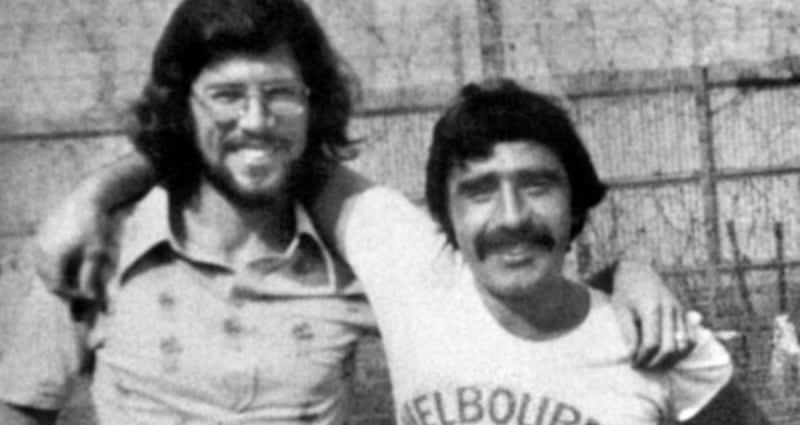 Former IRA man Brendan Hughes (right) in Long Kesh prison with Gerry Adams. Hughes featured in the oral history project. Photograph: Alan Lewis/Photopress IRA man Brendan Hughes like a brother, but then a ‘disappointment’, says Adams
Adams denies his friendship with Hughes was “life long” as, he says, Hughes was, disappointingly, against the peace process. Adams confirms he was by Hughes’s side when he died in 2008.
Hughes on several occasions said “I should be shot” and was quoted as saying he would “shoot me himself”, says Adams, adding that he views that in the context of what Hughes went through in prison, particularly in the H-blocks and the hunger strikes.
“He ended up as a very sorry figure: alcohol dependent, but I still retain a fondness for him even though he should not have done what he did and he is a disappointment in what he did. He was also a victim of what was happening in our country.”
Ellen O’Riordan – 5 hours ago
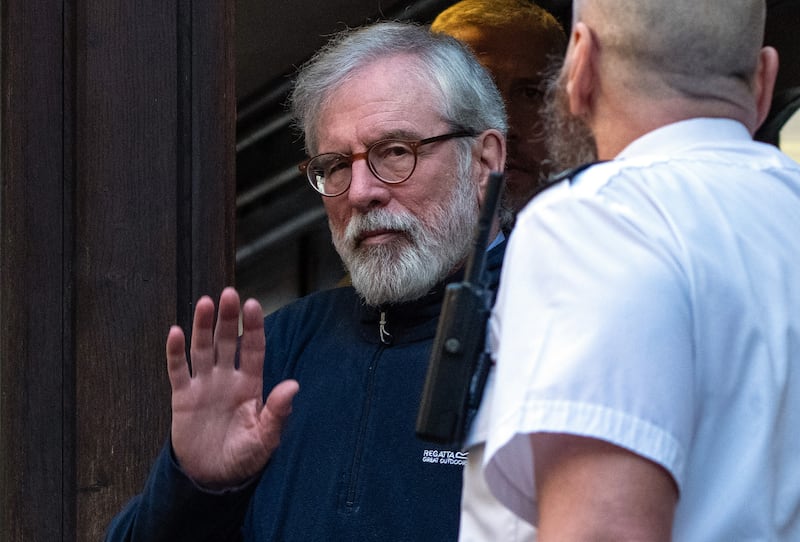 Former Sinn Féin leader Gerry Adams arrives at the Royal Courts of Justice during civil proceedings on Wednesday. Photograph: Carl Court/Getty Images
Adams is back in the witness box and is being questioned about a photograph of him and the late Brendan Hughes in Long Kesh prison, which Adams thinks was taken in 1973. Hughes was a hunger striker and officer commanding of the IRA.
Max Hill, barrister for the three claimants, asks Adams if he was “like a brother to him and he to you”?
Adams says: “Yes, we were very good friends.”
Hill: “You were fellow IRA operatives and IRA volunteers, do you accept that?”
Adams: “No, I don’t. That is not true.”
Ellen O’Riordan – 5 hours ago
It is the seventh day of the civil trial brought by three IRA bombing victims against former Sinn Féin leader Gerry Adams.
Adams is due to resume his evidence to the court, under cross examination, at about 10.30am.
A quick recap of his evidence on Tuesday:
Adams “categorically” denied having any involvement in the three bombings around which the legal claims are centred.
He said he was never a member of the IRA or its Army Council and was never a “senior, let alone most senior figure”, in the organisation.
It was put to Adams that he “stands by” the IRA. Adams said: “Well I don’t stand by everything that they did, but these were my neighbours.”
“I’m glad the IRA has left the State … that they are not killing … I’m glad there is a peace process, but I don’t distance myself from the IRA.”