
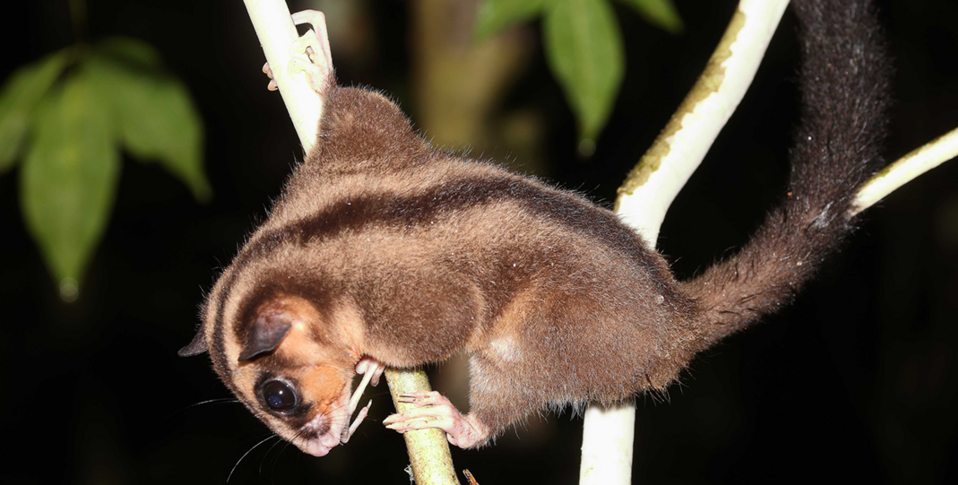
Two species of marsupials thought to have been extinct for the past 6,000 years have been found very much alive on the island of New Guinea.
The two Lazarus species, named after a biblical figure who was said to have risen from the dead, were recently described from rainforests in the Bird’s Head Peninsula on the Indonesian half of New Guinea (the island’s eastern half is part of Papua New Guinea). Before now, scientists only knew of the pygmy long-fingered possum (Dactylonax kambuayai) and the ring-tailed glider (Tous ayamaruensis) from fossil records.
The newly rediscovered species were described in two scientific papers by a team of researchers and Indigenous residents of the Bird’s Head Peninsula. Conservationists took a photo of the long-fingered possum in 2023, revealing a palm-sized striped animal with one finger on its front paw twice as long as the others. The glider is a tree-dwelling possum with large eyes, about the size of a squirrel. It has a prehensile tale and a membrane that allows it to glide through the forest.
Tim Flannery is a biologist with the Australian Museum Research Institute and part of the team that described the new marsupials. In an email to Mongabay, he said both were uncommon in the fossil record, “suggesting that even 6,000 years ago they were rare. So, when I saw that first picture of Tous, it felt like I had travelled back in time.”
Tous is the local name for the ring-tailed glider. Although new to science, both these species were long known to the region’s Indigenous residents. Rika Korain, an Indigenous Maybrat member of the team describing the glider, told the Australian Museum that it’s a sacred animal for the local Indigenous communities, “considered a manifestation of ancestors’ spirits and central to an educational practice referred to as ‘initiation.’” She added, “We worked very carefully and collaboratively with Tambrauw Elders and identification would not have been possible without cooperation with Traditional Owners and this connection has been essential for ongoing work.”
Flannery said there could be other Lazarus species living in the rainforests of western New Guinea. “There are almost certainly more. The small forest wallaby (Dorcopsulus) is a good candidate. And there are others. We are in the very early days of understanding the Vogelkop [Bird’s Head Peninsula] biodiversity,” he said.
“It’s fantastic to see new species still being discovered and it shows the importance of some of these rainforests in very remote parts of the world where there hasn’t been much study in the past,” David Lindenmayer, an ecologist who wasn’t involved in the research, told The Guardian. “I think it’s quite remarkable.”
Banner image: Pygmy long-fingered possum. Image by Carlos Bocos via Wikimedia Commons (CC BY 4.0).
