
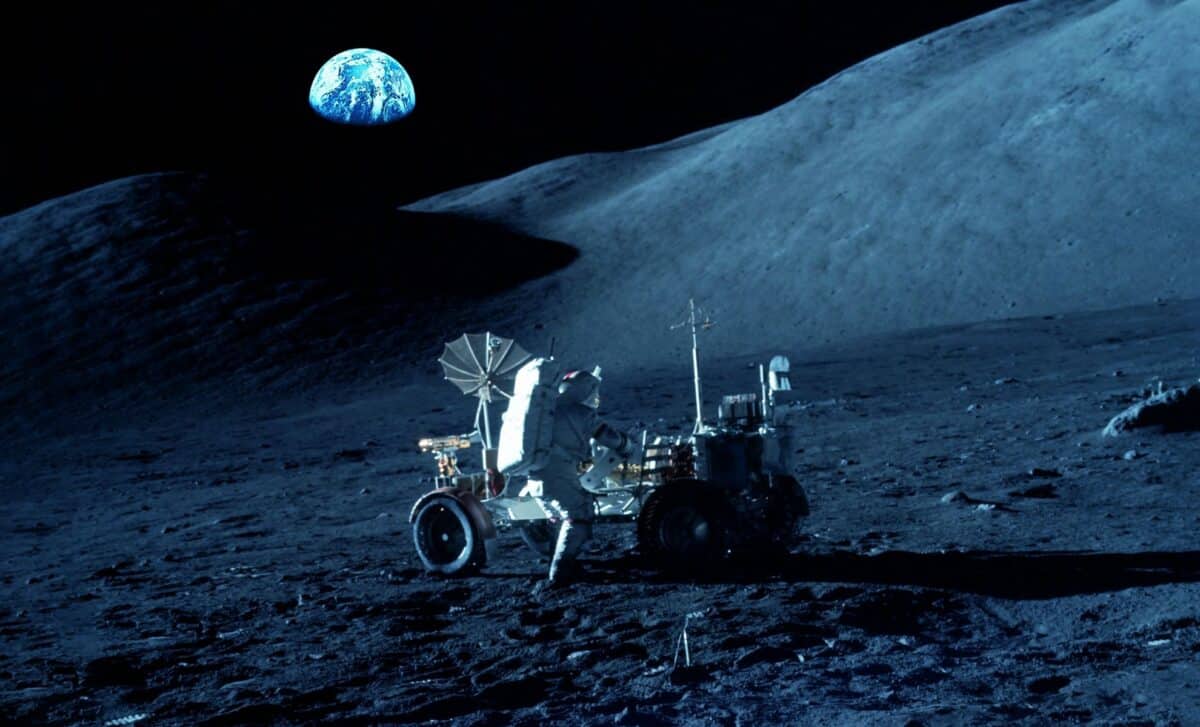
A German startup is working on a rover capable of generating artificial seismic shocks to explore the Moon’s subsurface. The goal is to identify resources and reduce uncertainty ahead of future lunar missions.
The concept relies on a well-known geophysical method: sending vibrations through the ground and analyzing how seismic waves behave. Variations in speed and direction reveal differences in underground structures. On Earth, this technique is widely used to locate valuable materials such as metals.
With lunar exploration gaining momentum, particularly around the Moon’s south pole, there is a growing need to understand subsurface conditions. Water ice and regolith could prove vital for sustaining long-term missions, yet their precise distribution remains unclear without further investigation.
A Seismic Rover Inspired By Dinosaur Footsteps
The project is being developed by IMENSUS, a German startup designing a rover that actively generates ground vibrations. According to BBC Science Focus, the system adapts terrestrial seismic prospecting into a mobile platform suitable for exploration. David Frey, head of prototyping at IMENSUS, described the concept using a cultural reference:
“You know in Jurassic Park, how the dinosaurs move and the whole ground shakes? That’s what we are… We’re shaking the ground,” he said, as reported by the publication.
Sensors deployed at the surface record how seismic waves travel through the subsurface. Changes in wave behavior can indicate dense rock formations or other structures, helping identify potential resource zones.
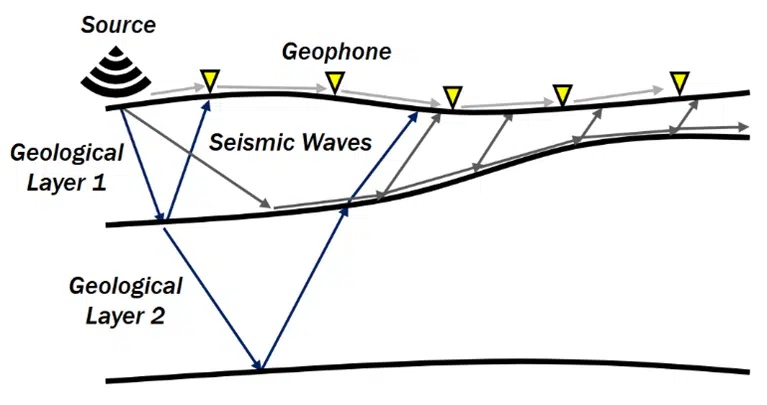 Seismic waves used to map underground geological layers. Credit: IMENSUS
From Natural Moonquakes To Controlled Experiments
Seismic studies on the Moon have historically relied on natural moonquakes, often caused by temperature-driven cracking of the surface. These events are generally weak and unpredictable.This limits the precision of subsurface analysis. As explained by the starup, this approach introduces controlled seismic activity, allowing scientists to generate “moonquakes” on demand. This provides better control over measurement conditions and improves data accuracy.
Dr Nicholas Schmerr, a lunar seismologist at the University of Maryland, explained that such methods can probe up to about one kilometer below the surface.
“If humans want to establish a long-term presence on the Moon they are going to need to be able to access the resources that are already there,” he added that: “having technology that can enable that resource utilisation may make the difference in enabling human habitats and maybe even spark a space economy.”
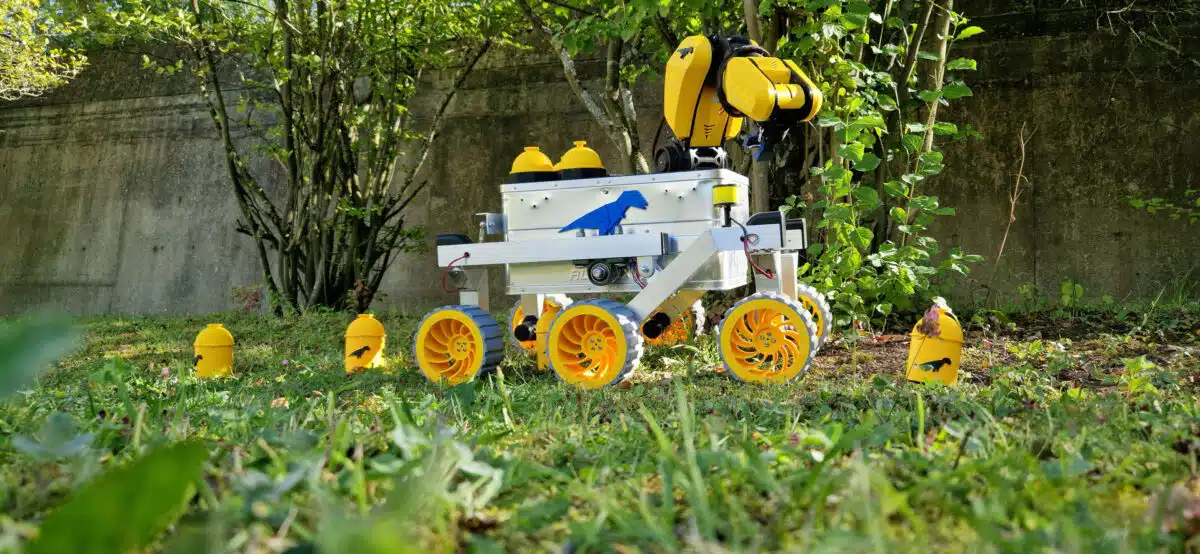 Prototype rover equipped with seismic sensors designed to scan the ground for hidden subsurface structures. Credit: IMENSUS
Reducing Uncertainty For Future Missions
This technology could help mission planners assess landing and construction sites before deployment. Without prior analysis, a site may appear suitable while hiding obstacles such as large rocks or underground cavities.
“In my area of space engineering, no one’s thinking about that,” he stated. “Everyone’s just thinking, ‘Okay, let’s just go with builders, dig and use the material’. But there might be a huge rock underneath. Or you might be needing 10 tonnes of regolith, but there’s a big cavity or rocks, so you can only use 500kg of it. You want to know this before you go to the Moon, because it’s super expensive.”
He pointed out that even good-looking sites can disappoint, if what’s beneath the surface turns out to be less usable than expected. The Moon also presents a harsh operational environment. Extreme temperatures, radiation, and abrasive dust can damage equipment. Schmerr cautioned, as cited in the same source, that any seismic system must be engineered to withstand these conditions.