
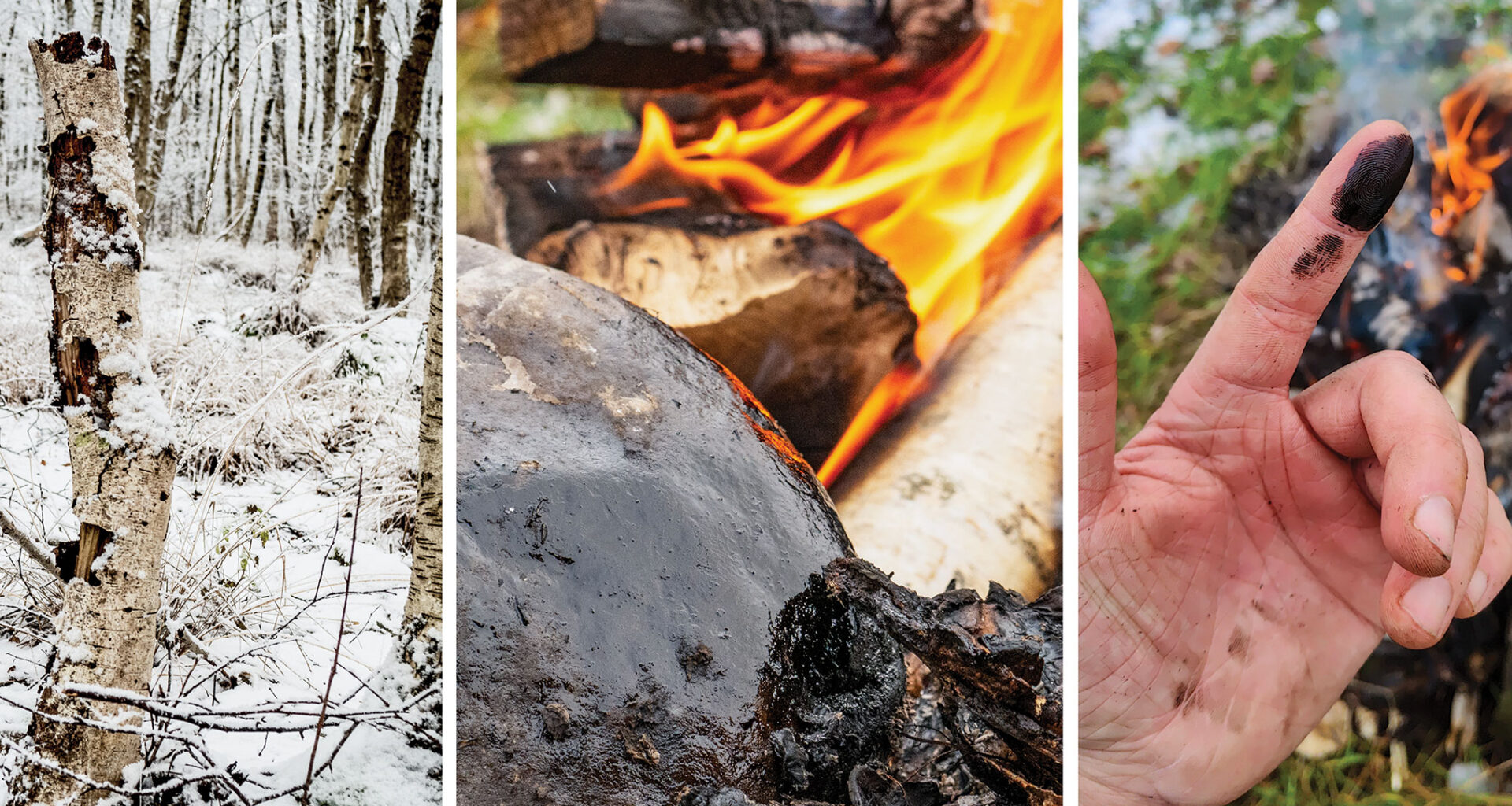
Neanderthals had their own version of prehistoric superglue that they used primarily for crafting tools. They made tar from the bark of birch trees and used it to glue stone points to wooden clubs, a process called hafting, to improve their efficacy. Birch tar has been documented at multiple Neanderthal sites and was likely produced in specialized hearths.
Now scientists report that Neanderthals might have used this ancient glue as a topical antibiotic. They found that birch tar is quite effective against Staphylococcus aureus, a notorious bacterium that lives on human skin and causes various infectious lesions (PLoS One 2026, DOI: 10.1371/journal.pone.0343618).
While exploring how Neanderthals kept infections at bay, Tjaark Siemssen, a graduate student at the University of Oxford and the study’s lead author, learned that birch tar was used by several indigenous communities, such as the Mi’kmaq people in Canada, for wound dressing. “Seeing birch bark being used for something so completely different than what we’ve seen so far in the archaeological record made us investigate it scientifically,” he says.
The researchers first collected bark from dead European birch trees, Betula pendula and Betula pubescens, the two species that were quite common in European Pleistocene when the Neanderthals lived. They extracted six tar samples from the bark using three methods: distillation in tins stacked above each other, distillation in a raised clay mound, and condensation of burning bark’s smoke on a hard stone surface. The first method was used by the Mi’kmaq tribe, and the latter two were possibly used by the Neanderthals to produce birch tar.
Next, they performed antimicrobial assays by incubating the tar samples with S. aureus (gram-positive bacteria) and Escherichia coli (gram-negative bacteria). Barring one, all samples showed bactericidal action against S. aureus, with one sample outperforming the rest. None of them showed any activity against E. coli, leading researchers to conclude that birch tar selectively targets gram-positive bacteria.
These findings validate what many indigenous communities including Yakut, Saami, and Mi’kmaq have practiced in the past. The researchers attribute this antibacterial activity to myriads of phenolic derivatives such as catechols and guaiacols present in tar. Since a mere 0.2 g of tar can cover 100 cm2 of skin, sufficient quantities for topical application can be easily salvaged as a byproduct of tool hafting, regardless of the extraction method used.
Michael Petraglia, an evolutionist at Griffith University, Australia, who wasn’t involved with the study, calls it “impressive,” noting that the combination of scientific experiments and indigenous knowledge “sets [it] apart,” leading to “reasonable judgments about Neanderthal behavior and lifestyles.” He says the Neanderthals were aware of birch tar’s properties due to its extensive use for hafting tools. “It is not too far of a stretch to think that Neanderthals realized the medical effects of birch tar,” but he cautions that “additional biological and archaeological evidence shall be needed” for a definitive conclusion.
Chemical & Engineering News
ISSN 0009-2347
Copyright ©
2026 American Chemical Society