
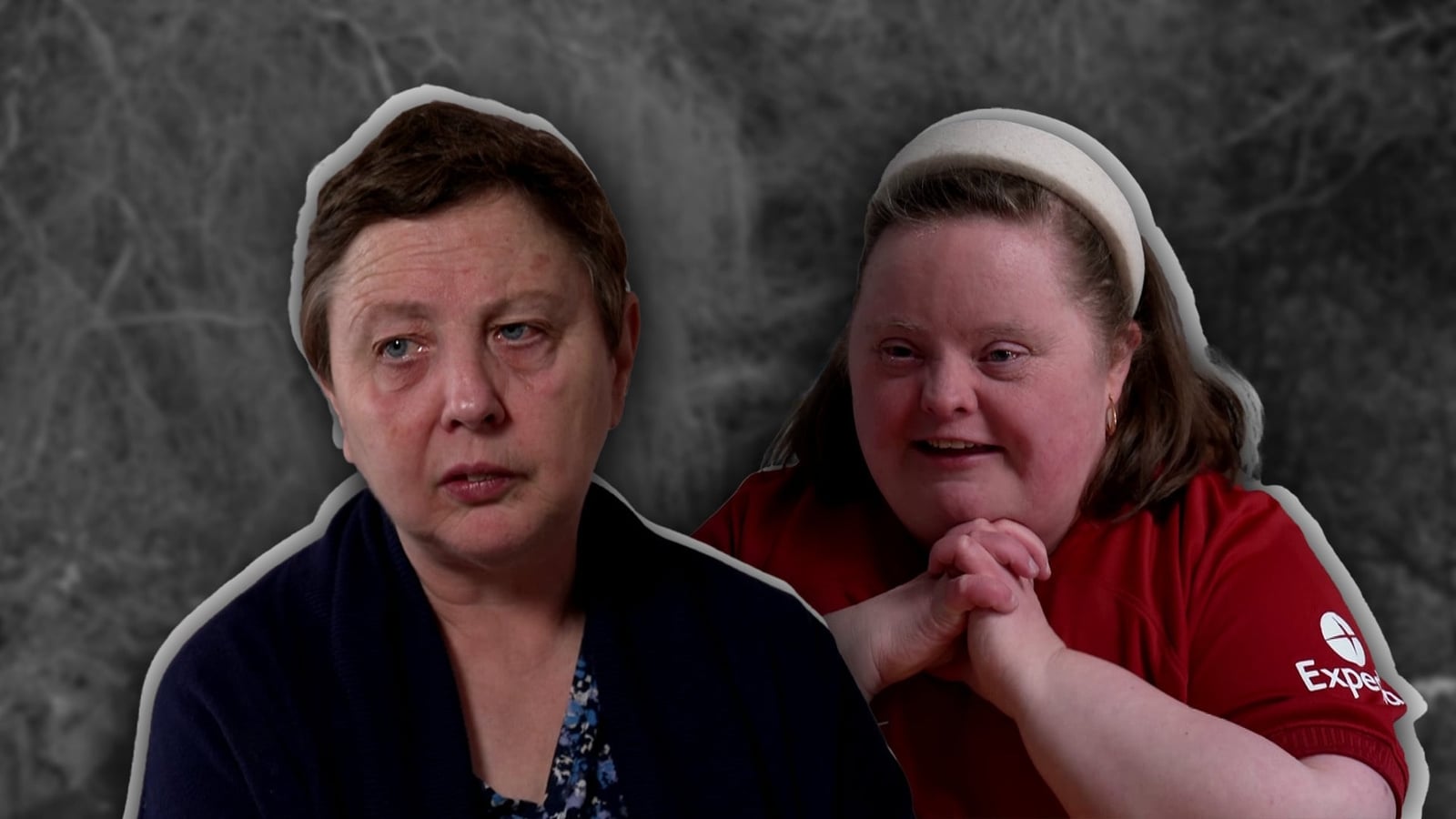
Most people with an intellectual disability in Ireland are cared for by their parents. But as those parents grow older, families are being forced to confront an uncertain future.
More than 2,000 people with disabilities are currently waiting for a supported residential place – yet just 152 will be provided this year, and only 72 are planned for those are for people living at home with ageing parents.
So, what happens for the families of people with intellectual disabilities when a place isn’t available?
Antoinette, Pat and Samantha
Antoinette Curtis is 56 and has a mild intellectual disability.
She lives in Balbriggan, Co Dublin, with her father Pat, who is 75. Her sister, who lives locally, also helps care for her.
Antoinette has always wanted to live independently, with some supports – but that has never been possible.
“I do think it’s very important to learn [to do things for herself] before I get too old to practice this and see what it’s like. I’m dying for it to happen as soon as it can,” she said.
Her mother died five years ago, and Antoinette says she now feels like a burden on her family.
“My dad and my sister, they can’t be always around me. They’ve been doing it since I was a baby. It’s not fair on them.”
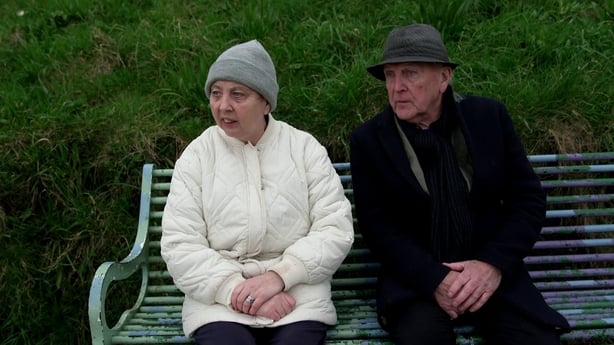
Antoinette Curtis and her father Pat
Her sister, Samantha Kendellen, has been trying for years to secure her a place – but no local residential options are available.
She says she was told any places arising are outside the county.
“At the moment we’re being told that she could be sent down the country. There’s no way Antoinette could be sent off somewhere that she doesn’t know,” she said.
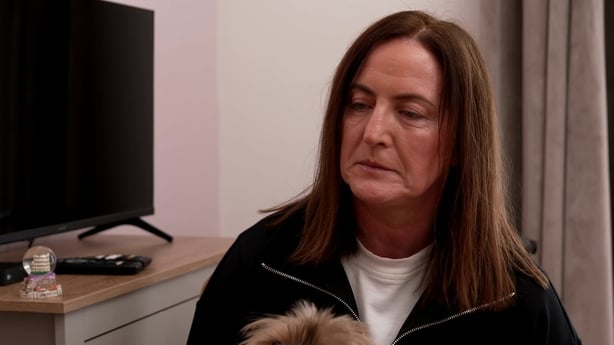
Antoinette’s sister Samantha Kendellen
Antoinette, who has a vibrant social life through a local day service and social club, says she could not imagine living away from her community.
“I’m not going anywhere else. I’ll be terrified anywhere else,” she said.
Her father Pat says he is finding it increasingly difficult to care for his daughter.
“I feel time catching up on me now,” Pat said. Mentally, it takes a toll. I think a lot about what’s going to happen and just get exhausted.”
If his situation changes, Antoinette could be treated as an emergency case – and placed wherever a bed becomes available.
“I think they cannot wait for that crisis to happen. And not either can we, because I’ll be devastated if that ever came to that,” she said.
Aoife, Tony and Susan
Tony Murray founded the campaign group Before I Die last autumn for families like Antoinette’s.
The group aims to highlight the situation facing ageing parents caring for adult children with disabilities – and their struggle to plan a secure future for them.
“Since I started group, I’m absolutely shocked by what I’m hearing. It’s just abject, neglect, lack of planning that has left people like ourselves in an absolute crisis,” Tony said.
He is 71. Along with his wife Susan, who is in her late 60s, he cares for their daughter Aoife, who has Down syndrome. They are now trying to find the best way to secure a place for her to live.
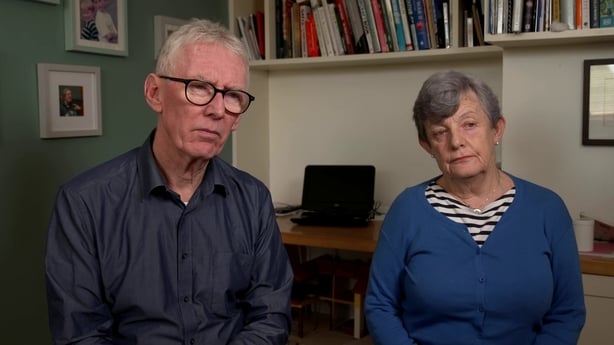
Tony Murray and his wife Susan
Currently, there are two ways a residential place can be secured, once parents have put their adult child onto the housing list of their local authority.
One route is through day service providers putting people onto a HSE list for a residential care place.
The other is that the local authority offers the adult with a disability a home from the housing list, but the parents must seek care supports from the HSE to complement this.
Tony says he has encountered a number of obstacles when trying to secure a home for Aoife, who is 42.
“She can’t get the house unless the HSE have put a care plan and package in place for her. The HSE won’t put a care plan in place unless she has a house: catch-22,” Tony said.
He recently brought members of the Before I Die group to meet TDs at the Dáil.
“The worrying part from meeting politicians is that we don’t sense there’s a plan to have a plan.”
For this reason, Tony is worried that Aoife faces becoming an “emergency case” if they can no longer care for her.
“There has to be an emergency and that emergency usually is mom and dad are dead, and then the services kick in.”
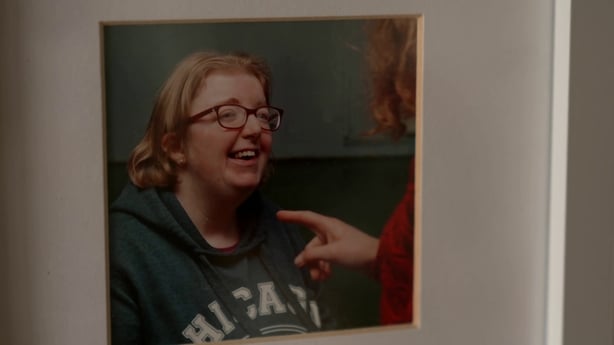
Aoife Murray’s parents are trying to find the best way to secure a place for her to live
He believes that would be catastrophic for Aoife, as it means she would likely be relocated to whatever place is available at the time.
“So, she would have lost her parents, her house, her service, her friends, and her two brothers, if she’s moved to the middle of Ireland: her [day] service, which is her life, her friends, her social club, all gone.”
He believes she would be severely traumatised if this were to happen.
“She’ll probably act out and the answer to that will be we’ll medicate her – that’s the future.”
The thought of that future has led him to a stark conclusion.
“It’s heartbreaking, but I would be happy if she went before I die. And that’s just awful,” he said.
A HSE letter sent to a parent seeking support for a young adult with an intellectual disability last month underlines the pressure on families.
It stated that parents are legally obliged to support their child into adulthood – “indefinitely if the child has a disability” – including the provision of accommodation.
Aoife’s mother Susan contrasts her daughter’s situation with that of her own sister, who had an intellectual disability and was provided with supported housing in the 1990s.
“The critical thing was the house was local to where my sister had grown up. It allowed her to continue to go to her day service and to go to her social clubs,” Susan said.
Susan says the process of battling each step of the way is “tiring and exhausting”.
“I just want her safe and I want her to be with people that love her, that see the beauty of her little soul,” she added.
The scale of the challenge facing families like Antoinette’s and Aoife’s is reflected in national figures.
The latest figures from the Health Research Board (HRB) show that 5,064 parents caring for people with disabilities – 38% of all carers – are aged over 60.
More than 1,500 are over 70, including over 500 parents in their 80s. There are 2,053 people seeking a residential space.
However, the HSE says it is planning to provide an additional 152 residential places this year.
Only 72 of these homes are earmarked for people like Antoinette and Aoife, living with elderly parents seeking a “planned placement”. There is also provision for further 80 emergency placements. This is despite there being 246 emergency placements last year.
Asked about the issues detailed here, Minister for Children, Disability and Equality Norma Foley told Prime Time that the Government has allocated €3.9 billion to disability services, including €65 million this year for 152 new residential places – 72 of which are planned placements.
She also acknowledged longstanding concerns that the system has been overly focused on emergency placements.
“All the time the emphasis has been on emergency but not on planned… this will be for the first time a planned approach,” Minister Foley said.
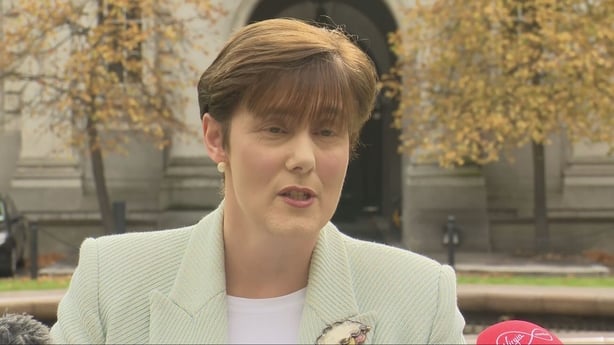
Minister for Children, Disability and Equality Norma Foley
Responding to concerns raised by Tony Murray about a “catch-22” between housing and care supports, she said efforts are being made to better coordinate between the HSE and local authorities.
“For the first time we are making provision for a national disability lead in the HSE, six regional disability leads, and a team of people working in each of the regions so that they are answerable to the local community in terms of delivery,” the Minister added.
On the recent HSE letter stating parents are responsible for supporting their adult children indefinitely, she said she did not agree with that position.
“People have an entitlement to be provided for housing when they need housing… whether they have a disability or otherwise.”
Evan, Dan and Jane
For families like Jane Johnstone’s, those figures are a daily reality. Jane is a widow living in the countryside outside Baldwinstown, near Kilmore Quay in Co Wexford, with her two adult sons, both of whom have intellectual disabilities.
Her 25-year-old son Evan, who stands at six foot four and is taller than her, has complex needs.
“He’s a great guy, fondly known as the gentle giant, he has a diagnosis of profound autism, profound intellectual disability. He’s completely nonverbal.”
Evan is also partially sighted and has epilepsy. He attends a day service, and Jane receives support from two carers twice a week, as he requires two-to-one care.
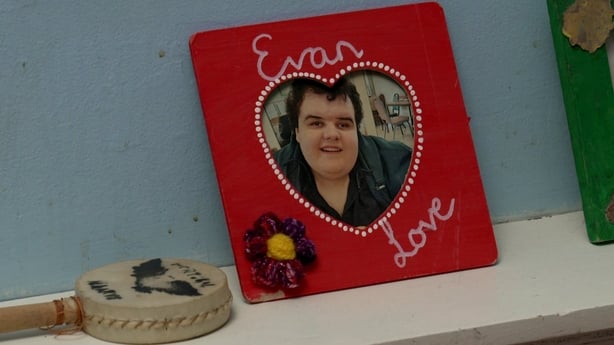
Evan Johnstone has a diagnosis of profound autism, profound intellectual disability
Her younger son Dan also has an intellectual disability, and suffers debilitating anxiety, which is often triggered by Evan’s behaviour.
“It’s been really tough for Dan. He has tried to manage this in his home his entire life. I do feel that that has contributed to the level of anxiety that he battles with,” Jane said.
Jane gets four weeks a year respite, when her sons go into full time care. She also gets an overnight once a month.
Despite this, she finds daily caring very tough as she is mostly on her own with her sons.
Her eldest daughter Ciara works full time in Dublin and her husband, Rod, died suddenly just over a decade ago. For this reason, Jane has made the difficult decision to seek full time residential care for Evan.
Evan has been on the housing list with Wexford County Council since late 2024 and has been registered with the HSE for a residential care place.
She was told that there are currently no residential places available in Wexford and there are 81 others also on the list.
She has turned down offers for places outside the county but says her current circumstances are unsafe and not sustainable.
“Evan will get so overwhelmed that it becomes physical. The overwhelm is in his fists and in his whole body. It’s those times that I know, I’m going to get a punch and you just have to kind of brace yourself and take it, as best you can. But as you get older, it becomes harder.”
Most of the time she is able to calm him, but she worries as she gets older if she will be able to do so.
“I do worry, ‘would that be another time that there’d have to be an ambulance? And what would happen then?’”
Jessica, Gladys and Mick
For many, the exhausting battle for supports and the burden of daily caring, means it’s hard to plan.
This is where 70-year-old Gladys Hand in Ballymun, Co Dublin finds herself. She’s been caring for her daughter Jessica, who has Down syndrome, for 45 years.
She has only recently discovered that her daughter needed to be on the housing list.
“She could have been on the list years ago, but I only found out about it just before Christmas. I was told if she’s not on the housing list and she hasn’t got a bank account, she would be passed over for residential care,” Gladys said.
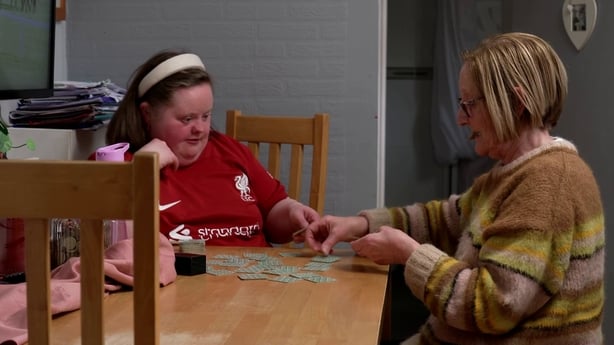
Gladys Hand (right) cares for her daughter Jessica who has Down syndrome
Gladys also cares for Jessica’s father Mick.
“I just feel worn out. I have [medical] complaints, but I haven’t had the time to make an appointment and go to the doctor. I just haven’t,” she said.
When Jessica’s is not in day service, she’s highly dependent – with medical and physical needs.
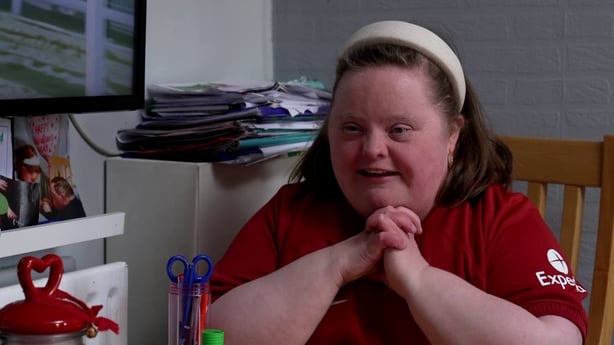
Jessica Hand
“She needs drops in her eyes three times a day plus steroids and then ointment at night. These have to be done every day without fail.
Jessica has a catheter site, which the family refers to as her “wound”. Each morning, it must be cleaned and dressed, often after she tells her mother that it is “wet.”
Gladys has not had respite for Jessica since she was a child – something which she feels could build her independence and transition her to life without her.
She admits she has not sought respite as Jessica was always very reluctant to go but says she wishes someone had encouraged them both to try it sooner.
“I was giving in, but the reality of it now is she’s going to have to go. She has to get used to it. Time is running out.
“It’s really hitting me now. If anything happened to me, what’s going to happen to her? I’d be afraid she’d be taken out of the community and that would just be devastating for her. I’d rather bring her with me.”
A report on this issue from Oonagh Smyth and producer/director Sallyanne Godson is being broadcast on the 19 March edition of Prime Time on RTÉ One and RTÉ Player at 9.35pm.