
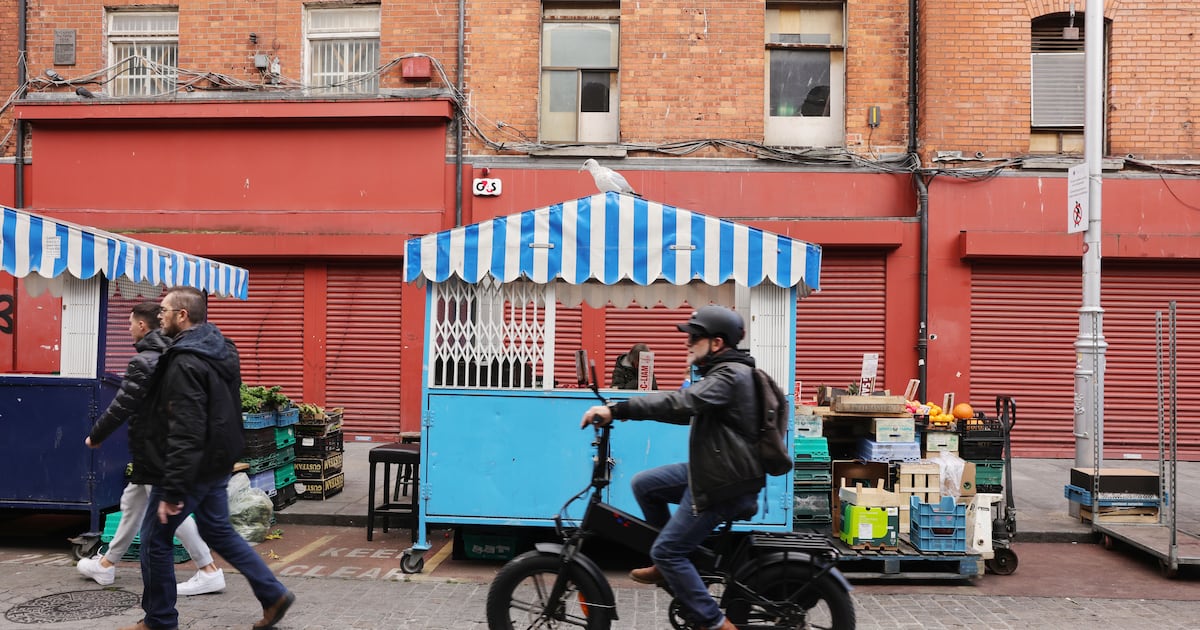
How many documentaries has RTÉ made about Moore Street – the beloved historic outdoor market in Dublin’s north inner city? It feels like there have been a few – and that they have generally taken the shape of a hagiography to dear auld Dublin and its flinty, loquacious locals.
Welcome to Moore Street (RTÉ One, 10.15pm) is different. It is a melancholic valentine to a part of Dublin that seems to be passing into history before our eyes. Shuttered stalls, plunging footfall, an increase in drug addiction and lawlessness – it’s a wonder this wasn’t called Farewell to Moore Street.
It’s a wonderfully poignant documentary that resists laying on the misery with a two-for-a-euro trowel but instead lets those who have grown up on Moore Street, or come from abroad to work there, speak for themselves. The picture they paint is not flattering and raises questions about how Dublin is administered – or if it really is administered at all or is instead a victim of benign indifference.
“There’s always a risk every day in Moore Street,” says Amanda, a reiki practitioner and oracle healer who has set up a stall on the street as part of a Dublin City Council initiative. She feels that the street is “amazing” and has “taken her in” and “given her a chance”, but she acknowledges there is a downside, too.
“Every single person on that street is trying to find their way in life. Yes, you face trouble. There are drug addicts; there’s all sorts that come at you. There’s always a risk every day on Moore Street. There’s stabbings, beatings, stealing… It’s going to make you or break you.”
“I’m all my life living in the city and I wouldn’t come out in the nightlife, and I wouldn’t come out to Moore Street at night; it’s gone that bad,” says former fishmonger Margaret. “There’s part of me that will always be in the street, and it’s gone. I really feel sad about that. There’s no future in the street.”
A sadness hangs over the episode. We meet Lauren, whose mother, Siobhan, used to run a stall on the street before her death in April 2025. “If you had met my mam, you would have known… the big smile on her face,” says Lauren. “She was just such a great person. Everyone loved to come down, just for the chat, because she was just so lovely.”
She and her brother, Ryan, want to keep the business going, but it’s hard to do so as they continue to grieve. “It’s nice to have the memories,” says Ryan. “But it dawns on you some days [that Siobhan has died], and it puts you in bad humour.”
We also meet Naleem from Sri Lanka, who, like more and more people who work in Dublin, commutes from an adjoining county. He finally throws in the towel, however, when the lack of footfall around his food stall puts paid to his dream of introducing Dubliners to the joys of Sri Lankan cooking.
He still has his restaurant in Wicklow. The sobering message of this admirably unflinching documentary is that he is probably better off there, rather than trying to breathe life into Moore Street – a neighbourhood which, as portrayed here, has been left for dead.