
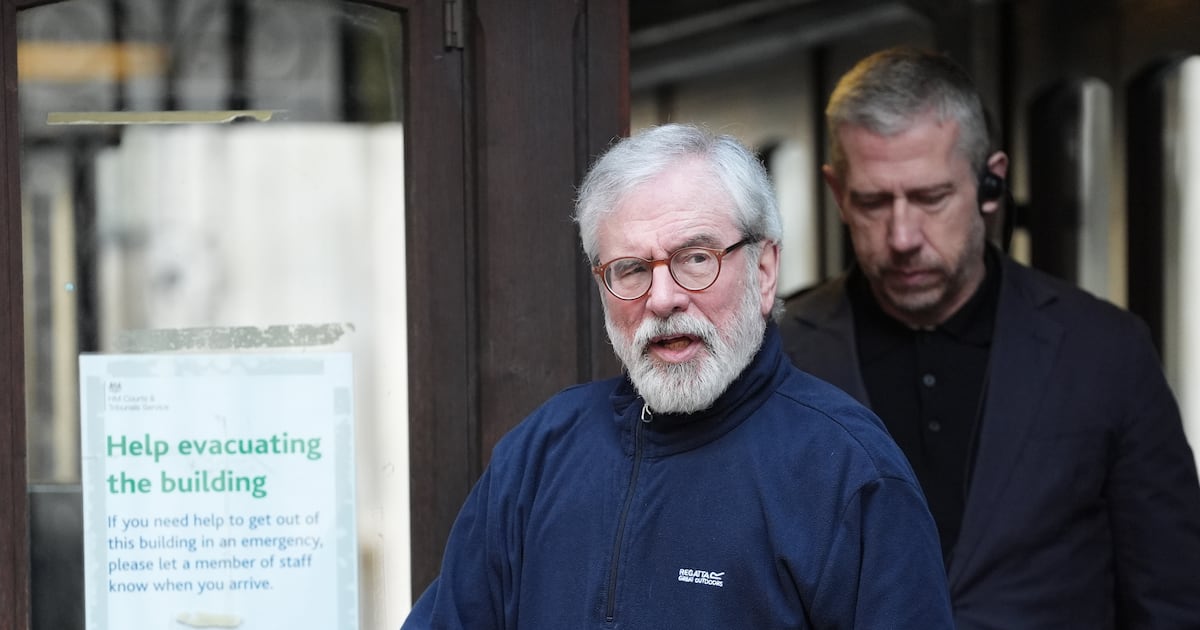
Sinn Féin leader Gerry Adams has welcomed the decision by three IRA bombing victims to drop their civil action in the high court in London against him.
The case was taken in May 2022 by Barry Laycock, injured in the Manchester Arndale bomb in 1996; Jonathan Ganesh, injured in Canary Wharf that year, and John Clarke, injured in the Old Bailey bombing in 1973.
If he had lost the case, Adams would have faced vindicatory damages of £1, but, even more significantly, it would have left him open to years of civil actions – if current legacy legislation being debated by Westminster becomes law.
Rising shortly after noon on Friday, the barrister for the claimants, Anne Studd, said the claim had been withdrawn with no order for costs.
Adam was not in the court to hear the result because he had travelled back to Ireland on Thursday evening, though Sinn Féin MP John Finucane was present, as he had been throughout the two-week trial.
The decision to withdraw the claim, said Studd, had been taken because of the claimants’ concerns that a cost protection order imposed two years ago – which protected them from paying Adams’s costs, whatever the result – could now be at risk, she said.
Judge Jonathan Swift interrupted, saying such statements should more properly be made outside of the court and that he would not allow her to expand on the arguments that she wanted to make.
The judge had several times during the trial questioned whether the case against Adams was an abuse of process because a personal injuries claim was being used to challenge his wider role during the Troubles.
The case – which ended on its ninth day of hearing – had argued that Adams had been a member of the IRA, despite his decades of denials, and that he had been a key figure in ordering the bombings in England.
In his closing submission, Adams’s barrister Edward Craven said the judge had raised the issue of abuse of process and had invited legal teams for both sides to address the issue in their closing submissions on Thursday.
Adams had not previously applied, or asked the court to strike out the claim as an abuse of process, but the defendant’s legal team has carefully reflected on the issues raised by the judge.
In particular, Craven said they had looked closely at the stated purpose of the claim and the way it has been conducted and presented at the nearly two-week trial in the Royal Courts of Justice on the claimants’ behalf.
Following that consideration, the defendant’s legal team had concluded they considered that on a proper application of those principles the case does cross the threshold for an abuse of process.
The claimants had argued that the case began in 2022 because they had suffered years of trauma and injury and they were unaware until then that they had a civil route to sue Adams as a controlling figure in the IRA, Craven said.
“It is well recognised that proceedings may be an abuse of process where they have been brought for the purpose of seeking some collateral advantage beyond the proper scope of the action, or where the proceedings are conducted in a way designed to cause the defendant expense, harassment or prejudice beyond the scope of what is ordinarily encountered in the course of properly conducted litigation,” Craven said in his closing submission on Thursday evening.
In a statement issued on Friday afternoon, Adams said he welcomed the three men’s decision to drop the case against him and he had “attended the civil case out of respect for them.
“This decision brings to an emphatic end a case that should never have been brought,” he said.
“I contested this case and defended myself against the smears and false accusations being levelled against me.
“I asserted the legitimacy of the republican cause and the right of the people of Ireland to freedom and self-determination. I do so again.
“During my two days of evidence I categorically rejected all of the claims being made.
“I am glad to have been one of those who helped bring an end to the conflict,” he said.
Adams said there was now, “through the Good Friday Agreement, a peaceful and democratic route to a new Ireland” and this needed “a renewed focus, especially by the Irish Government”.
He thanked “all of those who have expressed their solidarity with me and the Sinn Féin team which worked closely with me” as well as his legal team and his wife Colette and his family.