
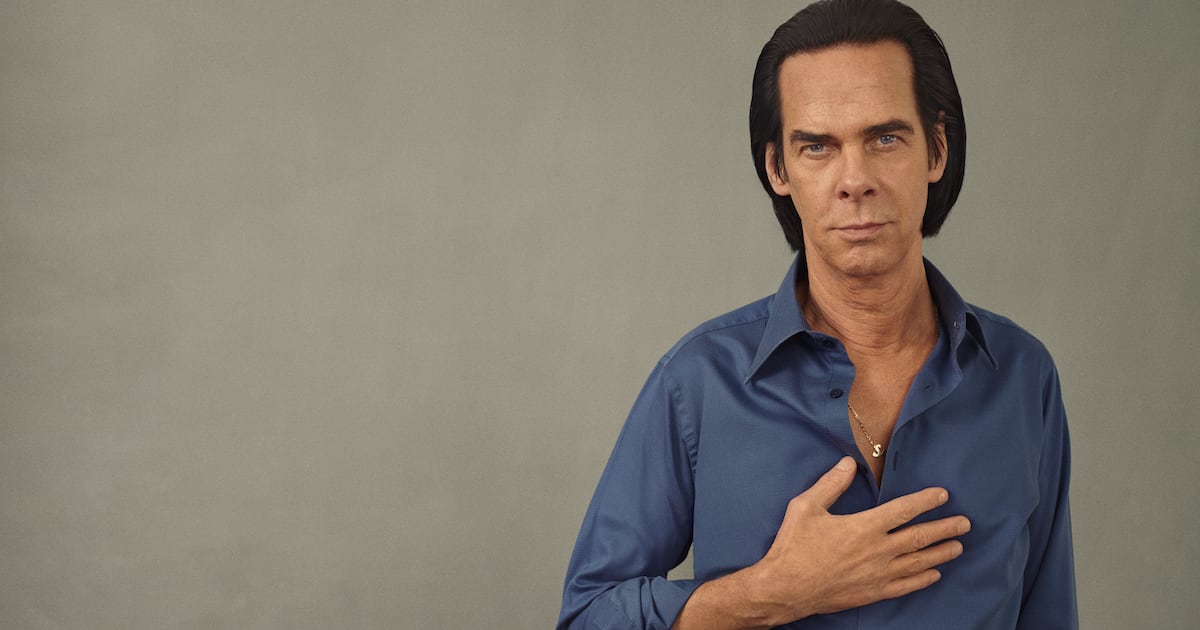
I can’t see Nick Cave. The Australian singer is talking from his home in London, favouring the telephone because he is convalescing from the flu. “The whole of London is infected with this thing,” he says with a sigh.
In the popular imagination, Cave has jet-black hair, a high forehead, an indomitable stare and, over his thin, angular frame, an open shirt and crisp, tailored dark suit, like that worn by a preacher, which some fairly say he is.
What is he wearing while poorly? Does he cleave to the suit even in such straitened circumstances? “Yes. More or less.” He laughs as he considers the image. “Well, I’m indoors. I don’t have my jacket on. I’m sick but not bed-sick. I’m not sitting up in bed in my suit with a thermometer sticking out of my mouth.”
It makes sense that the 68-year-old would preserve ritual even while coughing up a lung. Formal structure interests Cave. Suits matter. Offices matter. The Bible matters.
Ever since he arrived on the scene in the 1980s, first with The Birthday Party, then with The Bad Seeds, the artist has banked on an unpredictability couched within the solid framework of his musical collaborators (particularly the formidable Warren Ellis), a devotion to the scriptures and an understanding that, to be radical in art, rigidity helps.
“I get up in the morning, put on my suit, kiss my wife goodbye and go to the office for the day. I literally don’t have a creative idea outside office hours.”
For 30-odd years Cave sold fire and brimstone in a bottle. Songs such as Tupelo, From Her to Eternity and The Ship Song drove the faithful, and enduring classics – such as the incandescent Into My Arms – made it clear he was an artist for the ages.
Whether conjuring electrifying, tooth-rattling magic on stage, flirting with the mainstream on Where the Wild Roses Grow, his 1990s duet with Kylie Minogue, or being covered majestically by Johnny Cash, Cave’s pathway in life seemed set.
Everything changed when, in 2015, his 15-year-old son Arthur, twin brother to Earl, died, accidentally falling from a cliff near the family’s home in Brighton after taking LSD. The loss for Cave and his wife, the Vampire’s Wife fashion designer Susie Cave, was crippling.
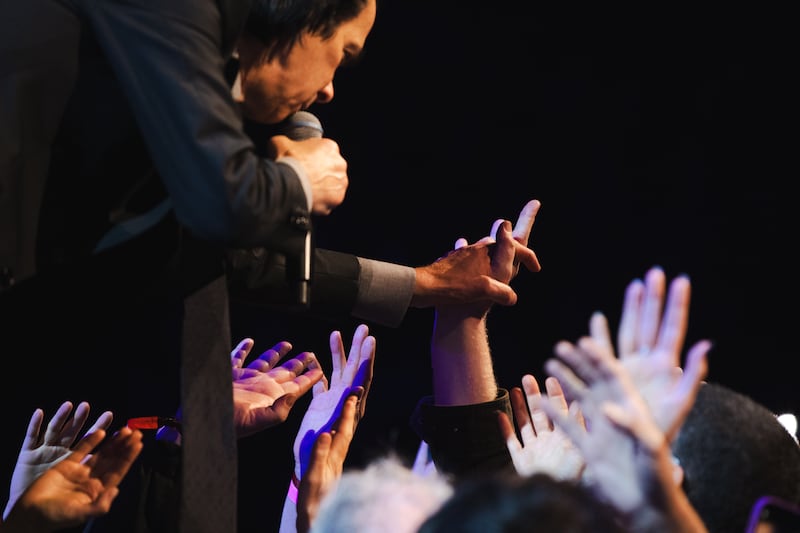 Some say Nick Cave is a kind of preacher. Photograph: Megan Cullen
In 2022 his son Jethro, a model in his early 30s, born to Beau Lazenby, died in Melbourne.
Grief lives with Cave now. There is no point sidling up to the story of his loss. It is part of the fabric of his being. He holds space for grief in The Red Hand Files, the online column he created in 2018, where he answers questions from the public, often about bereavement or other traumas, and how to be in the world afterwards.
He and Susie have found an anchor in their love for one another. Grief can split up a couple, I say. “I was alert to that at the beginning,” Cave says. “I saw a moment where Susie was just unreachable, very early on, in the first few days. And I felt on some level that I’d lost her as well.
“I made a concerted effort for that not to happen, and Susie made a concerted effort for that not to happen. That we remain close. That we never blamed each other for it. That never happened, although that’s often the case with couples.
“We just understood that our relationship would forever be defined by a catastrophe but that we were also deeply in love, and the only way either of us could get through the whole thing is to have the other. I couldn’t imagine life under these circumstances without Susie.”
He has mentioned in the past that Susie sometimes dreams about Arthur. Does he dream about him?
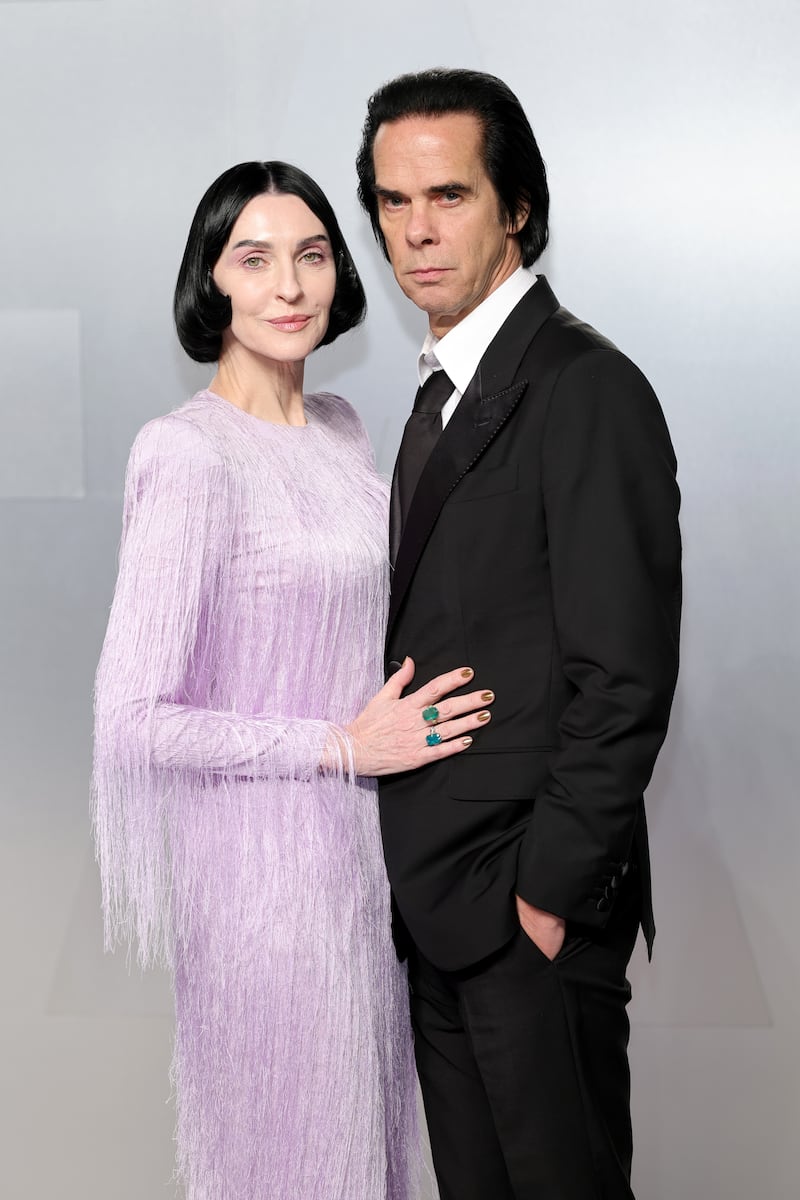 Susie and Nick Cave in Los Angeles, California, earlier this month. Photograph: Neilson Barnard/Getty Images
“No,” he says. “A mother’s connection to her child is different. I believe that Arthur does visit Susie in her dreams. The dreams are not complicated. He comes and he sits with her, and she talks to him or brushes his hair. They feel like visitations.
“I don’t dream very much anyway, but I feel I have my dreams through Susie. She says, ‘I dreamed about Arthur last night.’ And she’ll tell me. It’s something we share together.”
Cave is deeply grateful for their closeness, because he sees how it could be otherwise.
“A lot of people contact Susie who’ve had their children die. They want to talk to her. She had lunch with a woman whose son had died seven years ago, and she still hadn’t spoken to her husband about it. It can be incredibly …”
He trails off.
“It can, as you say, split the relationship. We see that all the time.”
He and Susie sold their Brighton home after Arthur’s death, because it was too painful to live there. They found refuge in a “small, pink” house in London.
It is fundamentally weird that musicians police other musicians in their views. I find that intensely creepy
— Nick Cave
His move was reminiscent of another fleeing: his first great leap from rural Victoria, Australia, to London in 1980, in the wake of his father’s death in a car crash, when Cave was 19. He remembers his childhood with great fondness. His father was a teacher, his mother a librarian at the school where his father worked.
The young Nick was carefree. “I had a very happy life as a young country boy, a free-range, happy childhood, and that continued, even though I became problematic as I grew up.”
It would, he says, trace “a neat line” to argue that his drug-taking began after his father’s death, spiralling into a heroin addiction that took six stints in rehab to kick. In fact Cave was “well into drugs” before his father’s death.
“But after he died there was a weird urgency or subterranean anger. I rushed away from Australia. I couldn’t handle what was going on.”
If the first 10 years of drug-taking was giddy and sociable, the second span of years was isolating, as an existential reckoning took place.
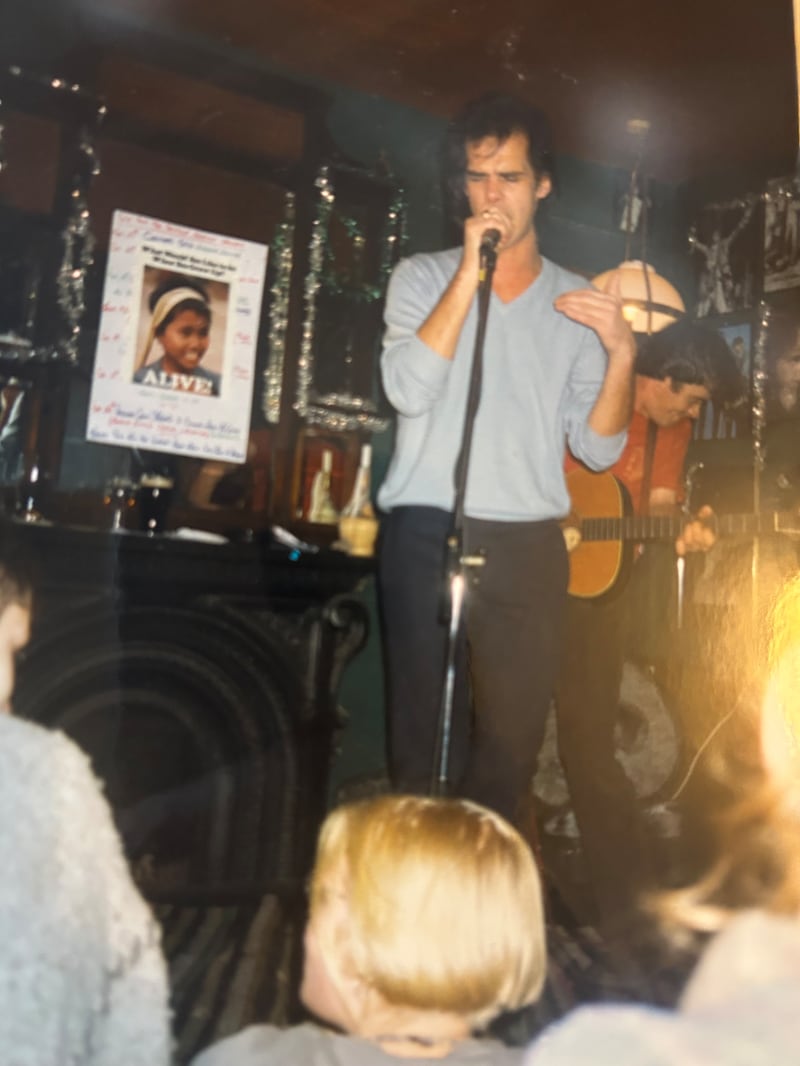 Nick Cave performing in McCarthy’s Bar in Baltimore in West Cork in the late 1990s
Some of that late recovery period he spent in west Co Cork, in Skibbereen, my hometown, where I first encountered Cave in the late 1990s. He would come to the Liss Ard Estate, just outside the town, on and off, over several years, writing songs such as Love Letter on its piano, and occasionally performing to dozens of people in a room or bar, offering a cappella renditions of Birthday Party tracks such as Dead Joe.
“I had amazing times in Skibbereen,” he says. “I have very pleasant memories of sitting over a pint of Guinness in a pub in Skibbereen.”
He also visited Nenagh, in Co Tipperary, on a hard winter’s day in 2023, for the funeral of his friend Shane MacGowan, at which he performed.
“I had a deep relationship with The Pogues over the years. It was very special and, I think, brought me quite close to what Irish music was essentially about, which was not something I knew too much about until I started to spend time with Shane.”
He feels “full of so much debt” to MacGowan and The Pogues for the lessons they taught him about the live experience.
“Something would happen to me in those Pogues concerts that is beyond mere entertainment,” Cave says. “It becomes a kind of religious experience or transcendent experience. I feel like music is one of the last legitimate transcendent experiences that this modern world leaves available to us.”
It’s a description that could well be applied to one of Cave’s own gigs. Whether before a crowd of awed locals in a small bar in Baltimore in west Cork or to 25,000 people at Malahide Castle, in Co Dublin, Cave stalks the stage, half-prophet, half-threat.
If he had a terse, dangerous energy in his 1990s days, in recent years a more complex tapestry has been at play. The performances are cathartic, choral and emotional. There are times when Cave – gaunt and thin at the piano – sings songs that haven’t always been written directly for his lost children, but seem to have been.
“Just breathe, just breathe, just breathe,” he repeated in Dublin at his 2024 gig at 3Arena, a whisper from Skeleton Tree, his grief-stricken record from 2016, as the big screens zeroed in and the pain on his face scalded the crowd. (Live God, his recent live album, is as complete a reliving of the experience of that tour as one could hope for.)
I don’t want to use my songs to further punish my fans because of very egregious acts of their government
— Nick Cave
His songwriting is led not by intellect but by heart, whether it’s the guttural roar of Tupelo, the doomy foreboding of Red Right Hand, the frenzied screech of From Her to Eternity or the fragile ethereality of Bright Horses.
“What I write is almost entirely emotional,” he says. “The coupling of two lines: what happens when you put one line with another line? The thing I’m looking for is a kind of internal shimmering. Meaning comes second and is revealed later on.”
Cave finds inspiration in the Bible, which he says he reads daily. “The stories of the Bible are a part of me. Whether you believe or not is another thing, but, just as a basic idea, it’s full of so much creative fruit and so much depth.”
Joy, and how to seek it after a pain so immense it is annihilating, is a subject that has become important to Cave in recent years. The small pleasures in his life stem largely from home.
“It often feels to me that the paradises we can build on Earth are of the most simple [things],” he says. “It is spending a little bit of time with my grandson and sitting and working on ceramics – it looks like I’m becoming a ceramicist in later life – and spending time with Susie. I swim in the lake in London all through the year. It’s small, basic things.”
Cave became a grandfather in 2024 to Roman, who is the son of Luke Cave and his wife, Sasha. (Luke is the second of Cave’s four children, born 10 days after Jethro, to Cave’s then partner, Viviane Carneiro.)
Does he change a nappy? “Can I change a nappy or do I change a nappy?” he says. “I haven’t had the privilege of changing my grandson’s nappy yet.”
Now in his elder-statesman era, Cave is coming up on the age Johnny Cash was when he covered Cave’s The Mercy Seat for his Rick Rubin sessions. “Oh really?” Cave says, sounding a little startled. He is.
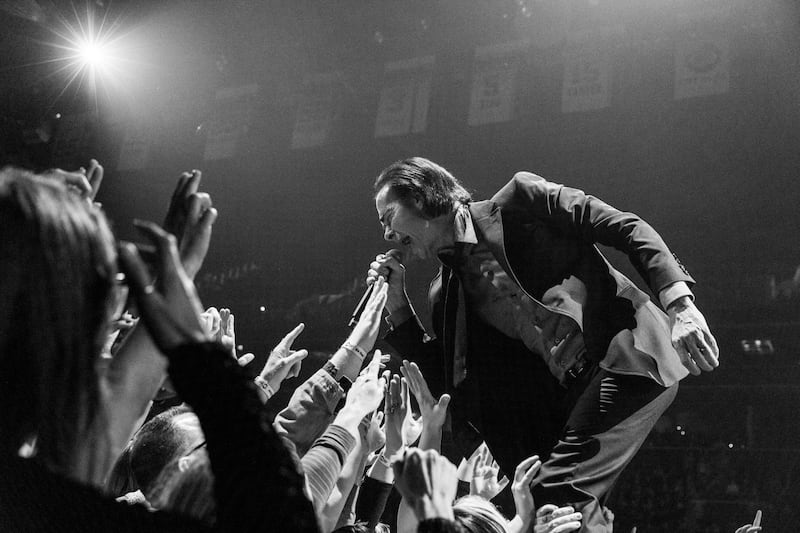 Nick Cave performing in New York last year. Photograph: Megan Cullen
What keeps him fit and limber enough for the knee-drops on stage? “How did I stay so young? Twenty years of drug addiction and a good face cream,” he says, with a dry laugh.
He’ll be putting his moisturiser to good use in the days after we talk, as he flies to Los Angeles for the Oscars. His song Train Dreams, which he wrote with Bryce Dessner, is nominated in the best-song category.
Is he looking forward to the event? “Tough question. My wife loves the Oscars. She loves to see what people are wearing, all that sort of stuff. So I got nominated and I thought, I’ll take my wife on a date to the Oscars. So yeah! Maybe. I don’t know.”
Train Dreams winds up missing out on the Academy Award in favour of Golden, the theme song from KPop Demon Hunters, but that’s okay, because Cave has worked on his game face for the announcement. “I’ve got to practice that stoic humility that actors practice when they don’t win.”
We’re coming close to the end of our phone call, and there’s a lot we haven’t got to yet. The recent screen adaptation of his novel The Death of Bunny Munro, for example, or his new version of Red Right Hand, recorded, at Cillian Murphy’s behest, for the Peaky Blinders film.
He does tell me a little about the Irish music he’s enjoying. “There’s lots. I can listen to Kneecap on occasion.”
And he’s looking forward to his European tour with The Bad Seeds this summer, which starts in Dublin in June.
“That mad, loony energy of the Irish,” he says. “The first gigs have a particular energy to them. They always feel unhinged and dangerous. I love Dublin.”
If Cave sounds as if he has mellowed with age, then that’s arguably true, but it doesn’t represent him in his totality. He remains defiantly himself. He doesn’t suffer fools. He’s nobody’s pawn.
Recently, on The Red Hand Files, Cave used his platform to support comments by the film-maker Wim Wenders that art and artists are “the opposite of politics”. Cave has consistently opposed the cultural boycott of Israel. “I don’t want to use my songs to further punish my fans because of very egregious acts of their government, so I stand firm around that,” he says.
“People suggest to me that to take this position means you just don’t have a fully functional heart. That might be true in my case, but I can’t find it in myself to construct my whole worldview around the hatred of one particular candidate or, indeed, one particular people.”
He believes The Red Hand Files can offer some good – “People write in, finding that what I’m talking about has been an enormous help” – but he doesn’t have a personality that is naturally political, and he doesn’t believe he should pretend that he does.
“I’m just not that guy,” he says.
He does not like to be told what to do.
“It is fundamentally weird that musicians police other musicians in their views. I find that intensely creepy, to have other musicians looking over your shoulder and seeing whether [you] behave in the way they think you should behave.”
“I follow my path intuitively and emotionally and do what I feel and think is right. And, you know, f**k it if people don’t agree.”
Nick Cave & the Bad Seeds play Malahide Castle on Wednesday, June 10th