
Molecular clouds, which are dense areas of gas and dust, are the birthplace of stars. Gravity pulls on material, drawing it inward, but internal pressure counteracts this force, pushing it outward. Scientists have long theorized that a third influence, magnetic fields, is critical to this dynamic. But they are also elusive, and these fields have been very difficult to observe directly.
In an impressive feat, Indian astronomers recently took important new steps toward mapping the hidden Magnetic “skeleton” around a small molecular cloud in the Milky Way. These tenuous structures, although mostly invisible, serve as crucial pathways for star formation.
This discovery explains why stars form much more slowly than expected. Magnetic fields act like a stabilizing force, pushing back against gravity and preventing gas clouds from collapsing too quickly.
Using modern polarimetry techniques, researchers at the Aryabhatta Research Institute of Observational Sciences (ARIES), Dehradun, and Assam University mapped magnetic structures in space. The team discovered that the strongly magnetized clouds were different when they looked at two of its nearby brethren, L1604 and L121.
L1604 is heavy and dense, with enough material to form many stars. L121 is smaller but has a stronger, more organized magnetic field, which helps keep it stable against gravity. Both L121 and L1604 are “sub‑critical,” meaning their magnetic forces outweigh gravity and turbulence at the edges, stopping them from collapsing on a large scale.
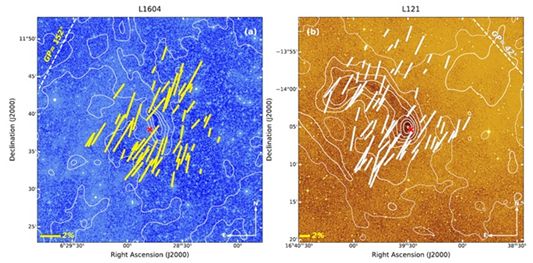 Polarization maps of dark clouds L1604 and L121. Solid lines represent the polarization vector corresponding background stars overlaid on the composite DSS images of the respective clouds. The orientation of the Galactic Plane (GP) is marked with a dashed line. The cross denotes the central position of each cloud. Contours of the Herschel SPIRE 500 μm dust continuum emission are over plotted.
Using the ARIES Imaging Polarimeter and the 104-cm telescope at Nainital, India, the team measured polarized light from distant stars. As this starlight passes dust grains oriented by magnetic fields, it gets polarized. By analyzing thousands of these signals, the scientists reconstructed magnetic field orientation and structure around the clouds.
By experimentally imaging the magnetic framework that had previously been hidden, they gained new insight into the material. The results show that magnetic fields act as a brake, preventing rapid star formation. Without this magnetic support, galaxies would be able to form stars from their gas at a significantly higher rate, drastically changing the course of their evolution.
Furthermore, the work highlights that while magnetic fields dictate large-scale structures, gravity might still dominate on smaller scales, with the densest inner regions where stars ultimately form. Understanding how magnetic fields shape star formation can help scientists build better models of how galaxies grow and how stars live and die. It could also improve predictions about where new stars and planetary systems are likely to appear.
This research heralds a new window into the delicate interplay of forces that govern our universe by turning molecular clouds into visible laboratories.
Journal Reference:
Bhaskarjyoti Barman, Himadri Sekhar Das, Gulafsha B Choudhury, Jeewan C Pandey, Biman J Medhi; Rajat Subhra Paul, Dipankar Paul, Sanchali Nath Mazumdar 3; Biki Prasad 4; Nambram Niroda Devi. Two small molecular clouds: L1604 and L121, magnetic field morphology and physical properties. Monthly Notices of the Royal Astronomical Society. DOI: 10.1093/mnras/staf2228