
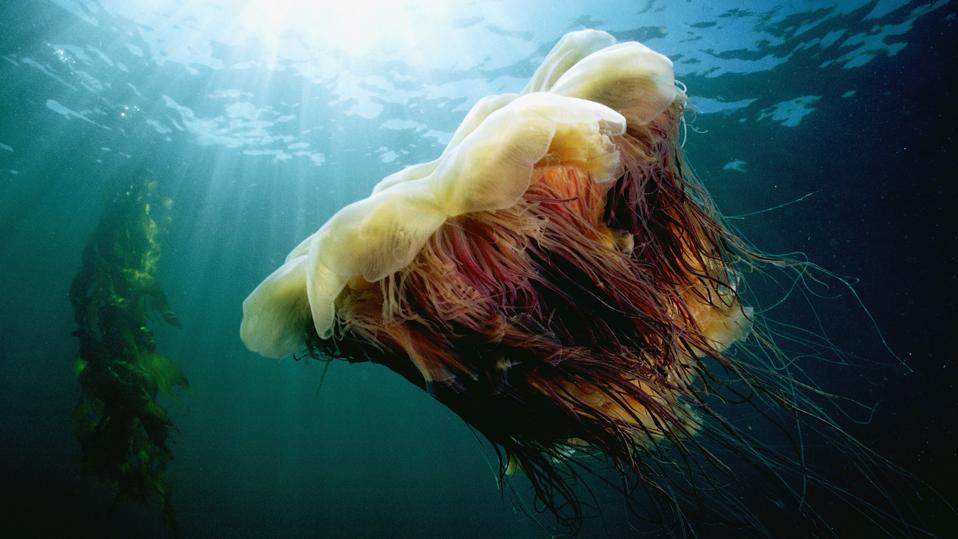
In 1865, a dead jellyfish washed onto a Massachusetts beach. When scientists measured it, they discovered that its bell measured 2.1 meters (7 feet) across, making it wider than most doorways. What was more shocking were its tentacles: they stretched 36.6 meters (120 feet) behind it. Longer, that is, than any other animal on Earth — even the blue whale.
The species was Cyanea capillata, the lion’s mane jellyfish. It still holds the record for the longest animal on the planet. This is not a minor taxonomic footnote. It is a genuinely strange fact about the world: the longest animal that we’ve ever recorded is a gelatinous, brainless, boneless predator that drifts through Arctic waters, trailing over a thousand venomous threads behind it.
However, we don’t usually think of animals in this way. “Largest animal” almost always means “heaviest,” and by mass, the blue whale still wins without contest. But length is a legitimate measure of size, too. By that metric, the blue whale loses hands down.
The Architecture Of The Longest Animal On Earth
The lion’s mane’s bell is divided into eight lobes, which gives it the look of an eight-pointed star. Each lobe contains roughly 70 to 150 tentacles arranged in four distinct rows; larger specimens shade from vivid crimson to dark purple, while smaller juveniles are pale orange. In a large adult, those tentacles can number over 1,000 in total, each of which is lined with stinging cells known as nematocysts.
Notably, nematocysts aren’t passive structures. They’re akin to a pressurized cellular harpoon: when triggered by contact or chemical signal, it fires in under 700 nanoseconds (at a rate of 18 meters per second, or 40 miles per hour), injecting venom into whatever it touches. This is one of the fastest mechanical events in all of biology.
The extraordinary length of a lion’s mane jellyfish’s tentacles is not coincidental, because the lion’s mane is a passive hunter. Its slow pulsations can only weakly drive it forward; for this reason, it relies heavily on ocean currents to travel great distances.
Because the lion’s mane is unable to chase prey, its survival strategy is to make itself into an obstacle instead: the jellyfish positions itself above fish, spreads its tentacles wide and slowly sinks downward, catching prey in its tentacle net. The longer the net, the larger the killing zone. And in the cold, nutrient-poor Arctic waters that it inhabits, where prey can be scarce, reach can trump speed.
There is a mechanical cost, however. As 2019 research published in the journal Fluids suggests, having extensive tentacles and oral arms can reduce a jellyfish’s propulsion efficiency by up to 80 to 90% compared to a tentacle-free state, as they disrupt the vortex formation around the bell.
This is a massive evolutionary trade-off. Although its tentacles make the lion’s mane a better predator, they also make it a significantly worse swimmer. But in an environment where the current does most of the hard work behind locomotion anyway, this has proven to be a worthwhile exchange for the species.
The Logic Of An Animal Being Mostly Water
Perhaps the strangest aspect of the biology of the lion’s mane jellyfish is that it is composed of 94% water. On top of this, they’re perfectly radially symmetrical, while also only having two layers of tissue.
They have no bones, no cartilage and no centralized brain. The entire animal is essentially a muscular bell, a digestive cavity and an enormous trailing apparatus of stinging threads, all of which are held together by a gelatinous substance called mesoglea — which is also mostly seawater.
This architecture has one major hidden advantage, as 2013 research from PLOS One explains: it is extraordinarily cheap to build and maintain. Bone, muscle, and organ tissue require enormous metabolic investment, whereas mesoglea does not.
This is precisely what makes it possible for the lion’s mane to grow to the remarkable sizes that it occasionally does, without the caloric demands that constrain most large animals. This matters enormously in lean Arctic waters. The downside, however, is that they’re also immensely fragile. Tentacles often break off or tangle, and their tissues are easily damaged.
Why This Animal Matters
Beyond their magnificence, lion’s mane jellyfish matter because they are increasingly used as a diagnostic signal for the health of our oceans.
Climate change, eutrophication, overfishing, coastal construction and species translocation have all been proposed as drivers of increased jellyfish blooms. However, the science here is genuinely contested.
A 2024 review in Frontiers in Marine Science noted that robust evidence to support these claims is still fairly limited; the widespread belief that jellyfish blooms are simply “increasing in number” has been challenged in recent years.
What the data does suggest, per a 2012 study published in PNAS, is that jellyfish populations have been pulsing globally at decadal scales. Researchers have observed a slight overall increase since the 1970s, correlated with warming temperatures, overfishing of competitors, coastal eutrophication and the spread of hypoxia. Notably, these are conditions that jellyfish are more tolerant of than most other animals.
The mechanism behind this is a feedback loop. Overfishing removes the fish that eat jellyfish and compete with them for zooplankton. Warmer water accelerates how quickly jellyfish grow and reproduce. Coastal runoff creates nutrient conditions that favor gelatinous plankton over fish larvae. In other words, the ocean gets more jellyfish-shaped the more that we break it.
What Being The ‘Largest’ Animal Actually Means
The blue whale is still, unquestionably, the heaviest animal that has ever lived. It is a dense, warm-blooded, metabolically voracious creature that needs to consume four tonnes of krill a day just to sustain itself.
Meanwhile, the lion’s mane jellyfish is nearly its complete opposite: it’s cold, diffuse and metabolically minimal, with a body made of 94% seawater, held together by the very ocean that it moves through.
Both are, in their own terms, the largest animal on Earth. The whale wins in terms of mass; the jellyfish wins in terms of reach. And in a changing ocean — warmer, more acidic, stripped of fish, enriched with runoff — the animal built to thrive on almost nothing may have a longer future.
The longest animal on Earth doesn’t think, plan or chase, yet it still thrives. How connected do you feel to a world shaped by animals like this? Take this science-backed test to find out: Connectedness to Nature Scale