
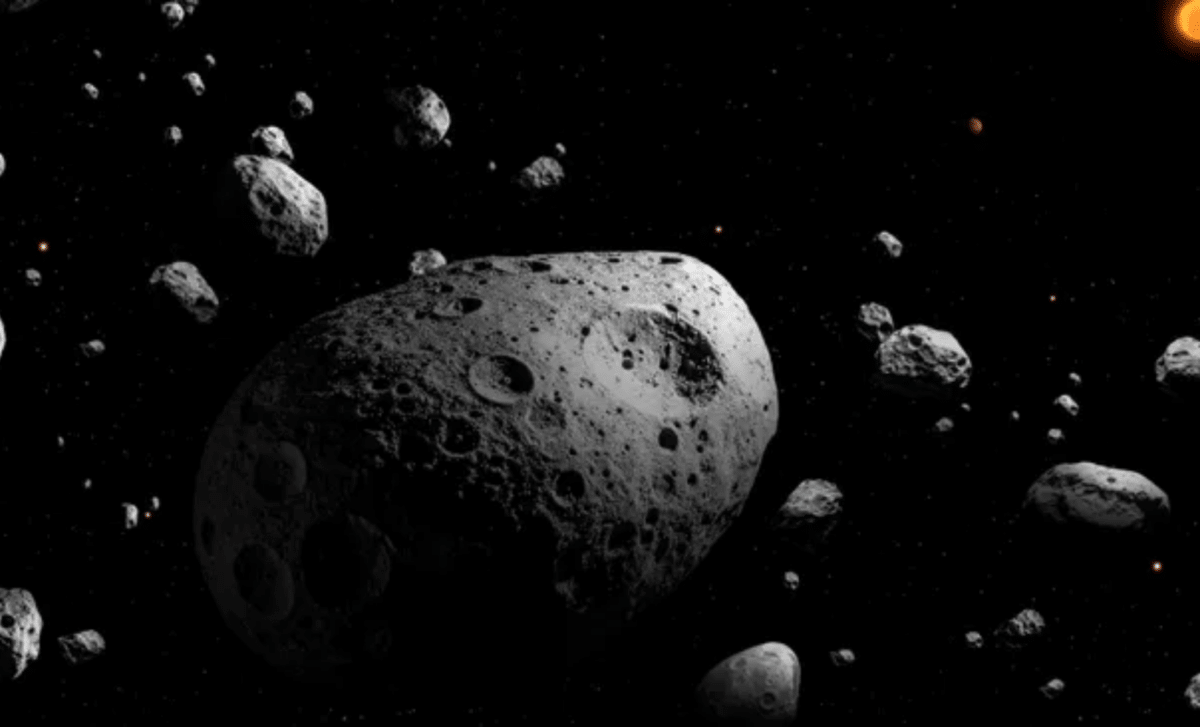
astronomers have identified a massive asteroid spinning faster than anyone could have imagined. The asteroid, with a diameter of 710 meters, completes a full rotation in just 1.9 minutes, far quicker than what is considered physically possible for such a large object. The discovery, detailed in a study published in The Astrophysical Journal Letters, has left scientists stunned, raising questions about the fundamental limits of asteroid rotation and the material composition of these distant objects. This finding not only pushes the boundaries of space science but also opens new avenues for exploring the nature of asteroids and their behavior in our solar system.
The Discovery: A Massive Asteroid Defying the Odds
In late April and early May of 2025, astronomers using the Vera C. Rubin Observatory in Chile observed the rapid spinning of a 710-meter-wide asteroid, cataloged as 2025 MN45. The speed of its rotation was far beyond anything previously recorded for such a large object. Typically, the rotation of large asteroids is measured in hours, with the threshold considered safe for such objects being approximately 2.2 hours. However, this asteroid is rotating in less than two minutes, an astonishing rate that challenges our understanding of asteroid mechanics.
“The speed of rotation we observed was almost unbelievable,” said Dmitrii Vavilov, an astronomer from the University of Washington in Seattle, during his presentation of the study at the Lunar and Planetary Science Conference in Texas. “We thought that was crazy that they could rotate any faster,” he added, emphasizing how this discovery defies established theories about the rotational limits of asteroids.
This extraordinary finding sets the stage for further scientific exploration, particularly in the study of asteroid formation, structure, and the forces acting on such massive objects in space.
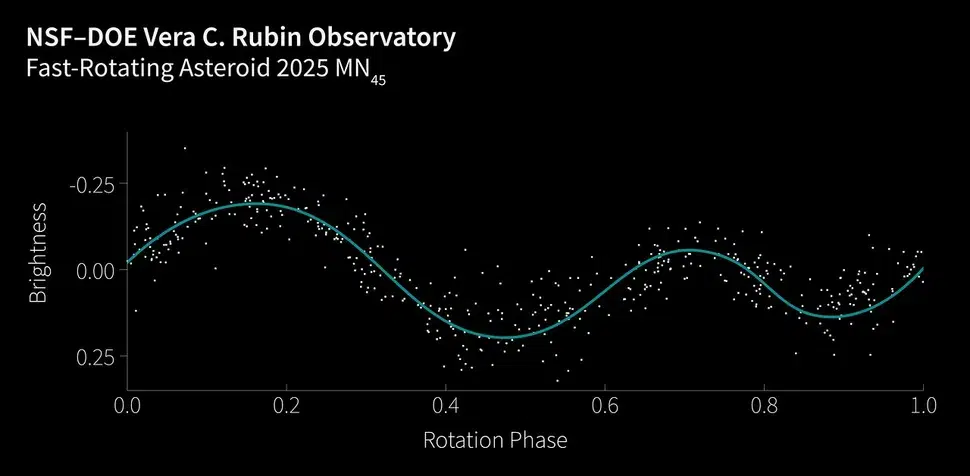 This lightcurve shows how the brightness of asteroid 2025 MN45 rises and falls as it rotates. Tracking these changes helps scientists work out how quickly the asteroid spins and what its surface may be like. (Image credit: NSF–DOE Vera C. Rubin Observatory/NOIRLab/SLAC/AURA/J. PollardAcknowledgement: PI: Sarah Greenstreet (NSF NOIRLab/Rubin Observatory))
The Science Behind the Speed: What Makes This Asteroid Tick?
To put the significance of the discovery into perspective, it’s essential to understand the physics of asteroid rotation. The force of gravity, combined with the asteroid’s mass and shape, typically dictates the maximum rotational speed an object can achieve before it begins to break apart. For an object like the 2025 MN45, which is several hundred meters across, its rotation speed should have been limited by these factors.
Yet, the discovery reveals that this asteroid is spinning far faster than any object of its size and mass should be able to. “2.2 hours is supposed to be the limit for this asteroid, and yet it’s rotating in less than 2 minutes,” Vavilov explained. These findings defy previous assumptions about the structural limits of asteroids and force researchers to reconsider what materials might be holding this object together.
In all likelihood, the asteroid is not composed of loose rubble or a loosely packed surface as many scientists had initially assumed for objects in space. Instead, Vavilov and his team suggest that 2025 MN45 is likely made of solid rock, or possibly even metal. “Even clay would not be enough to hold this asteroid together,” he remarked, suggesting that the asteroid’s core could be much denser than expected. This insight opens up new possibilities for understanding the composition of asteroids and challenges old models that relied on the idea of loosely bound structures.
A Study That Shakes Assumptions
The findings were published in The Astrophysical Journal Letters, a prestigious scientific journal. The paper offers a detailed analysis of the data collected by the Vera C. Rubin Observatory and provides new insights into the behavior of fast-rotating asteroids. The study not only describes the asteroid’s rotation speed but also discusses the implications of this discovery on our understanding of the structural integrity of asteroids in the solar system.
Astronomers have long been fascinated by the mysterious dynamics of asteroid rotation. Previous studies had suggested that the maximum speed of rotation for a large asteroid would be governed by the material it is made from. This discovery, however, seems to contradict those predictions. It suggests that there is more at play than previously understood, and the asteroid’s composition and internal structure may not follow the patterns seen in smaller, faster-rotating objects.