
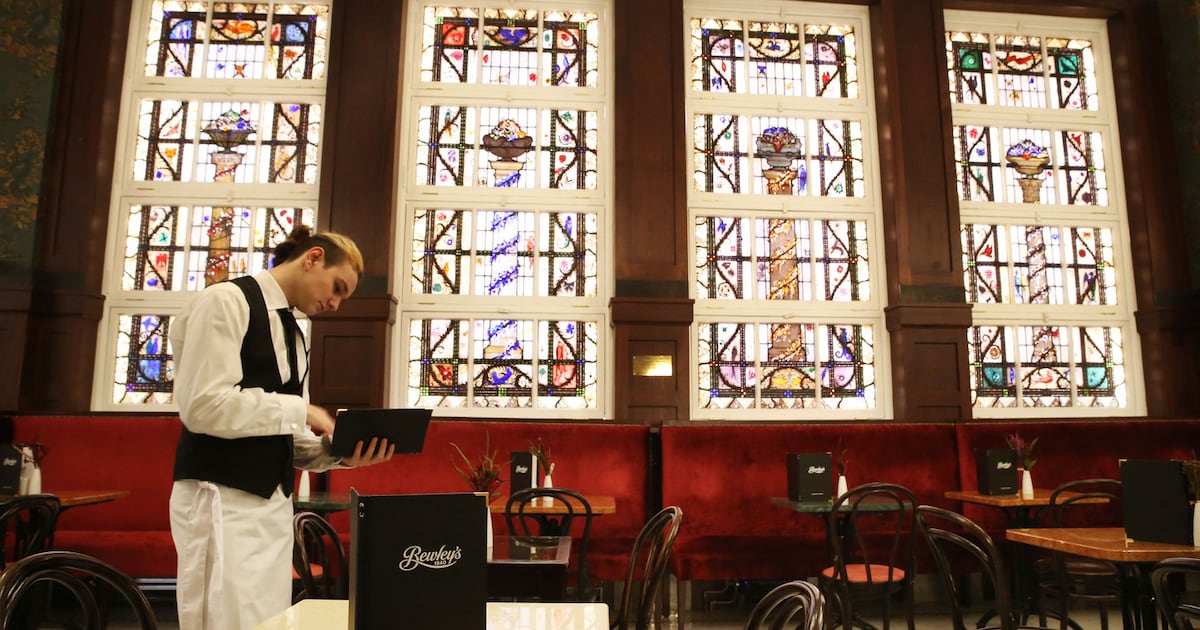
A plaque commemorating the birthplace of Irish stained-glass artist and illustrator Harry Clarke, the “genius of light and colour”, has been unveiled in Dublin’s north inner city.
Clarke, whose works include the stained-glass windows of Bewley’s Café on Grafton Street, was described on Saturday as an “extraordinarily original and talented artist”.
Born at 33 North Frederick Street on St Patrick’s Day, 1889, his art spans more than 130 stained glass windows across Ireland and internationally.
Among his other well-known pieces are the windows of the Honan Chapel at University College Cork and the Eve of St Agnes in Dublin’s Hugh Lane Gallery.
Speaking at the event, Lord Mayor of Dublin Ray McAdam described 33 North Frederick Street as “the house where the genius of light and colour first practised his art”.
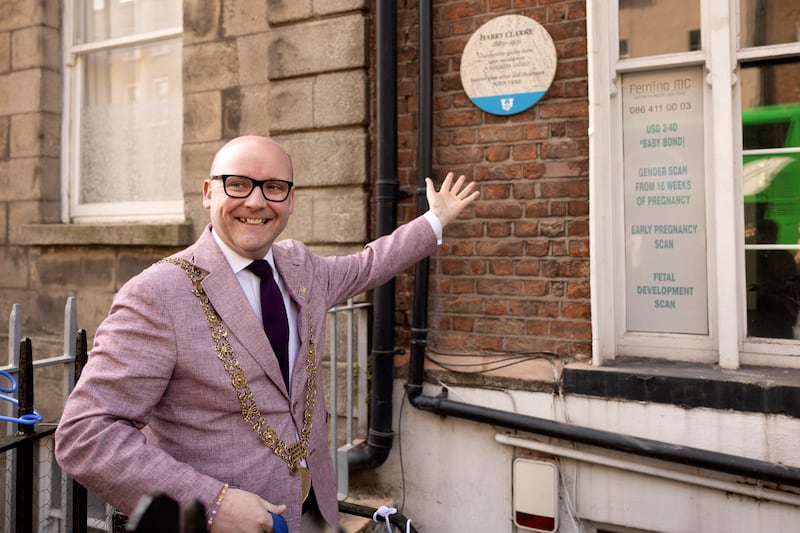 Lord Mayor of Dublin Cllr Ray McAdam unveils the commemorative plaque unveiling marking the birthplace and studio of stain-glass artist Harry Clarke at 33 North Frederick Street, Dublin. Photograph: Chris Maddaloni/The Irish Times
“Harry Clarke’s work represents one of the most remarkable chapters in the history of Irish art, and his legacy continues to illuminate churches, cultural spaces and public imagination across Ireland and beyond,” he said.
Clarke died at the age of 41 in 1931, some two years after being diagnosed with tuberculosis.
“Despite his life being cut short”, the Fine Gael councillor said Clarke’s artistic legacy “endures as a cornerstone of Irish cultural identity”.
“Today’s unveiling ensures that his contribution will be remembered and celebrated in the very place where his remarkable journey began,” he said.
An unveiling of the plaque on Saturday at the property, which is occupied by a dental practice, was attended by some of Clarke’s family members, including his granddaughter, Sunniva Sheridan.
“We grew up not actually knowing the person, because he died when daddy was young. We knew him through his work,” she said, recalling “always visiting churches” to see his pieces.
The 78-year-old, who lives in Co Wicklow, described a “sense of pride” of both her grandfather and grandmother, Margaret Clarke, “who herself was a wonderful artist”.
Barbara Dawson, director of the Hugh Lane Gallery, which hosts the Eve of St Agnes, described Clarke as an “extraordinarily original and talented artist”.
“He really revived, in a very original and imaginative way, certain tropes of Celtic art and tracery,” she said, adding: “He had both the technique and the imagination.”
She noted a “certain eroticism in his work that was a joy of the natural world, a joy of the human figure, a joy of love”.
“What he did was marvellous. He was international, but also drew heavily on Irish landscape.”
Dawson said the commemoration is “hugely fitting”.
The plaque marking Clarke’s birthplace was erected following a proposal to Dublin City Council’s commemorations and naming committee.
The committee’s chair, Green Party councillor Donna Cooney, said the scheme commemorates those who have made a “significant contribution to the life of Dublin”.