
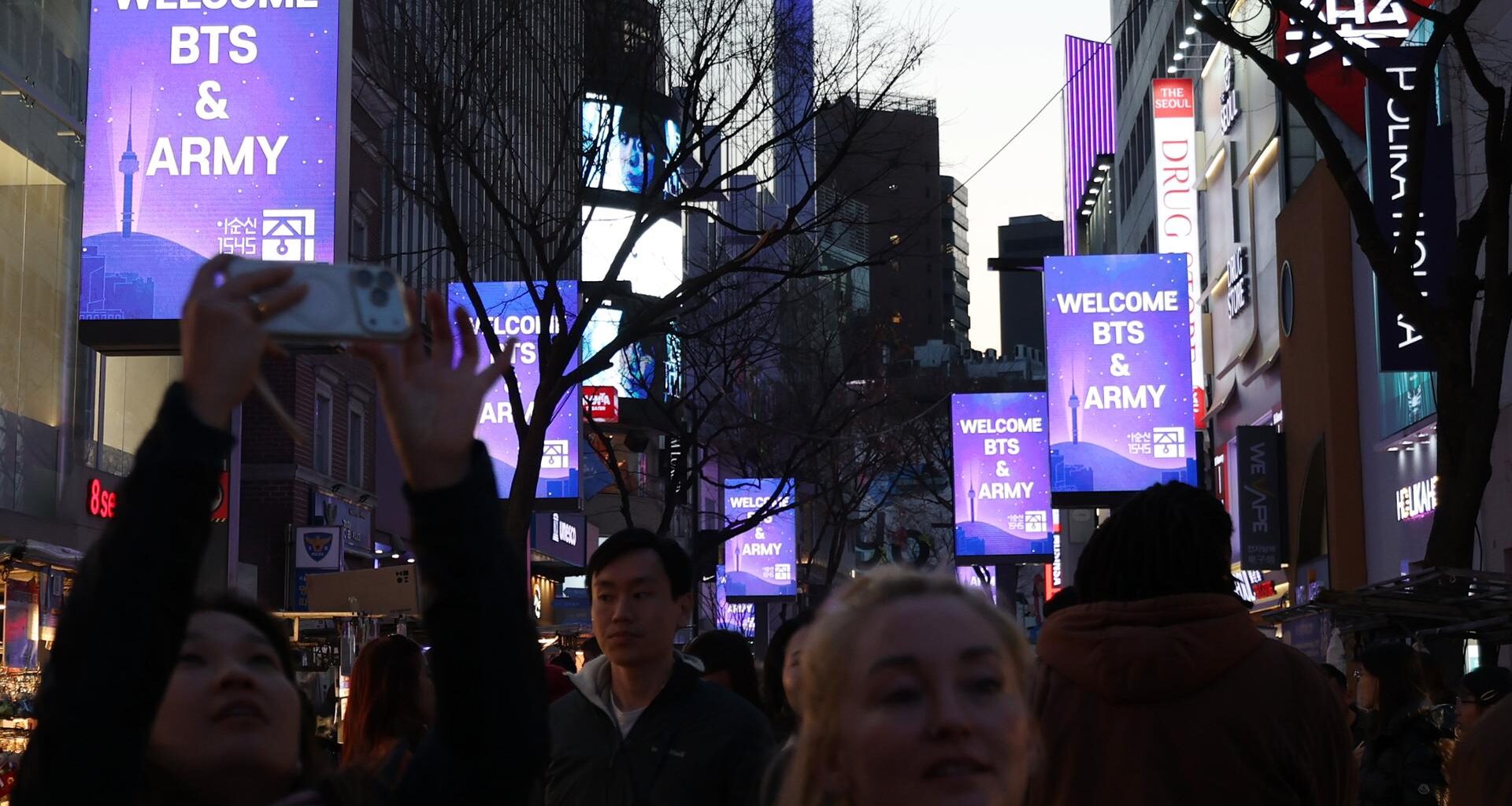
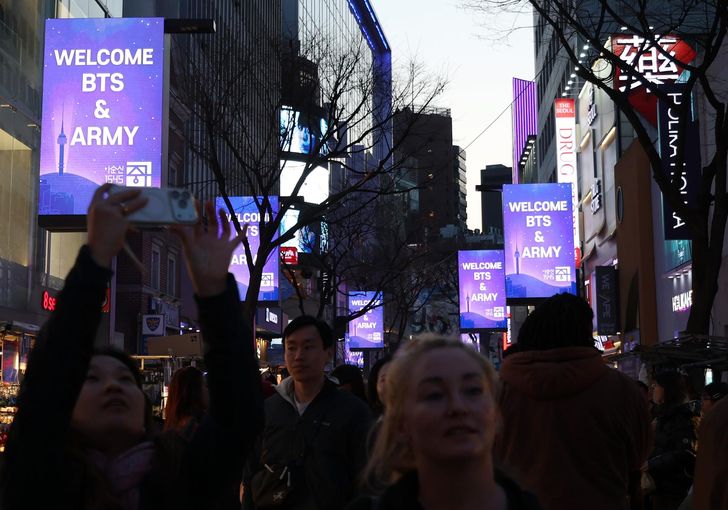
Ahead of BTS’ Gwanghwamun performance, messages welcoming BTS fans are displayed on media poles in Myeong-dong, central Seoul, Thursday. Yonhap
When Hu Siyi, a 27-year-old Chinese fan of BTS, secured a ticket at midnight for the group’s concert at Gwanghwamun Square, she said she could hardly contain her excitement.
“I came to Korea and restarted my undergraduate studies because of them,” Hu said. “I’m so happy that I feel like I might explode just thinking about their comeback.”
Drawn in by the group’s music, Hu has been a fan for more than eight years. She said she was particularly drawn to the positive messages in their songs, as well as the members’ talent and involvement in songwriting and choreography.
However, the group has had limited exposure in mainland China since Beijing’s unofficial restrictions on “hallyu,” or the Korean wave, following the 2017 deployment of the Terminal High Altitude Area Defense (THAAD) system.
Hu moved to Korea in May 2025, hoping to attend concerts and other in-person events after all the members completed their military service last year.
“If they can’t come to where I live, I’ll just come to them.”
Hu is among millions of Chinese fans who have remained devoted to BTS despite the group’s limited presence in mainland China, where political tensions have constrained K-pop’s reach for years.
Big market is missing piece in BTS’ global expansion
BTS was once active in China, appearing in televised galas and holding concerts, even collaborating with famous Chinese lyricist Vincent Fang on a Chinese version of “Boy In Luv” in 2015.
But after tensions flared over the deployment of THAAD in 2017, the group disappeared from television shows, commercials and local concert halls.
“First, there is the issue of political instability. As seen from the THAAD controversy, cultural exchange with China can shift in unexpected ways due to political factors,” said Lee Gyu-tag, a professor at George Mason University-Korea and director of its Center for Korean Culture and Society.
“Scheduled concerts may be canceled, or new regulatory restrictions on activities may suddenly be introduced.”
Such instability creates “significant risks” for K-pop agencies, Lee said, adding that overreliance on China and Japan — traditionally key overseas markets for K-pop — can amplify losses when disruptions occur, prompting companies to diversify in recent years to minimize unforseen risks.
Despite China’s vast population and consumer base, BTS has not been able to prioritize it as a market, even as the group has expanded globally. In its recently announced world tour, BTS is only scheduled to perform in Hong Kong in March 2027, with no mainland China stops on the list.
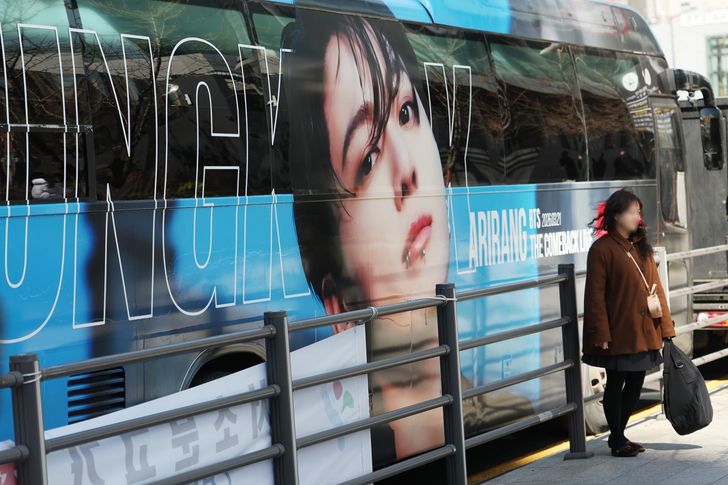
Ahead of BTS’ Gwanghwamun performance, a fan poses in front of a bus decorated with the image of member Jung Kook, near the HYBE building in Yongsan District, Seoul. Yonhap
Resilient fans
The group’s limited presence has done little to dampen the enthusiasm of Chinese fans.
As of March, BTS’ official account on social media platform Weibo had 5.64 million followers, significantly higher than the 1 million to 3 million typical for most K-pop groups. Very few K-pop acts rival BTS on the platform.
“Chinese ARMY, or C-ARMY, are prominent voices in the world of K-pop,” said Grace Kao, a sociology professor at Yale University.
“When you see large-scale displays of support for BTS, including those in Korea, the organizers are often identified by monikers that identify themselves as Chinese fans,” she added.
The group’s large Chinese fan base also demonstrates strong spending power.
BTS member Jung Kook’s Chinese fan club said it had secured a large screen at Koreana Hotel near Gwanghwamun to broadcast videos of the singer for several hours a day between March 20 and 22, to celebrate the comeback. It also booked all digital billboards at Gwanghwamun Station for a two-week campaign.
Chinese fan clubs for other members have also announced similar plans to broadcast videos of their idols on screens in central Seoul to mark the comeback. The total cost has not been disclosed, but industry estimates cited by local media suggest that a single campaign involving such massive screens could cost as much as 45 million won ($30,200).
In China, fan clubs typically fund these activities through sales of self-produced merchandise and fan donations.
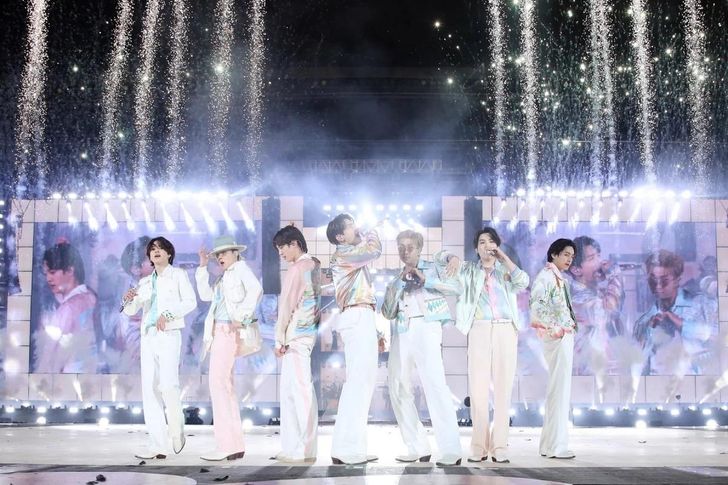
K-pop boy group BTS / Courtesy of BigHit Music
“Although BTS has not been able to actively promote in China, Chinese fans understand that this is not because the group does not value or appreciate them, but rather due to China’s unofficial hallyu ban, which makes it difficult for BTS to visit even if they wish to,” Lee said.
He added that as engagement channels diversify nowadays — including online platforms, fan communities and livestreaming for concerts and fan meetings — fans are able to sustain their support despite geographical limitations.
Liu Xiaoyun, who became a fan of BTS in 2021 — a year before the group announced its hiatus — said she has mostly followed the group through online content.
“I was drawn to the energy they have as a group, so for a long time I could only watch their past performances as there hasn’t been much content with all the members together in recent years,” the high school student said.
“I also tried getting into other groups, but in the end I realized they’re just not as appealing as BTS,” she added. “Now I don’t have to just watch old videos anymore — I’m really excited they’re coming back.”
Alice Li is a reporter with the South China Morning Post. She is currently based in Seoul, writing for both The Korea Times and the South China Morning Post under an exchange program.