
It’s a spring evening with light lingering in the sky when men spill out of the city centre mosque after their Friday prayers. Office workers are milling around the area’s pubs for a quick one before getting the train home. All around, people are chatting in different languages; Romanian, Somali, Arabic, Hindi and Portuguese. And there’s a delicious waft of spiced kebabs in the air.
This is a happy multicultural scene that could be playing out in almost any city in the world but has only relatively recently become commonplace in Dublin, most notably on Talbot Street, right in the heart of Dublin’s north inner city.
Bookended by Connolly Station on one side and Marlborough Street on the other, with the Spire just beyond, the street is an everyday city centre thoroughfare for thousands of pedestrians and bus passengers. Named in 1821 after Charles Chetwynd-Talbot, a man who received compensation from the 1837 Slave Compensation Act for plantations in Jamaica and opposed Catholic emancipation, the street is wholly different from the imperialist vision of the lord lieutenant of Ireland.
These days, it’s an energy-filled artery of diverse cultures where, in the space of a couple of metres, Dubliners and visitors can eat around the world; Somali stew, Caucasian dumplings, Korean rice bowls, Brazilian croquettes and traditional Irish bangers and mash.
“Somali food, has a lot of different influences,” says Abudullahi Ali, the chef and owner of Marka Cadey, a Somali restaurant on Talbot Street.
“Our food has African, Arabic and European influences. Somalia was a colony of three different European countries – Britain, who colonised the north of Somalia, Italians who colonised the south, and the French who colonised a small part of Somalia called Djibouti [now the independent Republic of Djibouti].”
Somali-style biryani, stir-fried diced beef suqaar, spiced sugary Somali chai with cardamom, sambusa with mince beef and spices, Somali crêpe cooked with ghee butter known as malawax and ground maize meal with fish are just some of the dishes customers can enjoy at Ali’s restaurant.
Located close to Faizan E Madinah, the mosque on Talbot Street, Marka Cadey’s menu is halal and its custom largely Muslim. Ali explains that this means it has just emerged from one of its most challenging times of the year: the Muslim festival of Ramadan, which involves a month of fasting.
“We don’t let go of staff just because it’s four weeks. We try to amalgamate it into the bigger picture. But it’s hard – 50 per cent is a big reduction,” he says.
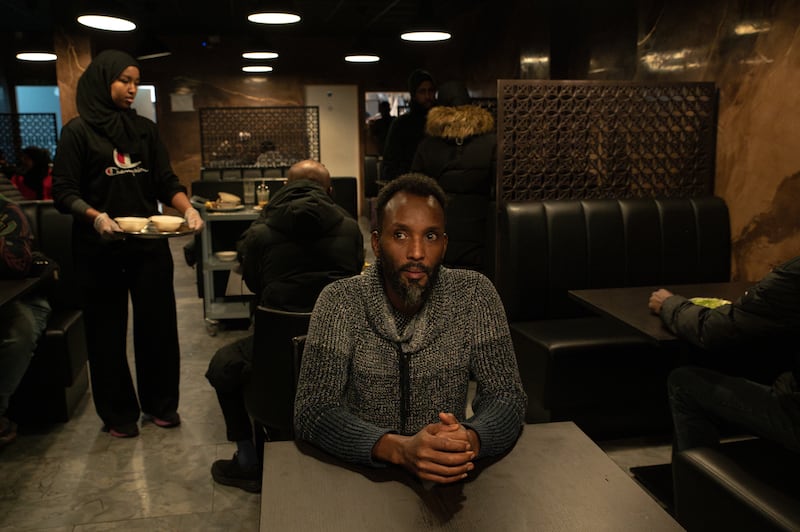 Abudullahi Ali, the owner, pictured at Marka Cadey Halal Food on Talbot Street in Dublin, with staff and a customer in the background. All photos: Natalia Campos for The Irish Times
 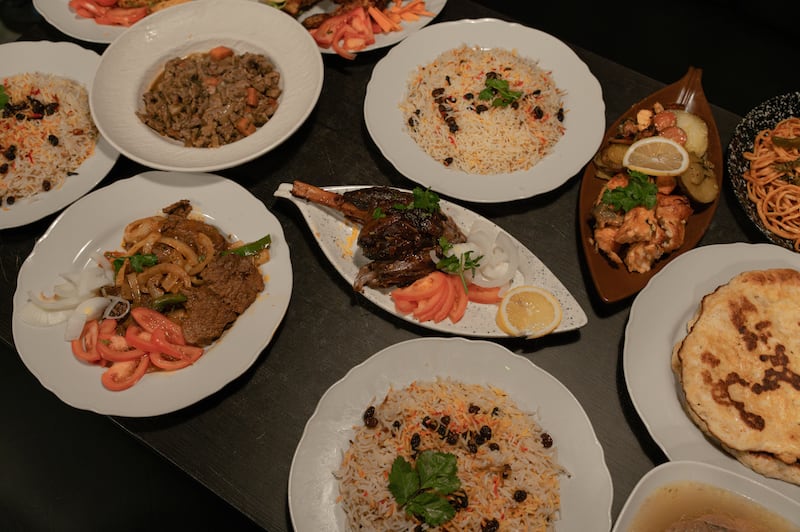 Dishes from Marka Cadey on Talbot Street in Dublin.
“This small place has nine full-time staff,” he adds, gesturing around the restaurant, which has been open since August of last year.
Ali, who also owns a branch of Marka Cadey on North Frederick Street and has plans to set up a Dublin 8 location, takes pride in his business success but notes that it hasn’t always been easy.
[ Five places in Dublin city centre where you can get a €5 lunch. ReallyOpens in new window ]
“I’m very proud of my achievement,” he says. “I am happy because I am working for my people. It’s both a restaurant and a space for the community. It’s not easy. It’s challenging. This is my first foray into business in Ireland.”
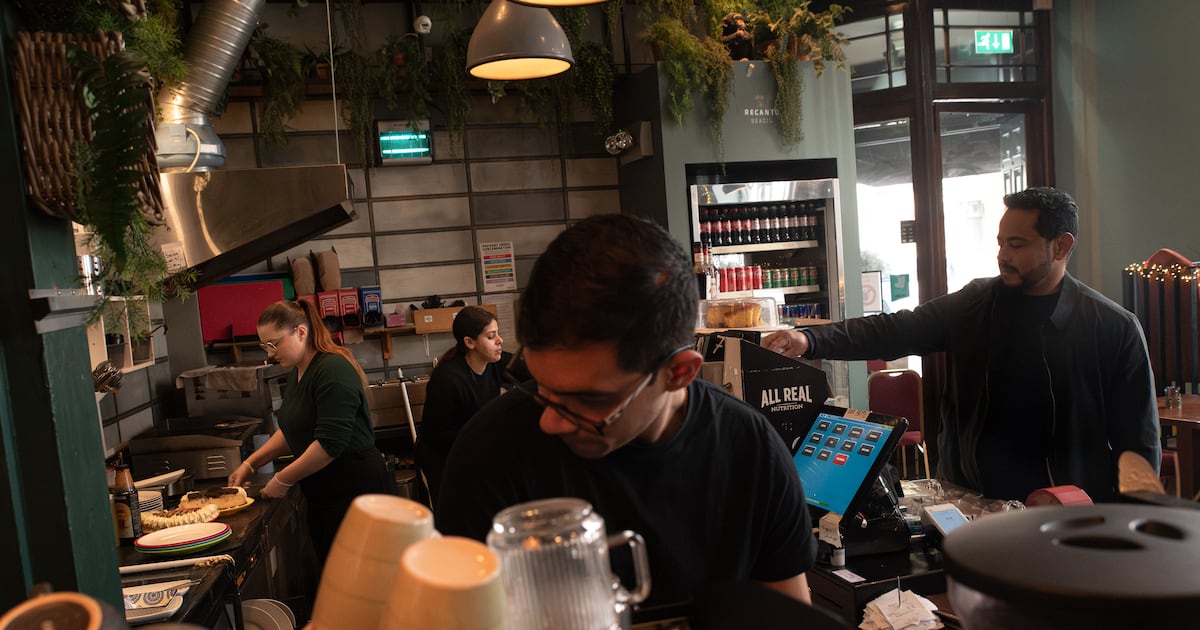
A few doors away, Miglioli França Reis of Recanto Brazil is another first-time business owner.
França Reis opened his Brazilian coffee shop in a kiosk on the street in 2019 before adding his spacious cafe across the road at 79 Talbot Street under the same name.
“When I saw that the place across the way closed down during Covid, I zoomed over,” he says.
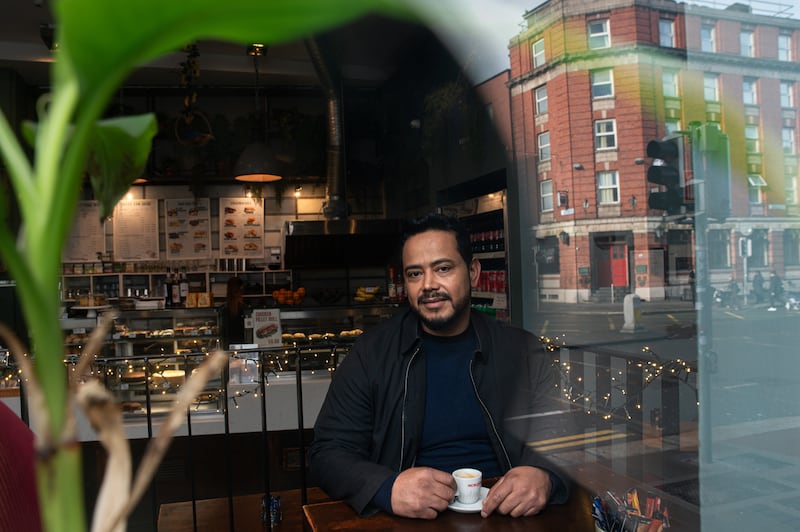 Miglioli França Reis, owner of Recanto Brazil on Talbot Street
“Whoever ran a business during the pandemic suffered because they were still trying to catch up with the bills so I had an opportunity and I opened Recanto in 2023.″
França Reis says Recanto Brazil caters to both Brazilians living in Ireland and Irish customers.
“We do Brazilian food but we also do the full Irish breakfast,” he says, adding that some traditional dishes have become firm favourites with the cafe’s Irish clientele.
“We have a little breadcrumb-coated croquette with potato and chicken inside called coxinha and that’s the one that gets the most surprised reactions, because Irish people are more used to chicken breast or a hot chicken roll. But when they get mashed chicken inside a croquette, they are like ‘What’s this? It’s kind of weird but I like it’.
“The other dish that is a hit is the black bean stew, feijoada. People love it. I have never had any complaints. Sometimes I even say – if you don’t like it I will pay for it. And I have never lost a bet yet.”
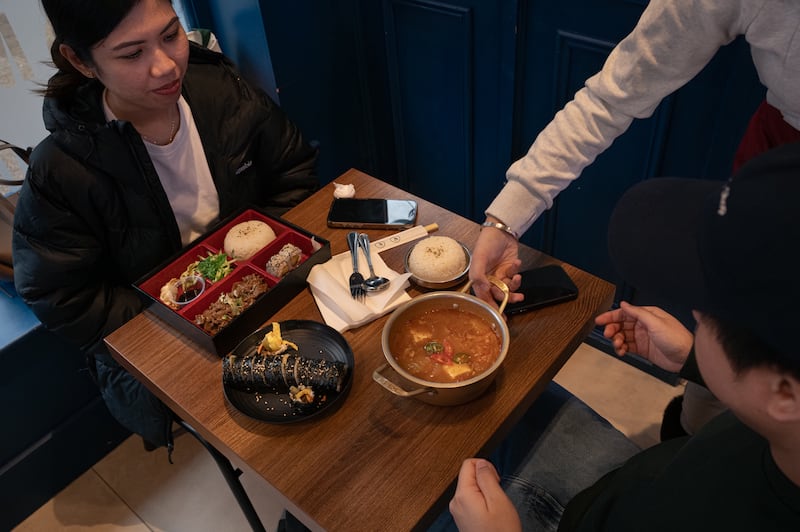 Food being served at Pocha Korean Street Food, pictured at their restaurant on Marlborough Street in Dublin
Closer to the Spire, where Marlborough Street, North Earl Street and Talbot Street intersect, is Pocha, a family-run Korean restaurant.
Cherry Li, who works at her family’s business along with her father Ming, mother Nancy and aunt Echo, says serving a completely traditional menu is tough.
“We think it’s difficult to open a restaurant that’s entirely authentic Korean cuisine so we also offer sushi and spice bags,” the 19-year-old Dún Laoghaire Institute of Art, Design and Technology student says.
“We want to have a menu that is self-explanatory. So if people want to try out Korean food they can try real Korean food, or they can look at the menu and go, ‘Oh I know what that is, I’ll just order it’.”
However, Li believes that the rise of Korean culture, sometimes referred to as the Korean wave, is contributing to greater awareness of the cuisine.
“I think more people know about Korean food now as K-pop and K-dramas are getting more popular,” she says. “There are quite a few college students and teenage customers who have seen Korean corn dogs on TikTok.”
Her favourite dish at the family-run eatery is bacon and cabbage – of sorts. It’s the Korean version, pork kimchi-jjigae: a spicy slightly sour stew prepared with the pickled cabbage.
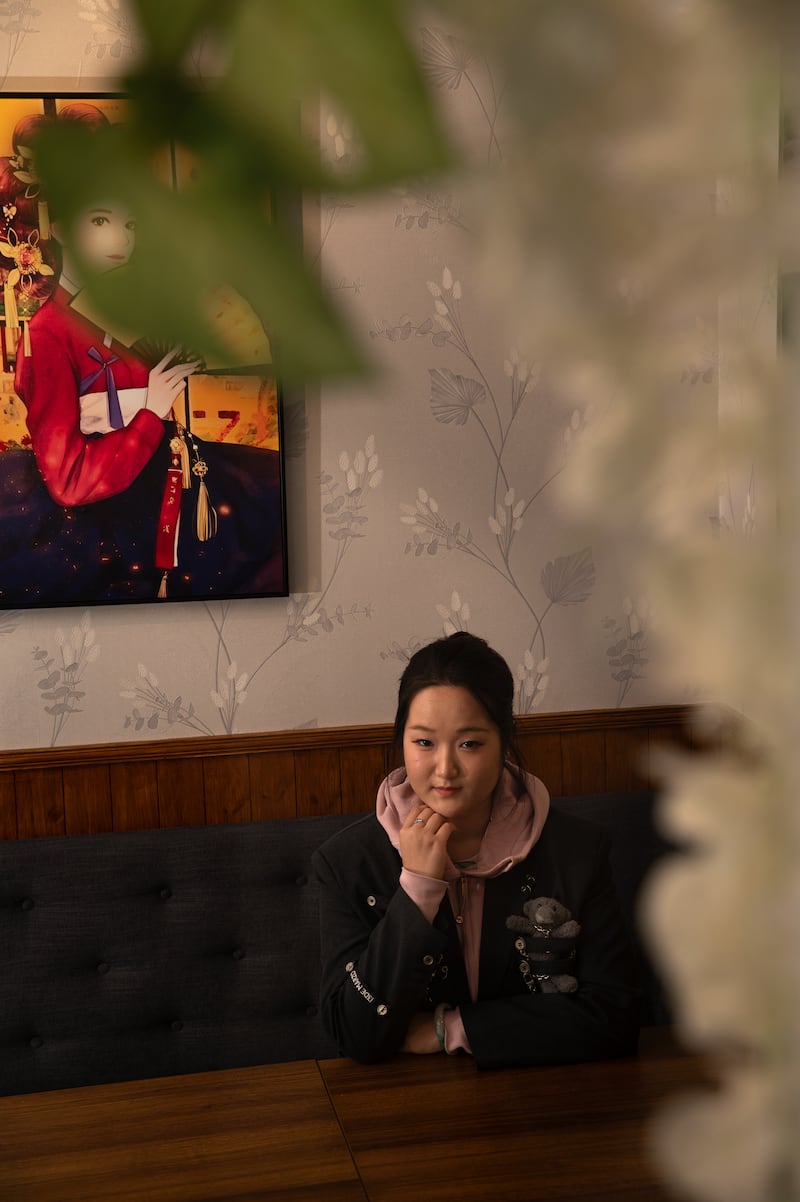 Cherry Li, daughter of the owner of Pocha Korean Street Food
Pocha also offers Bibimbap, a Korean rice dish topped with sautéed or blanched seasoned vegetables known as namul and served with Korean chilli pepper paste gochujang. Bibimbap is often topped with an egg and thinly sliced meats.
“It’s a very homely dish. It’s Korean comfort food,” Li says.
One business owner who chose not to serve familiar favourites to Irish customers is Amirkhan Hasanov, who runs two restaurants; bakery Ella’s Heaven founded in 2021 and kebab shop Jehan’s Heaven set up last summer.
“In Ella’s Heaven, we get a lot of Irish customers,” says Hasanov. “They used to come in looking for scones and croissants but I decided I am not going to sell them – you can get those things anywhere. Now, the Irish customers come in looking for ponchiki.”
[ Lunch with a side of art: Seven Irish galleries with great cafesOpens in new window ]
Ponchiki (deep fried doughnuts from eastern Europe), baklava (a layered nut and filo pastry dessert drenched in syrup), kunefe (a Turkish dessert made with shredded filo pastry, melted cheese, and syrup), are among the bakery’s sweet offerings.
“This is not a fusion kitchen, it’s a cuisine with roots”, says Hasanov, who was born in Tbilisi in Georgia but identifies as Azerbaijani.
Named after his daughter and son, his restaurants serve Caucasian food.
“Caucasian cuisine is a regional cuisine – Azerbaijani, Georgian, Russian, Armenian and parts of Turkey,” he says.
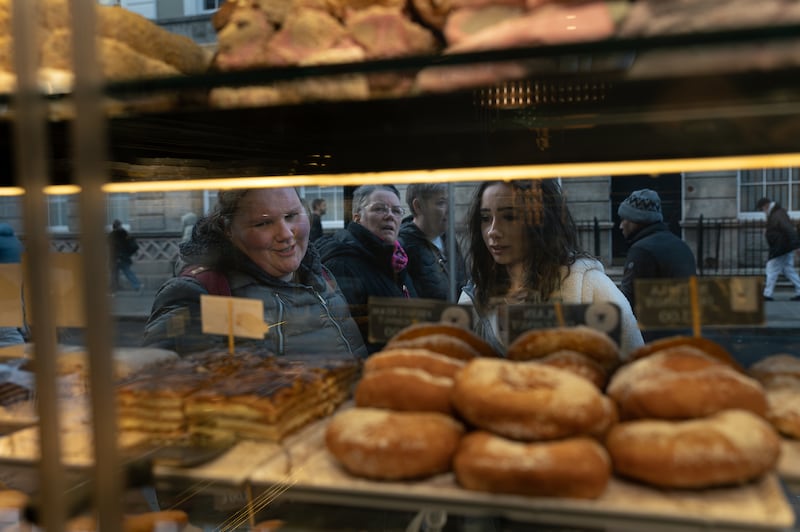 Customers look through the window at Ella’s Heaven on Talbot Street in Dublin
In the savoury sphere, Ella’s Heaven offers khinkhali, which are rich Georgian dumplings stuffed with potato, beef, or lamb.
“I was never a chef before moving to Ireland, but when I was a kid I loved eating khinkhali. My mum used to say to me ‘Amir, this is not healthy, you can’t eat dough all the time’.”
I said to her, “When I grow up, I will open my own restaurant and I will eat dumplings all the time”.
“I grew up, I ate dumplings non-stop and now I don’t eat dumplings any more,” he says, laughing.
“We have also have Khachapuri, a traditional bread, cheese and egg dish.”
Directly across the road, at Jehan’s Heaven, customers can be found guzzling char-cooked meats; adana kebab, Azerbaijani-style lule kebab, lamb shish, and lamb chops, which Hasanov describes as the “star dish”.
“Meat speaks with fire,” he says. “We simply cook it correctly.”
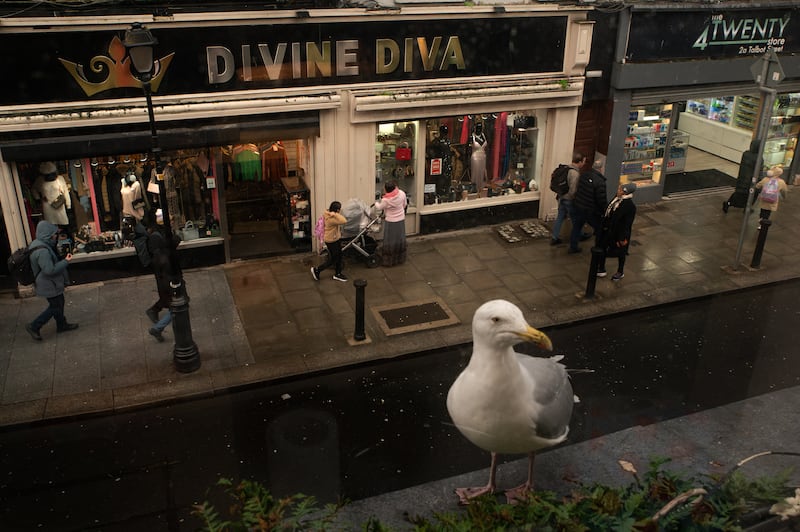 ‘Divine Diva’: A seagull perched near a window on Talbot Street, with people walking in the street
Noel Tynan, a veteran of the area, has been running the popular The Celt bar on Talbot Street for 29 years, and has seen many changes over his tenure.
“It’s becoming a very multicultural street,” says Tynan, adding that his bar is also part of this growing diversity.
“It’s an Irish pub – Irish in essence. We try to give the céad mile fáilte with the good food and all that. We have 14 different nationalities working in the bar. If we didn’t have those people my doors would be closed.
“I can see a lot of parallels with the Irish who went over to America in the recession. I worked in the States in the 1980s. I was the very same, I went out there with no money and I opened a small shop and then I opened something else then I opened this, that, and the other.”
Regardless of the origins of The Celt’s staff, it still strives to offer that traditional Irish food experience.
“The food we serve in The Celt is all basically what your mammy down the country would have cooked for you. Bacon and cabbage, bangers and mash, chicken and mash potatoes and Guinness brown bread that we make ourselves in house.”
Tynan takes time to praise recent improvements to policing on Talbot Street.
“The Garda presence on the street has been absolutely brilliant recently. We can see that the loitering and the crime is way down because of that Garda presence.”
Like others, Tynan is set to expand locally. He plans to open an American country and western-themed bar in the old Guineys premises next door to The Celt.
“Our menu will be southern-style American food; chicken wings and barbecue ribs, opening June 2026. It’s going to be massive,” he says.