
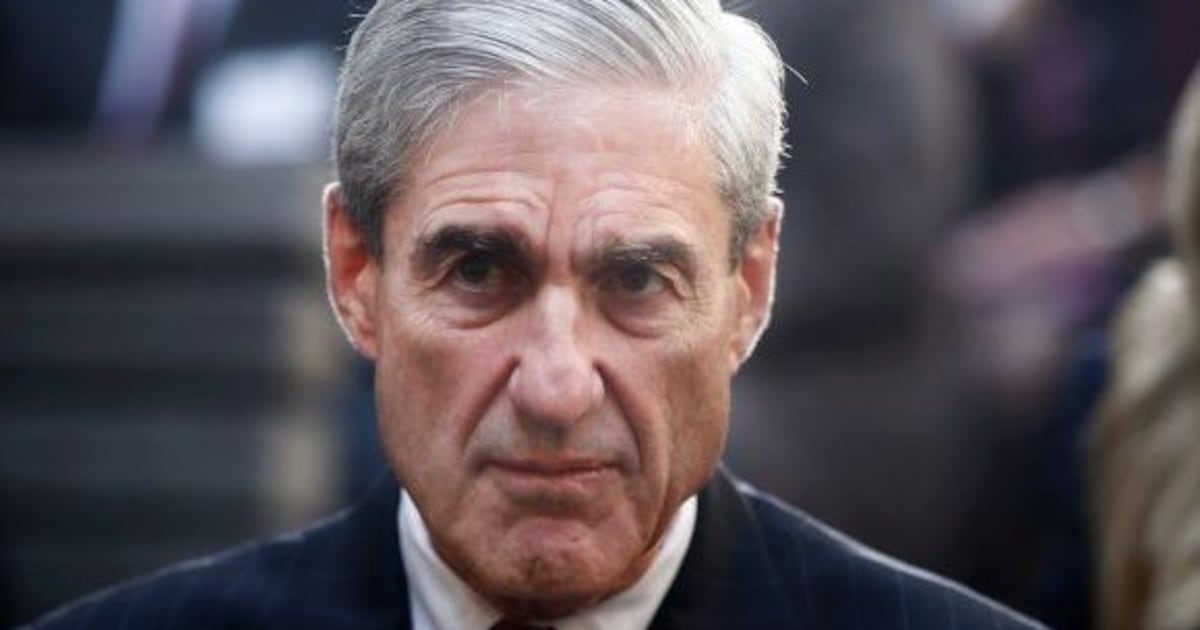
Robert Mueller, the former special counsel who investigated links between Donald Trump and Moscow, has died aged 81.
A statement from Mueller’s family, relayed by the New York Times on X, said: “With deep sadness, we are sharing the news that Bob passed away last night. His family asks that their privacy be respected.”
Mueller was appointed as special counsel in 2017 by then deputy attorney general Rod Rosenstein to oversee the federal investigation into Russian interference in the 2016 US presidential election.
The no-nonsense former FBI chief who documented Russia’s interference in the 2016 US election and its contacts with Donald Trump’s campaign but opted not to bring criminal charges against a sitting president.
No cause of death was given for Mueller, a decorated Vietnam War veteran who led the FBI in the aftermath of the September 11th, 2001 attacks on the US.
The New York Times last year reported that Mueller had Parkinson’s disease.
Mueller retired after 12 years as Federal Bureau of Investigation director in 2013 but was summoned back to public service by a senior justice department official four years later as a special counsel to take over an inquiry into Russia’s election meddling after Trump fired then-FBI chief James Comey.
Mueller conducted a 22-month investigation that produced indictments against 34 people, including several Trump associates as well as Russian intelligence officers and three Russian companies, and a series of guilty pleas and convictions. Mueller ultimately stopped short of a criminal indictment of the Republican president, bitterly disappointing many Democrats.
Trump on Saturday celebrated Mueller’s passing. “Good, I’m glad he’s dead,” Trump wrote on the Truth Social site. “He can no longer hurt innocent people!”
During his career as a prosecutor and FBI chief, Mueller displayed a patrician manner and sometimes wooden personality – just about the opposite of the bombastic Trump. He was known by some as “Bobby Three Sticks” because of his full name – Robert Mueller III – a moniker that belied his formal bearing and sober approach to law enforcement.
His Russia inquiry, detailed in a 448-page 2019 report, laid bare what Mueller and US intelligence agencies have described as a Russian campaign of hacking and propaganda to sow discord in the US, denigrate 2016 Democratic presidential candidate Hillary Clinton and boost Trump, the Kremlin’s preferred candidate. Russia denied election interference.
“First, our investigation found that the Russian Government interfered in our election in sweeping and systematic fashion,” Mueller said during 2019 congressional testimony.
“Second, the investigation did not establish that members of the Trump campaign conspired with the Russian Government in its election interference activities. We did not address ‘collusion,’ which is not a legal term. Rather, we focused on whether the evidence was sufficient to charge any member of the campaign with taking part in a criminal conspiracy. It was not,” Mueller added.
In analysing whether Trump had committed the crime of obstruction of justice, Mueller looked at a series of actions. These included Trump’s attempts to have the special counsel fired and to limit the scope of the investigation as well as the president’s efforts to prevent the public from knowing about a 2016 meeting at Trump Tower in New York between senior Trump campaign officials and Russians. Mueller pointedly did not exonerate the president, as Trump claimed.
“Based on Justice Department policy and principles of fairness, we decided we would not make a determination as to whether the president committed a crime,” Mueller told lawmakers.
“The president was not exculpated for the acts that he allegedly committed,” Mueller added.
Mueller was named by the justice department’s number two official, Rod Rosenstein, to take over the Russia investigation.
The investigation, according to the report, unearthed “numerous links” between the Russian Government and Trump’s campaign and said the president’s team “expected it would benefit electorally from information stolen and released through Russian efforts,” referring to hacked Democratic emails.
Mueller, a long-time Republican, faced unremitting attacks by Trump and his allies on his integrity as they tried to discredit the investigation and the special counsel himself. Trump used social media, speeches and comments to news media to assail Mueller, accusing him of running a politically motivated, “rigged witch hunt,” going “rogue,” surrounding himself with “thugs” and having conflicts of interest.
“It’s all a big hoax,” Trump said in 2019.
“Absolutely, it was not a hoax,” Mueller told the congressional hearing, noting the numerous charges arising from the probe.
The Democratic-led House of Representatives at the time twice impeached Trump after Mueller had finished his work, though those actions did not grow out of the special counsel’s findings.
Appointed by Republican president George W. Bush to head the FBI, Mueller took over as its director one week before the September 11th attacks on the US by al Qaeda militants using hijacked planes that killed about 3,000 people. Democratic president Barack Obama later extended Mueller’s appointment. By the time Mueller left the position, his tenure was exceeded only by J Edgar Hoover’s 48-year stint.
Mueller was credited with transforming the premier US law enforcement agency after Congress and an independent Government commission determined that the FBI and CIA had failed to share information before the September 11th attacks that could have helped prevent them.
Born into an affluent New York family, Mueller grew up outside of Philadelphia, graduated from Princeton University, earned a master’s degree at New York University and joined the US Marine Corps, serving as an officer for three years, leading a rifle platoon in Vietnam and receiving honours including the Bronze Star and Purple Heart.
Mueller then earned a law degree from the University of Virginia and later became a federal prosecutor and headed the Justice Department’s criminal division, supervising cases including prosecution of the crime boss John J Gotti and the probe into the bombing of Pan Am Flight 103 over Scotland, before Bush chose him to lead the FBI.
“He really hates the bad guys,” former Massachusetts Governor William Weld, who preceded Mueller as the US attorney in Boston, told the New York Times in 2013.
Mueller and his wife, Ann, had two daughters. – Reuters and The Guardian