
In this op-ed, writer Jiye Kim explores the question some fans are asking—is the BTS album Arirang Korean enough?—and how we think about cultural identity.
Last month, a friend of mine asked how I’d celebrated Seollal. There was an underlying assumption that I would have gone about the Lunar New Year in the traditional way: eating tteokguk (rice cake soup), playing the traditional board game yutnori, and dressing in hanbok to do sebae to my elders. I had, in fact, lain listlessly on the couch through a heat wave, contemplating whether to finally finish Stranger Things. Did this make me a bad Korean—or less of one? Would this lack of practice diminish my cultural roots to the point I had nothing to pass down to the third generation?
Such questions returned while listening to BTS’s latest album released on March 20th. It was a long-awaited comeback, having closed their first decade with the anthology album Proof three years and nine months ago before sliding into a hiatus to enlist in mandatory military service and enjoy solo activities. (So, an eternity, in fandom years.)
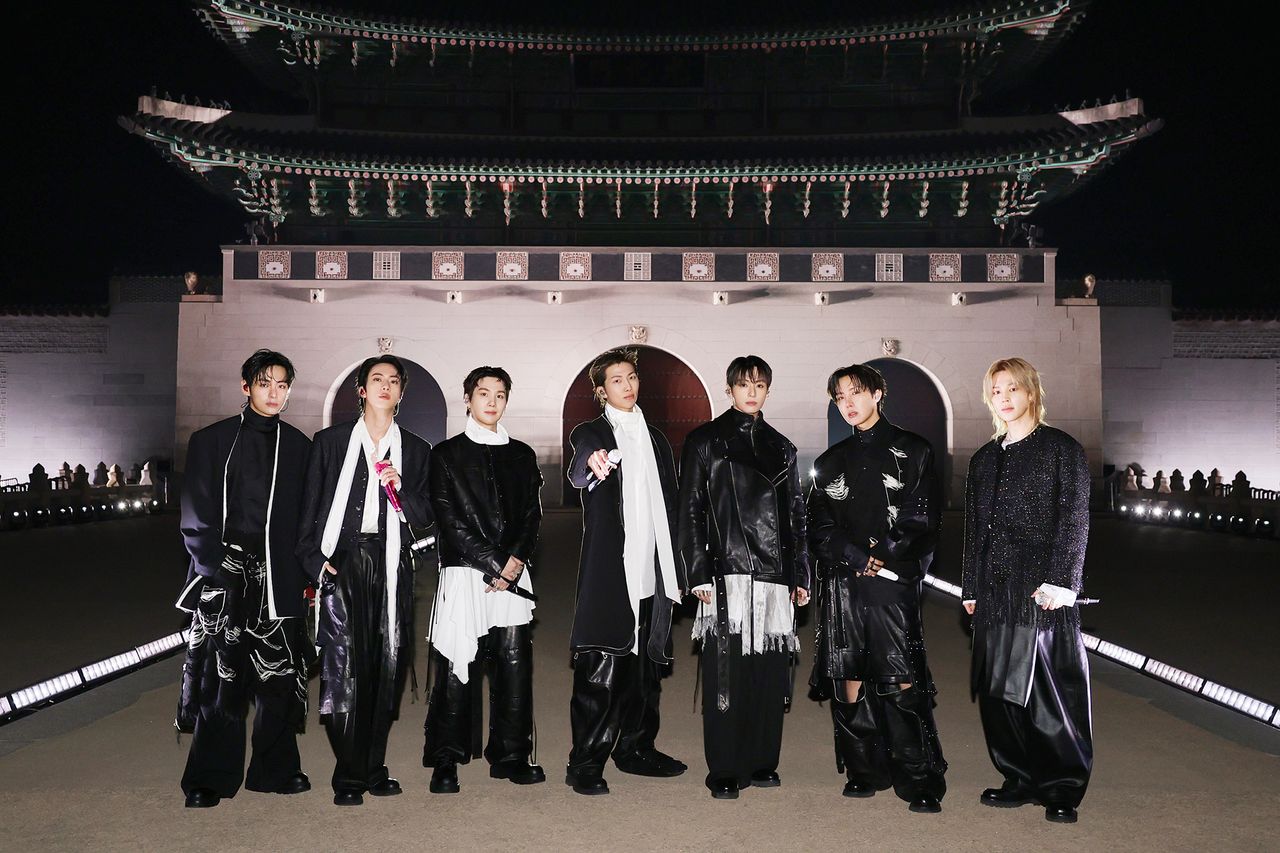
The album’s title, Arirang, harkens back to Korea’s most beloved folk song, with its thousands of lyrical, melodic, and contextual variations representing both the “han” (sorrow, yearning, and unresolved pain) and “heung” (spontaneous exuberance) of its people. In a monumental embellishment of the traditional theme, the septet performed their comeback stage in front of 104,000 fans on the “King’s Road” connecting Gyeongbokgung, the premier palace of the Joseon Dynasty, to its main gate Gwanghwamun, cementing their place as Korea’s pride.
And yet, Arirang contains more English than Korean. The greater number of its star producers and songwriters are international, with BTS and their in-house producer Pdogg joined by names such as Diplo, from the United States; El Guincho, from the Canary Islands; and Kevin Parker (Tame Impala) from Australia. Traditional Korean music samples are incorporated into a wild medley of genres that have emerged from elsewhere throughout the fourteen tracks: hip-hop, funk, pop-rock, R&B, and EDM. The music video for the title track, “Swim,” has its protagonist in Lilli Reinhart, an American actress of European descent. Their comeback stage was directed by the British Hamish Hamilton of Superbowl and Olympic fame, and streamed on Netflix, rather than a local streaming site.
So what does it mean for an album to be titled in such a fashion and for the first performance to hold court over the jewel of the capital city, but—dare I say it, only hold a minority of specifically Korean elements?
.jpg)
(L to R) SUGA, JUNG KOOK, JHOPE, V, JIMIN, JIN, RM at BTS The Comeback Live | Arirang at Gwanghwamun Square on March 21st in Seoul, Korea / BIGHIT MUSIC AND NETFLIX © 2026BIGHIT MUSIC AND NETFLIX