
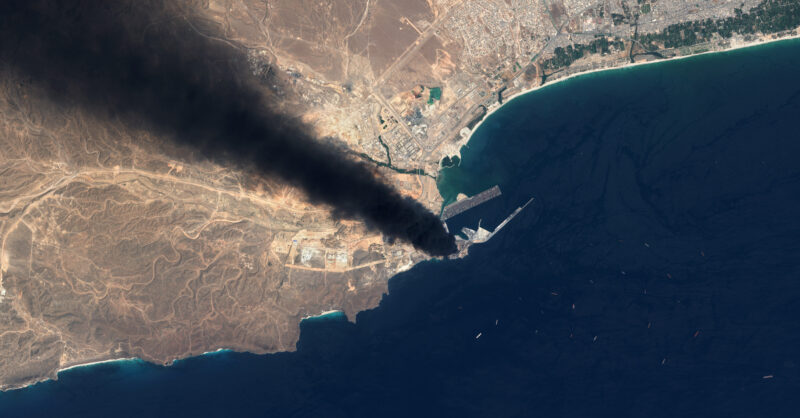
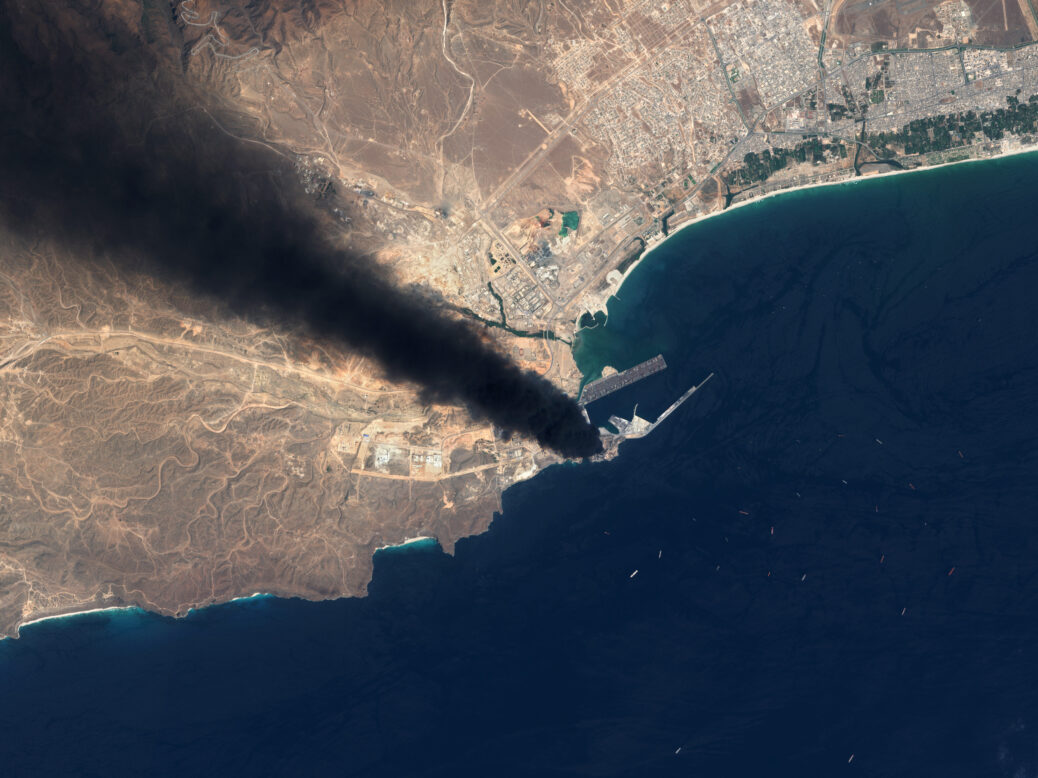
Satellite image of a fire at the Port of Salalah in Oman after a reported drone strike, sending a plume of smoke over a key Gulf shipping hub. Photo by Gallo Images/Orbital Horizon/Copernicus Sentinel Data 2026
Iran’s effective closure of the Strait of Hormuz, the artery through which nearly one-fifth of the global oil supply travels, has already sent energy prices soaring and left nations scrambling. But on 19 March the Middle East’s crisis situation turned potentially catastrophic when Israel struck Iran’s South Pars gas field and Iran retaliated with strikes on Qatar’s Ras Laffan, the world’s largest liquefied natural gas export plant. As a result, energy prices raced even higher, while analysts warned that the damage could take months or even years to repair.
To get a sense of where this crisis is heading, the New Statesman spoke to the energy economist Nick Butler, a former BP executive and former advisor to Gordon Brown, and the founding chair of the Policy Institute at King’s College London.
Megan Gibson: In terms of the global energy industry, are we in a worst-case scenario right now?
Nick Butler: Not yet. I think it will become a worst-case scenario if the war continues for several more weeks. If oil and gas doesn’t come out through the Strait of Hormuz and if a lot of facilities around the Gulf are damaged, I think then you are getting into a really difficult situation.

Subscribe to the New Statesman today and save 75%
Up until a few days ago, everyone’s focused on the Strait of Hormuz. Now we are seeing major hits on oil infrastructure and the production sites with the strikes on Iran’s South Pars gas field and Qatar’s Ras Laffan facility. What does that mean in terms of the global market and our ability to recover?
Well, we don’t know how serious the damage is in each case yet. The pictures [of Ras Laffan] look pretty bad. I think the Qataris have said for one of their facilities, it will take many months to restore. Some of the attacksreduce the potential for the production of refined products, so that compounds the problem caused by the closure of Hormuz.
As Qatar is one of the main hubs for LNG, how does that disruption translate?
Well, LNG – liquified natural gas – is half of the total traded gas around the world. If this [hub] is totally out of of actionthen this affects the whole global market, the price of the LNG that we and others import from anywhere will go up. There will be a physical shortage of supplies if the damage is as bad as it seems to be and if the strait remains closed. So we have to adjust to that. It’s very hard to put specific numbers on it but it would take a good long period, even after any ceasefire, before we get back to the status quo ante. So we are now looking at a real prospect of increased prices for gas and electricity in the UK.
If Ras Laffan is very badly damaged and getting LNG from Qatar is going to be really difficult to get for the foreseeable, how easy is it for other production sites to ramp up production?
Well, I think the US will do some ramping up, but then in the US there is a political issue as to whether US consumers, who will also be looking at an increase in prices, want to see exports [being prioritised] ahead of their needs. I think there will be some substitution away from gas in some places around the world: I think the Chinese, for instance, are likely to go back to using more coal rather than paying the very high prices.
There aren’t many countries that can increase their production very quickly. I was talking to the Norwegians and they say that they have very limited excess capacity. I think the one country that could increase production, if it was allowed to, is Russia. But that would involve breaking sanctions. And I don’t think anybody is keen to do that.
We’ve seen in recent days that the US is talking about lifting sanctions on Russia and, ironically, Iran. Is that a signal of how dire the situation is?
Yes, I think it’s a signal that everybody around the world is conscious of the cost of living, the risk of inflation, the risk of these shortages leading to higher prices and leading to an economic downturn. So there will be pressure, I think, from some people to allow more trade from Russia. I think that that would be very bad for Ukraine. It would be very good for Mr. Putin, who’s doing pretty well out of this crisisalready because of the increased prices for the oil gas that they are managing to export. So there are no easy options in this and I think it’s now beginning to look like a crisis that will go on for some time. I hope the government in the UK is properly prepared for that.
In terms of timelines, when do you estimate that the world will start to deplete the available stockpiles and inventories they have on hand?
Well, they pulled down some of the reserve stocks two or three weeks ago. That had very little impact. They could reduce them by more, but the problem is that you can only release reserves once. The time scale is very hard to be precise about but people have, I think, been too complacent about the length of this conflict. I suspect Mr. Trump at the beginning thought it would be over within a week at most. He thought that he could decapitate the regime and suddenly the Iranian people would rise up. That has not happened. The Iranian [regime] has shown themselves to be pretty resilient in the face of these attacks, and also to have adopted a strategy of raising the cost of the war to the international community. They’re still attacking facilities. It could go on some time. It will get more serious when we’ve had two weeks without supplies coming through Hormuz.
Is it correct that the UK essentially has no supply buffer?
That’s right. In contrast to the European economies, Germany and France have, I think respectively, about 90 and over a hundred days of supply of gas in storage. We have about two weeks and that storage is not always full. And there have been stories in the last few days that the storage in the UK is down to a very small number of days. I’ve always thought that was a dangerous and misguided policy. We normally think we can just rely on the open market. I think this crisis is going to prove that that’s not an adequate policy.
So is the UK then uniquely exposed to the crisis?
No, everybody is exposed to the crisis. We import about 60 per cent of our gas. We have a great relationship with Norway, which is the main source of supply, but we will still be affected by any price changes around the world. And there’s going to be fierce competition for any supplies that are available between all the countries that depend on it. So we are not immune – we are not the worst affected, but we’re certainly not safe.
In terms of the worst affected, are we talking about Southeast Asia and African countries?
Certainly the poorest countries. Because this will be about price. There will be supplies available, but there’ll be less than normal and everybody will be competing for them. Some can afford to pay, some will use their political relationships in order to get supplies, and I think that’s certainly true of the Chinese. And then other countries don’t have the resources.
It will also [affect] the poorest in this country. If we just leave it to the open market, you’ll find people who are on fixed incomes, who are already very stretched being asked to pay more for their supplies , that’s when people turn off the heating.
Timing wise, we’re heading into spring and summer, and I suppose heating homes won’t be as big of a consideration now as it would be if it was winter. But in terms of fertiliser and planting crops, now is a critical time.
Yes. A lot of the products that go into fertilisers come from the Gulf, come through Hormuz. There’s going to be a shortage and the whole farming sector internationally depends on energy. It’s a key input to their work. And I can’t see how this doesn’t lead to increases in food prices over the next few months as well. So this is an inflationary problem, it’s feeding through to fertilizer prices already.
Energy is just pervasive throughout our economy. We realised this when we had a tanker driver dispute [and fuel price protests] in the year 2000, which was very minor compared to this. But we suddenly realized that key parts of the economy – health service, schools, transport – all depend on continuous flow of energy. And though we’ve increased renewables to some degree, that dependency [on oil and gas] is still there: 96 per cent of vehicles in this country run on petrol or diesel. And so if the prices go up, that hits people and it hits businesses directly.
The war in Ukraine and the price shock in 2022 is a common comparison at the moment. And you just mentioned 2000. Do you think that we have been missing the lessons and that more should have been invested in renewables?
Well, renewables are helpful, but they won’t solve it. Our renewables only produce electricity and electricity is only 20 per cent of final energy demand. So it’s fine to build renewables, but we shouldn’t think about what makes us totally energy secure.
What about the argument that the UK should be increasing the number of licenses for drilling in the North Sea. Would that help our domestic situation?
It’s not a short term solution, but I certainly think that we should be using our own resources rather than importing. You can’t, in many of these sectors, make a quick shift away from oil and gas. If we don’t produce it in the North Sea where there’s still a fair amount left – though not a huge amount – we have to import it. If we don’t produce our own, we will import more. I cannot see any economic case for not producing what we have ourselves – not least because it creates jobs and produces tax revenue. Otherwise we just pay other countries to import their supplies and there’s no environmental gain at all.
What should the UK government be doing right now?
I think we should be maximising the amount of resources we can produce ourselves. I think we now need – and really need this urgently – a plan from the government on how they would handle this shortage. I think, and this goes back to your point on learning lessons from the past, if there’s a shortage, we have to protect key sectors: food supply, health service, schools, the transport system. And I don’t think we can just let it go to the anarchy of the free market and higher prices. I’d love to see the plan.
And then secondly, I don’t think you can leave ordinary consumers and tell them they have to pay. Some can afford it, but it’s not going to be comfortable.
Then you have to think: are you going to help businesses? Are you going to help poorer people? How do you manage the market with a sense of urgency? I think the danger, and I know the government is aware of this and bothered by it, is panic buying. I think we’ll only avoid that if we have a clear plan that is sold properly to the electorate, which everybody understands and accepts as being fair.
This week has changed the discussion. I think the sense of urgency has grown. I believe it’s beginning to grow in the government here. They did not create the crisis, but I think they were a bit slow to realise how serious it could be. And though none of us want to see the worst case, I think they should be planning against the worst case.
I realise obviously petrol prices have increased in the US – so there’s a political cost there too – but isn’t it true that the American oil and gas industry stands to benefit quite a lot from this crisis?
Yes, that’s right. If you look at the stock market, most stocks have gone down because people see an economic downturn and companies are suffering because they’re are going to have to pay more for their energy.
The only sector that’s really gained is the producers, the oil and gas companies. And that’s true here, it’s true in Europe and it’s certainly true in the US. I’m sure Trump will call it a victory, whatever happens, but I’m not sure the American people see it like that. I think [it will be seen as] another foreign war and the US has lost a number of foreign wars. They don’t look to be winning this yet. Despite a great effort, they seem to have underestimated the Iranians. I think they thought they were a backward country that could just be walked into. But they’re actually a very intelligent and skilful country. You may not like the regime, I think it’s terrible and I hope it falls, but they do seem to know how to resist. And in an asymmetric war, they seem to have found a way to hold up the Americans and now to drag them into a continuing war, which can’t be what Mr. Trump wanted.
What is the most optimistic scenario for this crisis in your mind?
I suppose the most optimistic scenario is that there’s now a regime change in Tehran to a decent government that does not want to destroy the region – which allows shipping to resume, which rebuilds the country and becomes part of the international community. I think that is very optimistic, but I think that’s the best case. The worst case is that it just goes on and on.
Perhaps a better question: what is the most realistic scenario?
It’s very hard to read Iran at the moment. I think it may be the case now that there aren’t the people [in place] there and the leadership who can take the decisions to go in a different direction. And I think what you see around the Gulf with these attacks on other countries may be because there isn’t a proper chain of command anymore. The power to launch strikes is in the hands of the units on the ground. I think that’s very dangerous. The Trump administration failed to properly identify those who were going to take over in Iran and to help them. They wanted regime change – that’s fine, and I agree with that – but if you want it, you have to find both the means to do it and the people who are going to take the lead. I don’t think you can just do it by bombing.
[Further reading: “If the Strait remains closed, we’re not talking about a global recession – we’re talking about a depression”]
Content from our partners