
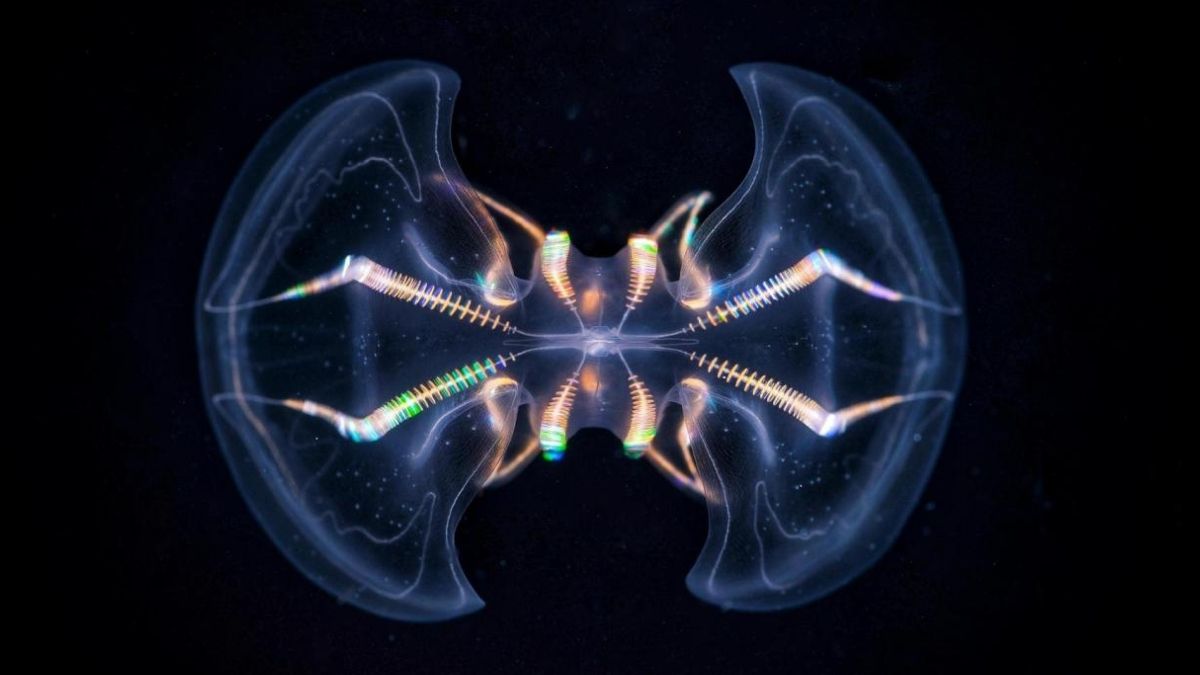
Comb jellies – very simple, gelatinous creatures best-known for their hypnotic underwater light shows – first appeared in Earth’s oceans around 550 million years ago.
For a long time, biologists have kind of considered them the living embodiment of ‘no thoughts, head empty’.
But a new study suggests their central sensory organ is far more complex and brain-like than we realized.
That’s got huge implications for the evolution of animal nervous systems, since comb jellies are also candidates for being the oldest ‘blueprint’ of early animals (sponges being the other main contenders). In other words, of all animals surviving on this planet today, comb jellies seem to be the most closely related to our last common ancestor.
The newly discovered complexity of their nervous systems suggests brain-like structures have been part of animal life for a very, very long time.
“Our study profoundly enhances our understanding of the evolution of behavioral coordination in animals,” says the study’s senior author, Pawel Burkhardt, an evolutionary biologist at the University of Bergen in Norway.
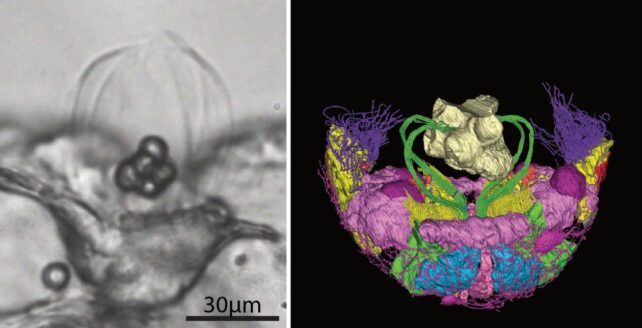 A photograph of a young comb jelly’s aboral organ (left) shows a cup-shaped structure topped with gravity-sensing statoliths. Researchers used volume electron microscopy to build a 3D reconstruction of the organ (right). (Carine Le Goff (left), Pawel Burkhardt (right))
This leap in understanding came from high-resolution scans of the creature’s aboral organ (AO) in unprecedented detail. This sensory structure allows the jelly to orient itself in the ocean’s depths by detecting gravity, changes in pressure, and the direction of light.
These 3D scans were created using an advanced imaging technique called volume electron microscopy, which allows scientists to digitally reconstruct organ structures exactly as they exist in the body – something that traditional dissections never truly accounted for.
The resulting models revealed the comb jellies’ AO is strikingly complex, though quite different from equivalent organs in animals such as cnidarians (which include jellyfish and sea anemones) or even the larvae of animals more closely related to humans, like bristle worms.
The jelly’s nerve net, which transmits signals around the animal’s body, converges in a dense central node that encases the AO. Synapses between the two structures form a clear path for transmitting electrical information.
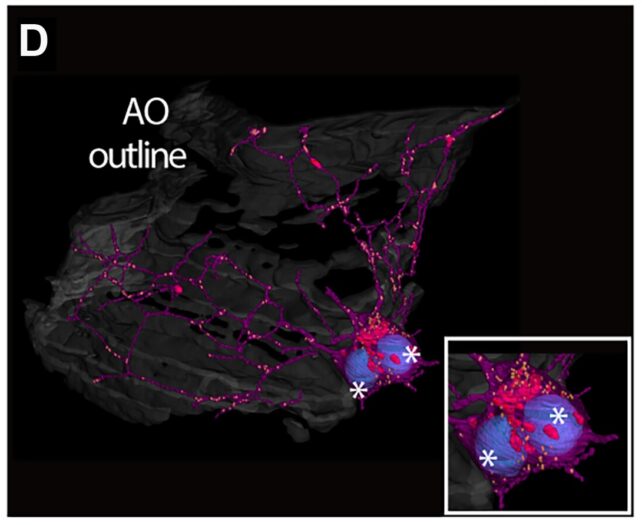 3D reconstruction of nerve net cell bodies containing two nuclei (white asterisks). The neurites extend toward the AO cells; the AO outline is shown in grey. (Ferraioli et al., Sci. Adv., 2026)
The AO itself was made up of about 900 cells in total, with 17 distinct cell types. Eleven of these are totally new to science.
“I was amazed almost immediately by the morphological diversity of the aboral organ cells,” says University of Bergen molecular biologist Anna Ferraioli, the first author of the study.
The next steps for the team, Ferraioli says, will be to probe the molecular identities of the newly discovered cell types and to investigate the extent to which the aboral organ modulates behavior.

The team also noticed many of the non-synaptic cells in the AO were full of vesicles – fluid-filled sacs which pump chemicals in and out of cells. These kinds of cells are probably involved in a broader, slower form of chemical signaling called volume transmission.
Volume transmission is one way chemicals such as dopamine, serotonin, and histamine can work in the brain; rather than using synapses for rapid-fire, targeted communication, these neuromodulators can also wash across cells, affecting their activity.
The genes and molecules that comb jellies use to form this elementary central nervous system are unique, distinct from those seen in cnidarians and bristle worm larvae.
Related: Wild Discovery Reveals That Comb Jellies Can Age in Reverse
“Our findings redefine the ctenophore AO as a distinct, integrated, and potentially multimodal sensory system critical for behavioral regulation,” the researchers report in their published paper.
While the AO is not like our brain, Ferraioli explains that it’s the organ that comb jellies use as a brain.
“In other words”, Burkhardt adds, “evolution seems to have invented centralized nervous systems more than once.”
Together, this suggests that centralized nervous systems may have arisen in animal anatomy much earlier than we thought, albeit in very different formats from our own.
The research was published in Science Advances.