
Your support helps us to tell the story
From reproductive rights to climate change to Big Tech, The Independent is on the ground when the story is developing. Whether it’s investigating the financials of Elon Musk’s pro-Trump PAC or producing our latest documentary, ‘The A Word’, which shines a light on the American women fighting for reproductive rights, we know how important it is to parse out the facts from the messaging.
At such a critical moment in US history, we need reporters on the ground. Your donation allows us to keep sending journalists to speak to both sides of the story.
The Independent is trusted by Americans across the entire political spectrum. And unlike many other quality news outlets, we choose not to lock Americans out of our reporting and analysis with paywalls. We believe quality journalism should be available to everyone, paid for by those who can afford it.
Your support makes all the difference.Read more
The Northern Lights are set to appear yet again on Sunday night after Britain’s skies lit up green and purple on Friday and Saturday.
AuroraWatch UK has issued a red alert, meaning auroras are likely, with skies in Scotland and possibly the far north of England and Northern Ireland expected to enjoy more views.
The natural phenomenon is a rare occurrence in the UK, and requires a severe or extreme geomagnetic storm to bring the aurora belt southwards from Norway, Iceland, and Greenland.
Although the spectacle is more often seen near the Arctic Circle and northern Scotland, it was visible as far south as Norfolk on Friday night, with other parts of the UK also enjoying the natural light show on Saturday.
The Met Office said: “The Northern Lights can produce a spectacular light show sometimes seen as far south as Scotland and Northern England/Ireland – if skies are clear.”
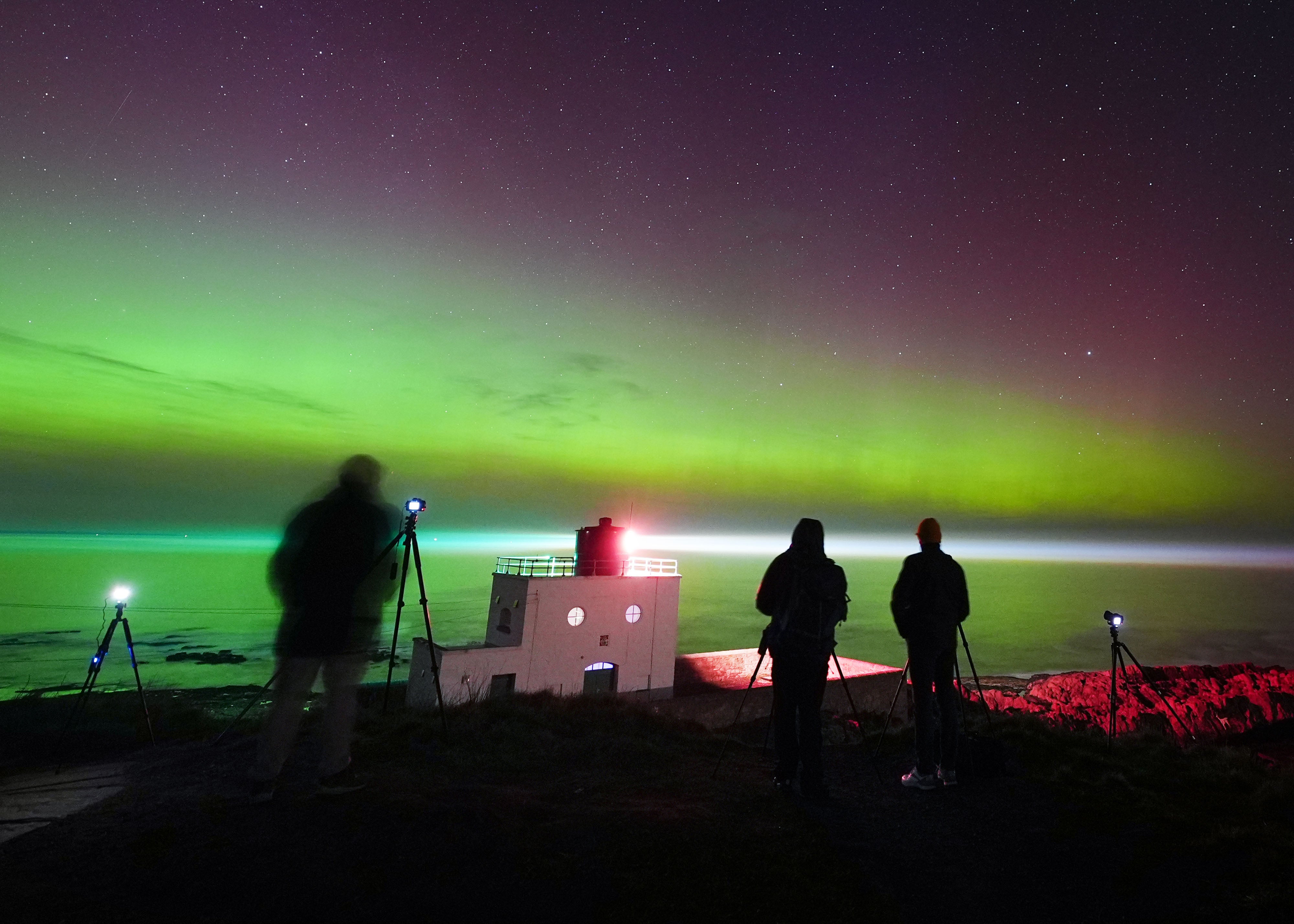 Photographers and stargazers watch as the aurora borealis, commonly known as the Northern Lights, light up the skies above Bamburgh lighthouse in Northumberland (Owen Humphreys/PA Media Assignments)
Aurora borealis displays are caused by massive explosions on the sun known as coronal mass ejections (CME). The particles that erupt from the sun’s surface interact with gases in Earth’s atmosphere and create a colourful display that can be seen 100 to 200km above Earth.
Oxygen, nitrogen, and other gases in the atmosphere light up in reds, blues, and pinks.
Some pictures from Friday showed the sky illuminated green at Bamburgh in Northumberland in the UK. People also reported seeing the lights in Canada and Russia.
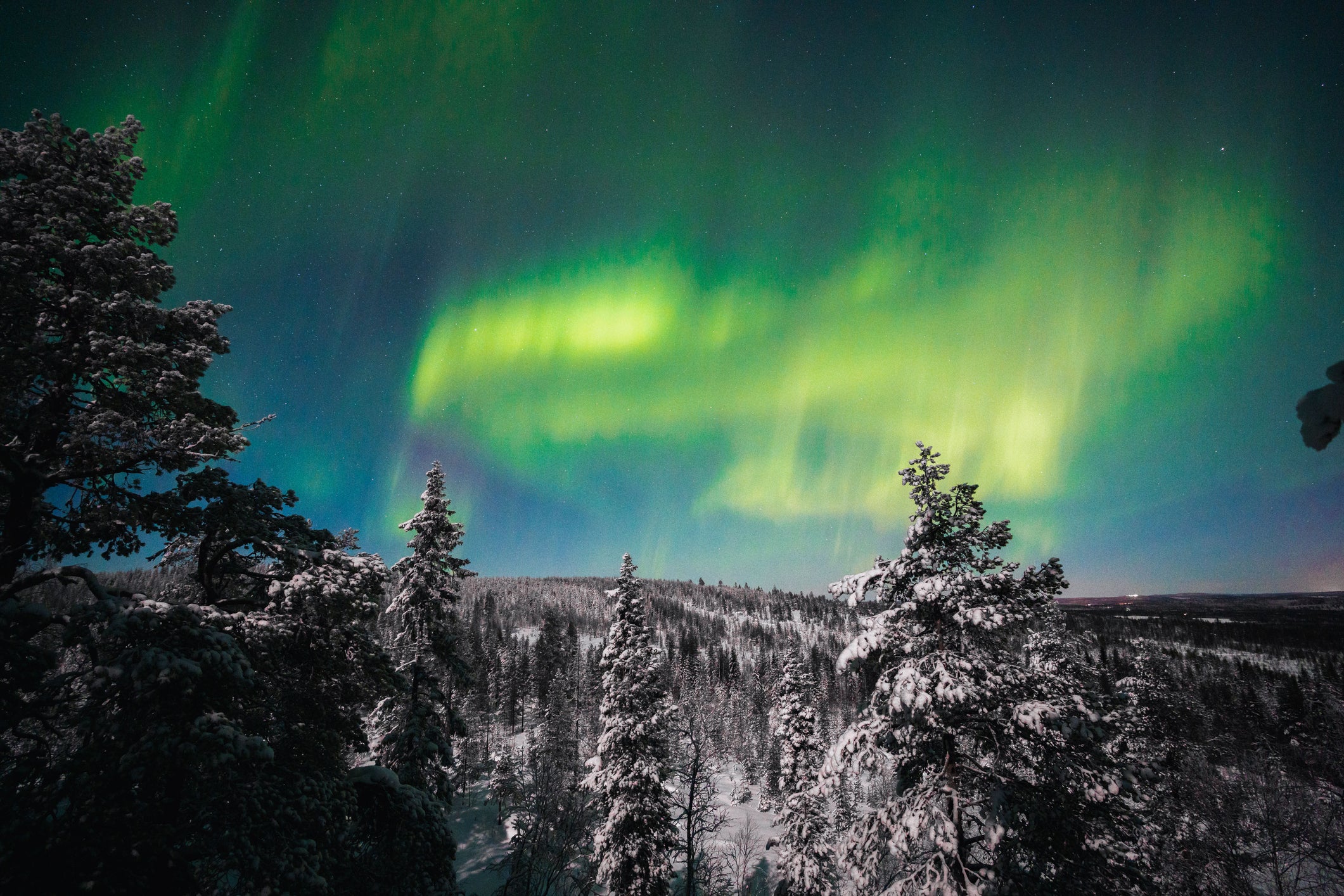 Northern lights in Rovaniemi, Finnish Lapland (Getty/iStock)
On Thursday, the Met Office said to “keep an eye out” for the northern lights over the next couple of nights, adding that “sightings are most likely across Scotland where skies are clear but perhaps into northern England too”.
The weather agency encouraged people to find a dark location with no light pollution, and look toward the northern horizon, for their best chance at seeing the auroras.
Its space weather forecast for Sunday said: “Residual CME influence, followed by coronal hole fast winds are expected to maintain enhanced geomagnetic activity during 22-23 March.
“Aurora likely to be visible at times on Sunday night across Scotland, and perhaps the far north of England and N Ireland. A slowly decreasing chance of enhanced auroral visibility then likely into the period.”