
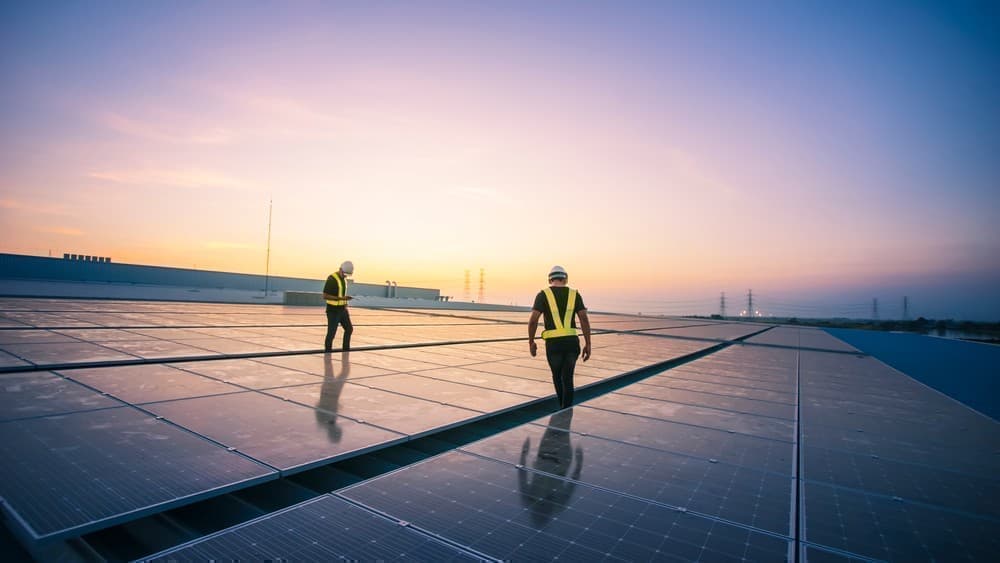
Since coming into office last January, United States President Donald Trump has repeatedly criticised renewable energy for hindering the country’s energy security and being a “green new scam”. Trump quickly introduced several executive orders aimed at ramping up fossil fuel output and restricting renewable energy production, thereby backtracking on much of the policy work of the Biden administration. However, a year into his leadership, it appears that not everyone is on the same page, as recent polls suggest that many U.S. voters continue to back renewable energy operations, such as wind and solar farms.
President Trump has repeatedly critiqued solar power, saying last year that the rapid adoption of solar and wind power has made U.S. electricity unstable and expensive. In April last year, Trump said that his administration would not approve new solar or wind projects. “We will not approve wind or farmer destroying Solar… The days of stupidity are over in the USA!!!” Trump posted on Truth Social. The move followed the tightening of federal permitting for renewables the previous month.
In July, Trump signed an executive order directing federal agencies to strengthen provisions in his One Big Beautiful Bill, focused on repealing or modifying tax credits for solar and wind projects. He justified the move by saying that renewables displaced more reliable sources, depended on foreign-controlled supply chains, and harmed the environment.

Despite continually attacking solar power, it appears that Trump has not succeeded in swaying voters away from supporting renewable energy projects. Before coming into office, several energy industry representatives warned that a majority of voters from both sides of the political spectrum had come to heavily support renewable energy, as the introduction of the 2022 Inflation Reduction Act (IRA) had supported widespread economic growth in both blue and red states. This view seems to have held true, as recent polls demonstrate the widespread support for solar and wind energy across U.S. voters.
A recent poll from the chief pollster for President Trump, Fabrizio Lee and Associates, showed that a clear majority of Republicans support expanding solar power in the United States. In the survey, 68 percent of Republican Party voters surveyed agreed that “we need all forms of electricity generation, including utility solar, to be built to lower electricity costs”. Meanwhile, 70 percent of respondents said they support utility-scale solar deployment when projects use U.S.-produced materials.
A separate poll from Kellyanne Conway’s KA Consulting revealed that three-quarters of Trump voters surveyed in Arizona, Florida, Indiana, Ohio, and Texas believe that solar power should be used to strengthen and increase the U.S. energy supply. The results of the polls reflect the outcome of a Pew Research Centre survey conducted last spring, which showed that six in 10 Republican respondents were in favour of solar power, as well as nine out of 10 Democrats surveyed.
The results of the polls are at odds with Trump’s suggestion that Republican voters do not support renewable energy and prefer a national energy policy focused solely on fossil fuel development. In fact, red states are now leading the country in terms of solar deployment, as operators seek out the lowest-cost and fastest-to-build resources. Last year, approximately 73 percent of all new U.S. solar capacity was developed in states that voted for President Trump in 2024, such as Texas, Florida, Indiana, Ohio, and Arkansas.
Texas recently achieved a new energy milestone when it surpassed California in solar power production to become the top U.S. producer of utility-scale solar electricity. Texas produced over 58.6 GWh of solar power in 2025, compared to California’s 53.7 GWh, according to recent data from the U.S. Energy Information Administration. In February, the Texas electricity grid was running on 30 GW of solar power, meaning solar resources contributed around 60 percent of the total electricity demand. During a time of geopolitical turmoil, solar power is helping to keep Texas’s electricity prices stable.
With no end in sight for the U.S.-Israeli war with Iran, severe supply chain disruptions to the oil and gas sector are expected to continue. This has already driven fossil fuel prices upwards in recent weeks, a trend that is likely to continue until the conflict comes to an end. The vulnerabilities in the global energy market, highlighted by the conflict, are expected to encourage several countries to invest heavily in the acceleration of renewable energy deployment to reduce their dependency on fossil fuel imports from foreign powers. This will likely result in U.S. consumers shifting more greatly in favour of a diverse energy mix, as they see their energy bills rise.
Despite the best efforts by President Trump to reduce public favour for renewable energy, focusing the national policy instead on fossil fuels, many Republican voters appear to continue supporting a more diverse energy mix. The rapid growth of solar energy resources in red states demonstrates a clear shift in the U.S. energy market during the Biden administration, which is not expected to change lanes any time soon.
By Felicity Bradstock for Oilprice.com