
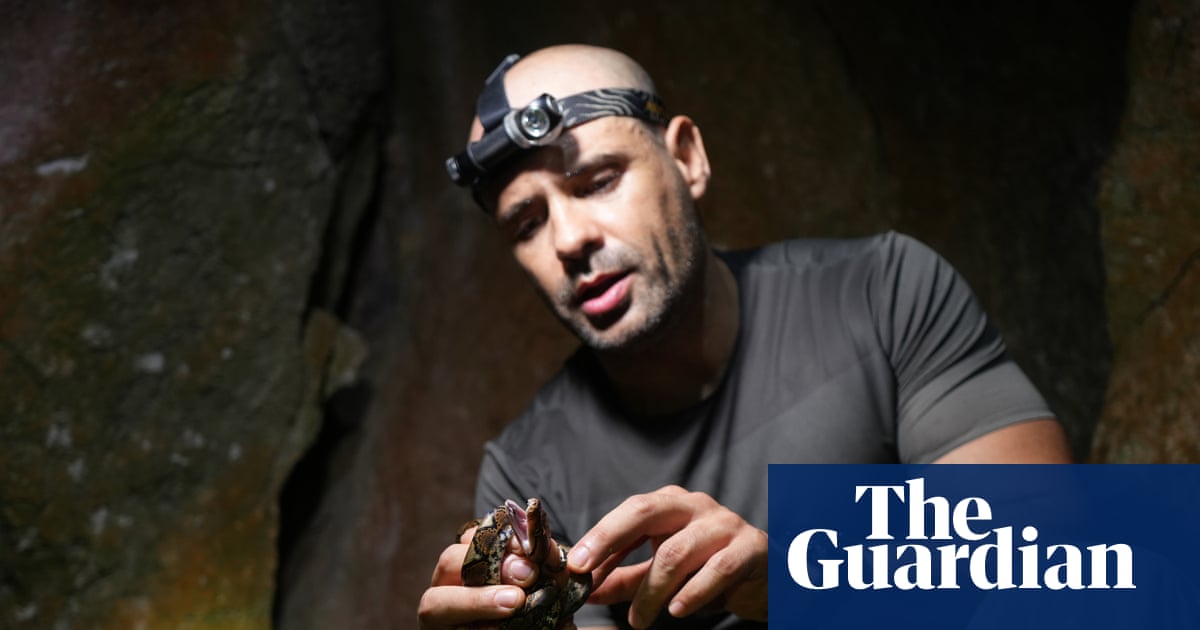
It can be daunting entering a cave. It is an underground world that possibly hasn’t been explored before. The first smell that hits you is guano (or bat poo). Some of these caves host millions of bats – you can hear them chirping above, hanging in the darkness, and occasionally flying around. It always seems like night-time inside a cave because it’s pitch black.
The walls are covered in interesting creatures such as tailless whip scorpions, which look like a cross between a spider and crab (they look dangerous, but are not), as well as millipedes and centipedes. The whole ecosystem feeds off guano, dead bats, or any dead animals on the ground. It’s not for the faint-hearted.
Water oozes through the cave walls, so you sometimes hear the sound of it dripping. Narrow passages link big cathedral-like galleries, and some passages are too narrow for a human to get through … it is an alien, and mostly silent place.
An aerial view of limestone karst formations where conservationists have searched for new species in Phnom Proek district in Battambang province. Photograph: Suy Se/AFP/Getty Images
Growing up in northern Spain, I was out in the mountains every day looking for wildlife. Even in school I was searching for small creatures in the playground. But I didn’t know much about the karst landscape before I moved to Cambodia.
double quotation markFinding a new species is a dream come true. Being involved in the discovery of so many was incredibly exciting
I led projects with Fauna & Flora, a nature conservation charity, in Cambodia for seven years, from 2019. Karst describes a landscape of limestone rock eroded for thousands of years by water. Because karst hills and caves are isolated from one another, each is its own “island laboratory” of evolution. Species adapted to these specific habitats are unable to cross from one place to another, so over time those populations start to drift apart and are eventually considered separate species.
Sometimes, a kilometre is enough distance for the species not to be able to disperse – they may have been isolated for thousands or even millions of years. Yet many animals hide in these karst landscapes and often get overlooked and neglected.
Pablo Sinovas (third from right) with the research team from Fauna & Flora and experts from Cambodia, the UK and US. Photograph: Manita Hem/Fauna & Flora
Together, our team of about 20 people surveyed more than 60 caves across 10 hills in the Battambang province, western Cambodia. The team included experts from Cambodia, Thailand and the US – it was an international effort.
We would do our main surveys at night, just after sunset, when the animals are most active. We would leave after dinner at about seven or eight, and sometimes carry on until after midnight.
We discovered three new geckos, two micro-snails and two millipedes. It’s likely we found an additional three gecko species and a new pit viper species, but we’re waiting to be able to confirm these. Finding a new species is a dream come true. Being involved in the discovery and description of so many new species was incredibly exciting.
The Battambang leaf-toed gecko (Dixonius noctivagus), discovered in the survey, is covered in tiny leopard-like spots. Photograph: Hun Seiha/Fauna & Flora
The geckos had brown and white stripes and were about 20cm long – so not small house geckos. We named one of them “night wanderer”, because that is what they do. Another we discovered has a strong bite and could draw blood. I find them so beautiful and interesting.
double quotation markIf you destroy one of these hills, you potentially wipe out an entire species, at least
We needed to collect a few specimens of each species and give them a lethal dose of anaesthetic into the heart. None of us in the team like to kill these species, but we have to in order to describe them; without that knowledge they could disappear before they are described.
To describe a new species, you look at details such as the number of scales between the eye and the mouth, the size of tail and length of fingers. An important part is genetic analysis, which involves extracting DNA. It’s a thorough process, and not easy.
Describing species involves DNA extraction and analysis, as well as looking closely at physical details. Photograph: Fauna & Flora
Our ultimate hope is that these ecosystems are protected. They are in high demand for things such as cement. If you destroy one of these hills, you potentially wipe out an entire species, at least. The vast majority of karsts are not protected, and the demand for cement is huge. This is not specific to Cambodia – it’s a global problem and the threat is imminent.
There is the thrill of exploration for knowledge and wonder, but it can be a powerful tool to showcase why you need to protect these species. These creatures exist nowhere else – this is their only home on the planet, and they have evolved over thousands of millions of years. How can we turn the hills into cement? They are not just rocks, they are unique evolutionary laboratories.
As told to Phoebe Weston
Pablo Sinovas is a senior programme manager at Fauna & Flora