
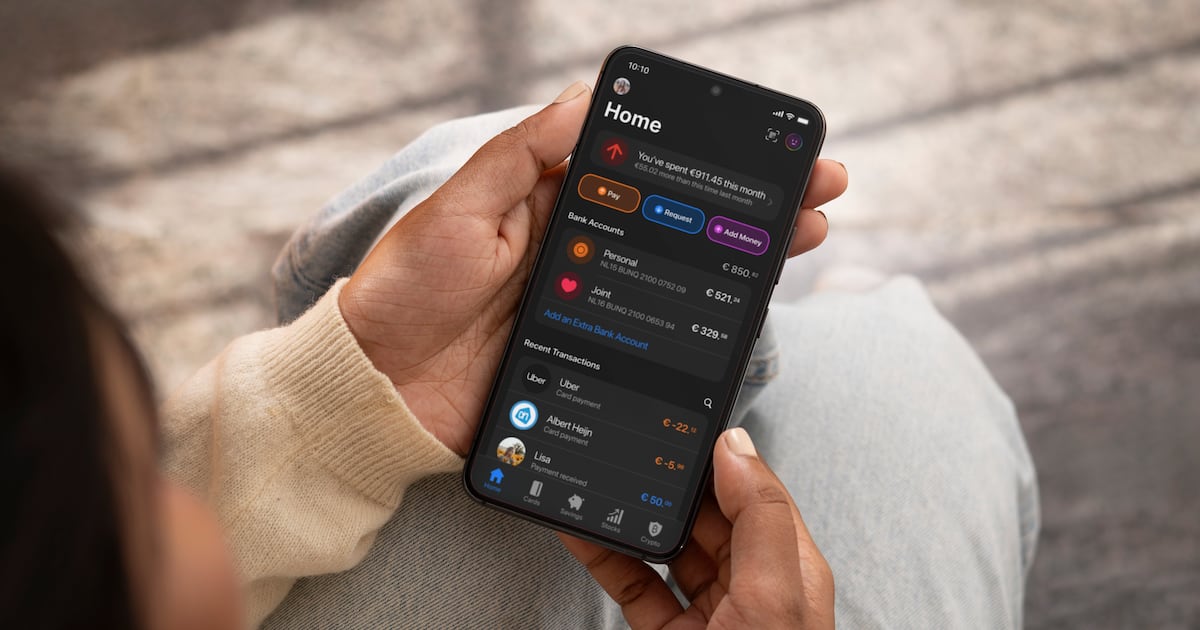
More than a third of Irish people believe artificial intelligence (AI) bots are more trustworthy than humans or at least think we are more upfront when talking to machines about our finances, research published on Monday by one of Europe’s largest neobanks suggests.
The pan-European survey from Bunq also found that just under half of those polled in Ireland said they were already using AI to make financial decisions, with many turning to it during moments of financial stress, and one in three saying it had saved them cash over the past 12 months.
The study, conducted in seven countries around the European Union, involved 1,000 Irish participants, with 36 per cent of those saying they felt more comfortable opening up to AI about their spending and a further 37 per cent saying they were just as honest with AI as they would be with another person.
A total of 49 per cent of Irish consumers polled said they had already used AI to make personal financial decisions. Although the percentage is high, it is adrift of Spain where three-quarters of respondents said they were already using AI to manage their money better.
“People often start using AI in a very practical way, before they trust it emotionally,” said Nick Hobson, behavioural scientist and consulting director at Influence at Work.
“That psychological distance – almost like opening up to a stranger on a train – can make it easier to be honest about money, which in turn brings the real benefit: saving more of it.
“Over time, as people test the advice and see what works, the relationship shifts. It starts to feel like a thinking partner rather than a calculator.”
Using AI to discuss their finances could have more far-reaching implications than the initial conversation for people, he said.
“It works like a sort of social gym. It offers a low-stakes space to rehearse the tricky conversations, asking for a raise, setting financial boundaries with family, without the fear of judgment that comes with the real thing,” Hobson said.
“Once people experience what honesty about their finances actually produces, the barrier to having those conversations with other people gets lower. The practice spills over, and they show up to the human conversation a little more prepared, and a little less afraid.”
This sense of psychological safety could be translating into real-world impact. The study suggested that one in three respondents said AI helped them save money in the past year, and more than a quarter reported savings of more than €500.
Ways people saved money by using AI included posing budgeting questions, identifying unnecessary expenses, setting savings goals, comparing options and asking more sensitive questions around personal finances.
Bunq spokesman Joe Wilson said: “It’s a dynamic time. People are increasingly turning to AI for help with everyday decisions and it only works when it’s genuinely built around their lives.”
He said that looking at Bunq’s own AI product’s usage in Ireland, they can see similar patterns in practice, with the most frequently asked questions including “how much did I spend on groceries this month?”, “how do I save money?” and how much the user has spent since a certain date.