
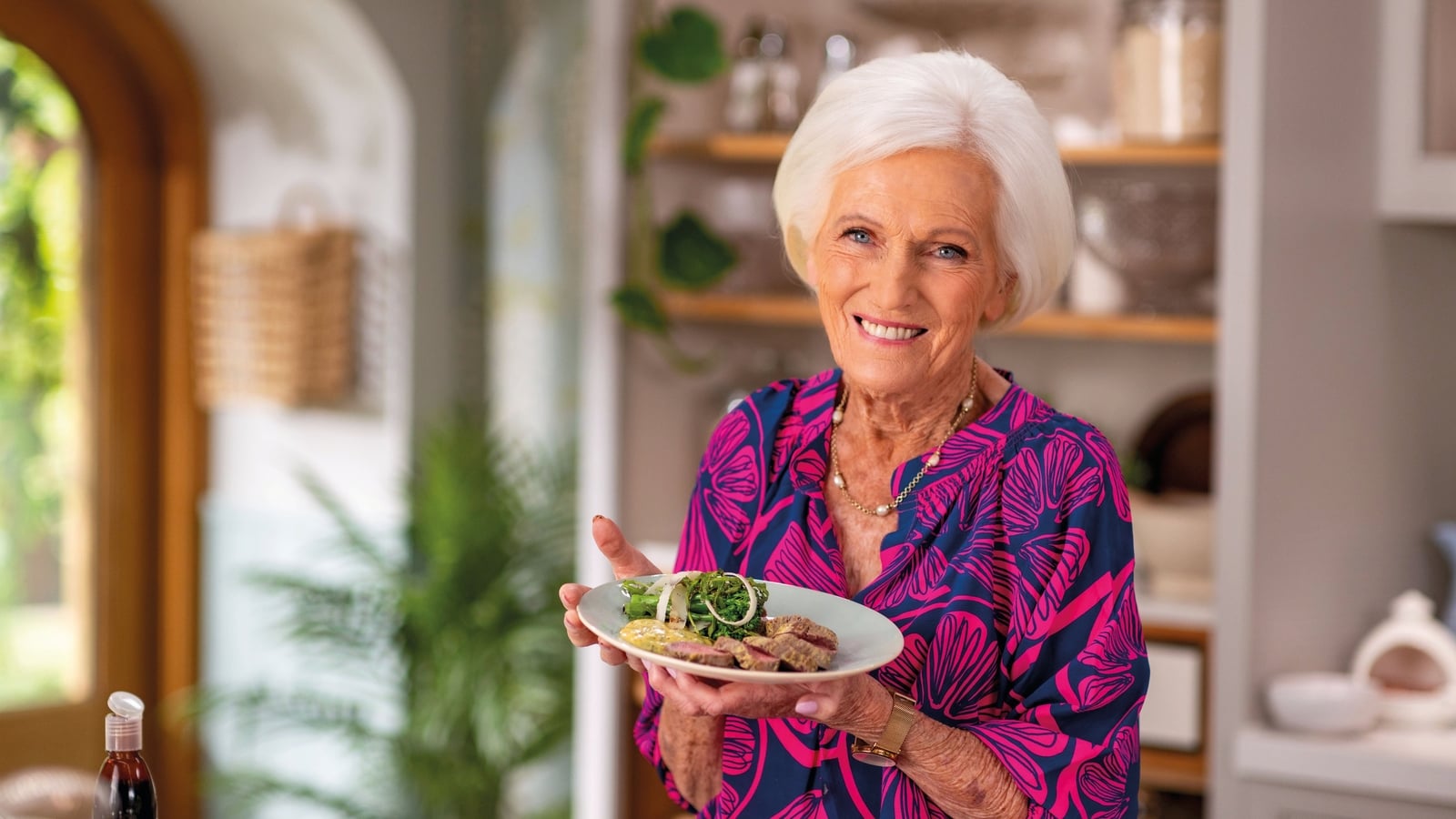
“In another life, I may have been a gardener” says the culinary queen Mary Berry, on the eve of her first gardening book. She talks to Donal O’Donoghue about her cherished memories of her son, William, her own happy childhood and why gardening is her therapy.
“I really found comfort in the garden after William died,” says Mary Berry of the darkest day in her life, when in the winter of 1989 her middle child, William, was killed in a car accident. We talk about her son towards the end of this interview, a subject she never tires of, not least because it recalls how much he was loved and still is.
“People gave us plants because they so loved Will and when we moved house, we brought all those plants with us. He was a lovely lad and I was so lucky to have had him. I have nothing but good memories. Isn’t that what they say? That you only remember the good times after someone passes. But Will was a great child and if he walked in the door right now, I’d say ‘Where have you been?’ The only thing is I’d expect him to be still 19 and not 52.”
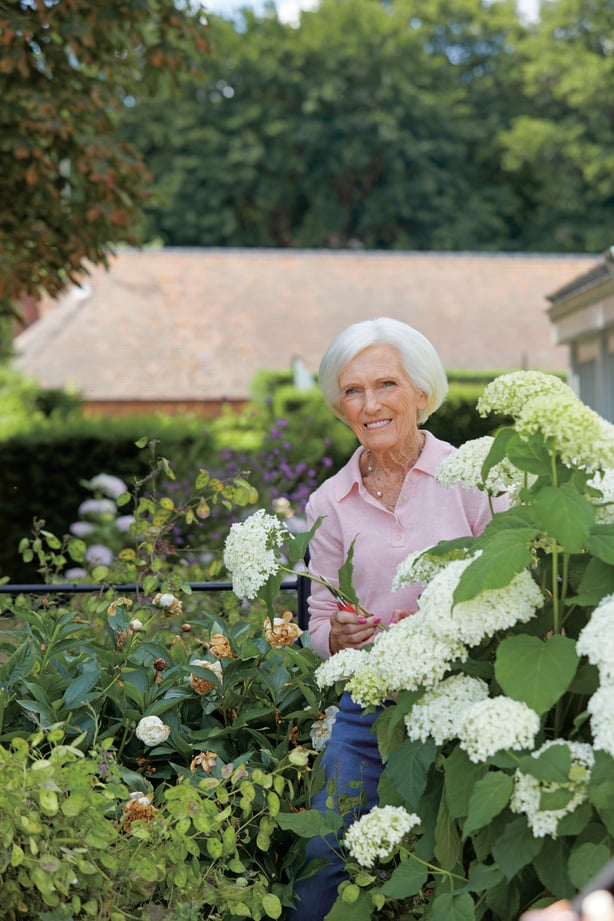
Photo: Britt Willoughby
It’s a sunny spring morning at the Pavilion Theatre in Dún Laoghaire. A few hours later Mary Berry will be on stage – the show has long sold out, but not before signing umpteen copies of her new book, My Gardening Life. “Gardening books on the whole don’t sell like cookbooks, do they?” she says when we meet. “No chance of 100,000 sales with this one so.” She laughs, effortlessly stylish in a lemon-coloured jacket and immaculately poised despite a red-eye flight from London.
In the UK, Dame Mary Berry is a national treasure, having published her first cookbook in 1970 (there have been more than 80 since) and a superstar following her role as a judge on The Great British Bake-Off. She’s still a regular on TV, and on the bookshelves, with her latest cookbook, Mary 90: My Very Best Recipes, published last October to coincide with the tie-in BBC series.
My Gardening Life, published on the eve of Berry’s 91st birthday, is her first ever gardening book. “Why now?” she says, repeating the question.
“I had no intention of writing a gardening book, but I’ve always been interested in gardening. When I was a child, growing up in Bath, I loved being outside. Back then, there weren’t theme parks, and I didn’t know what a sleep-over was. You played in the garden with friends, and I can name almost all the plants that were in my parents’ garden during those war years. I can still see the bay tree, the ash tree and the swing. I remember the herbaceous borders and can still get the smell of the flowers. Dad had to garden during the war because it was food. So, he grew vegetables and I also got a patch of garden to grow some flowers. You never forget all that.”
Berry writes of those early years in My Gardening Life in three chapters: ‘My Garden Memories’, ‘How I Garden’ and ‘My Gardening Year’. The latter takes us through the four seasons, beginning with her favourite, spring, ‘How I Garden’ is full of the tips and advice she has gleaned down the years and ‘My Garden Memories’ is a sort of horticultural memoir, taking us through Berry’s childhood, motherhood and her various gardens.
Throughout the book are a series of Q&As with gardening experts, including her old pal, Alan Titchmarsh. It took two years to complete the book, with the photographs taken in Berry’s garden in Henley-on-Thames, yet she had to be convinced to do it. “I said that I’d have a go, but it would not be dictatorial. It would be about what I’ve learned, all the mistakes I’ve made and all the things I love.”
A publicist sits in the room through the interview, but Mary Berry, oblivious to all, exudes warmth and curiosity. “That bag looks like it has weathered many years,” she says of my leather satchel, her eyes kindly but also in there a steeliness. Gardening, like cooking, she says, has always been a physical and mental therapy.
“When Will died, I think I took comfort in the garden,” she writes in her new book of the day in 1981 when William died in a car accident (her daughter Annabel, a fellow passenger, survived) but in the immediate aftermath, she and the family struggled to cope. “We lost our joie de vivre for a very long time,” she says. In My Gardening Life, she fondly recalls the 15-year-old who was “very keen on gardening and had a bedroom full of houseplants” just as she loves to talk of her other two children, Thomas, a tree surgeon, and Annabel, a keen gardener, with whom she exchanges primroses every spring.
Her own childhood in war-time Bath seems idyllic, growing up in nature with her older and younger brothers. They built their own garden shed (“with hot running water”), climbed trees, picked blackberries and primroses.
“As a child, gathering things in the wild is my first real recollection of enjoying plants and flowers,” she writes. But childhood ended abruptly when she contracted polio at the age of 13 and spent three months in an isolation hospital, hovering between life and death. The illness left her with a weakened left arm but also, as she wrote in her 2013 biography, Recipe for Life, toughened her up and instilled with a belief in making the most of life.
And she did, studying at Le Cordon Bleu in Paris, writing recipes for the Dutch Dairy Bureau, working for Housewife magazine before becoming the food editor at the prestigious Ideal Home.
Nestled in the pages of her gardening book is a photograph of Berry and her husband Paul on their wedding day, the happy couple posing with a cake baked by the bride. “Ooh let me look at that again,” says Mary when asked for memories stirred by the image.
“I think of my wedding dress because at that time I was working on Housewife magazine and was terribly busy with two jobs. I still hadn’t got a wedding dress, but I heard that there was a sale in Camden Town. So, I went and bought my dress for £5. And that was another job done.” Does she still have it? “I don’ think so! I used to wear it on my birthday to start with and then I got much bigger a few years ago (since then she has been “terribly careful to keep down to eight and a half stone”) and I wouldn’t have fit into it. I’d be able to get into it now.”
After 50 years together, her husband still asks her if she’d like sugar in her tea. “I love him dearly, but Paul just doesn’t think,” she says. She never took sugar in her tea, a legacy of rationing from the war years when her mother would say: “If you give up sugar in tea and coffee, I’ll be able to make the odd cake, stale bread and margarine pudding, or rhubarb and crumble.”
So, what in her estimation is the secret of an enduring relationship? “Paul would say it’s the words ‘Yes dear!’ but we rarely get cross with each other. If we do, I’ll open the back door, walk in the garden and by the time I’m back indoors I’ll have forgotten about it. When we were first married, Paul would be driving and say, ‘Did you see what that chap just did?!’ and I’d say ‘What does it matter? He can’t hear you and I couldn’t care less.’ More than anything I think a long, loving relationship is all about respect.”
Berry’s father, Alleyne, helped establish the University of Bath while her mother, Marjorie, who lived to 105, started the Friends of the Royal United Hospital. “I’m prouder of my parents and what they achieved than anything I’ve done,” she says now. But if she had to pick one thing she’s done with her life thus far, what would it be?
“If I start a job, I always finish it and that came from my dad,” she says. “When I first met Paul, we lived in Bristol and were decorating the flat. We had just put up two sheets of wallpaper and he said, ‘I think it’s time to go the pub’. And I said let’s get it done and then go to the pub. It’s the same with gardening. I’m always adding stuff to the garden. Recently, I put in some pear trees because Paul likes a pear for breakfast each morning and I put in a peach tree in a Perspex enclosure. I do love a challenge, and I usually get there in the end.
“You can ask me anything,” says Mary Berry towards the end of this interview. But the delivery man has just arrived with lunch, and as she has been travelling all morning, I feel bad keeping her from her food. Yet I also feel we should talk about William, the heartache that will never fade, but whose memory she keeps alive.
She says then how she can imagine her son walking in the door, even as she also knows that life goes ever on and the seasons come and go. “When I get home tonight, the very first thing that I will do is to open the back door, let the dogs out and walk round to the greenhouse where I have five pots of Delphiniums which are just starting to sprout,” she says. “They grow just a little bit each day. So, I will turn the light on in the greenhouse and check how everything is doing.”
My Gardening Life by Mary Berry is published by Dorling Kindersley.