
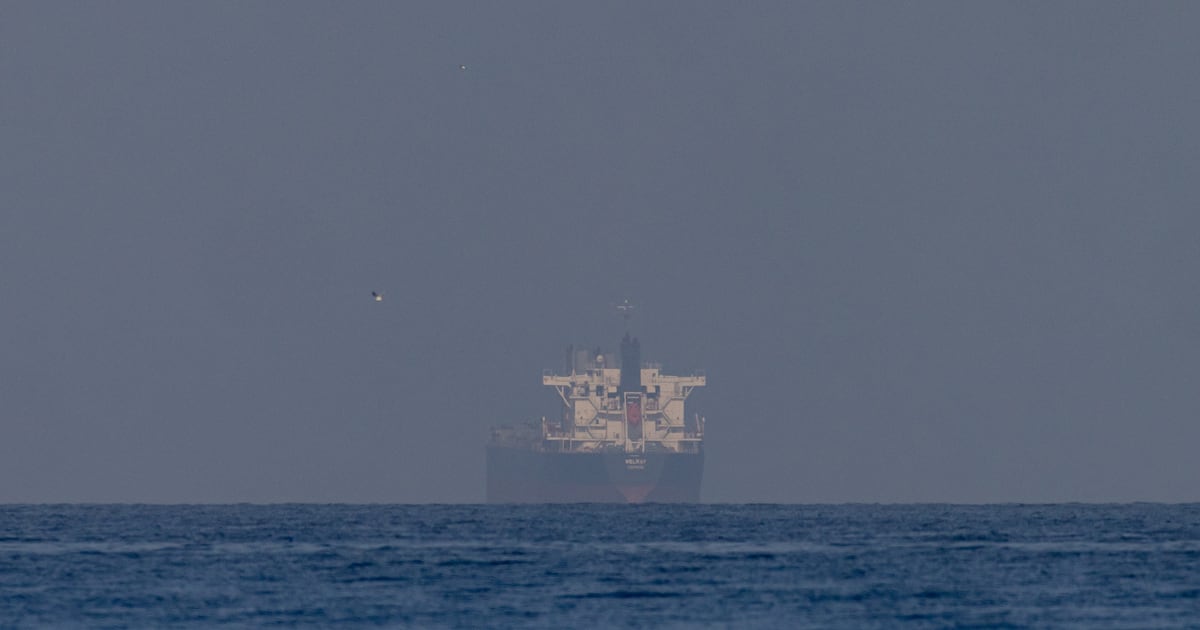
Main PointsDonald Trump threatened on Sunday that Iran had 48 hours to open the Strait of Hormuz to all traffic to avoid strikes that would “hit and obliterate” Iranian power plantsIran said it would retaliate to any attack on its electricity by targeting Israel’s power plants The crisis surrounding Iran’s chokehold on the Strait of Hormuz has created a global economic crisis, causing surging energy prices Share markets slid in early trade while US bond yields hit eight-month peaks as the US-Israel attacks on Iran showed no sign of endingKey ReadsStarmer plays down Iranian threat to UK
British prime minister Sir Keir Starmer said there is “no assessment” that the UK is being targeted by Iran.
It comes after the Israel Defence Forces (IDF) said on Saturday that Iran now has “missiles that can reach London, Paris or Berlin”. An Iranian missile would need to travel about 4,000 kilometres to reach London.
The claim, shared on X, came after reports that Iran had unsuccessfully fired ballistic missiles at the Diego Garcia US-UK military base, which is about 3,750 kilometres from Iran’s southern coast.
Asked whether the UK was within range range of Iranian missiles, following the attempted Diego Garcia attack, Starmer says the government carries out assessments “all the time in order to keep us safe, and there’s no assessment that we’re being targeted in that way at all”.
UAE resumes some natural gas production
The United Arab Emirates resumed operations at its largest natural gas processing plant, after an attack last week had forced a halt to the facility that’s vital for supplying much of the country’s requirements, according to a person familiar with the situation.
At the same time, the nation’s only operating LNG production plant at Das Island in the Persian Gulf is operating at very low levels due to the inability to export via the Strait of Hormuz, according to the person, who asked not to be identified discussing sensitive information.
The 6 million-ton-a-year facility hasn’t been fully halted to allow for a quick restart whenever the strait reopens, the person said, without providing details on the plant’s operating rate.
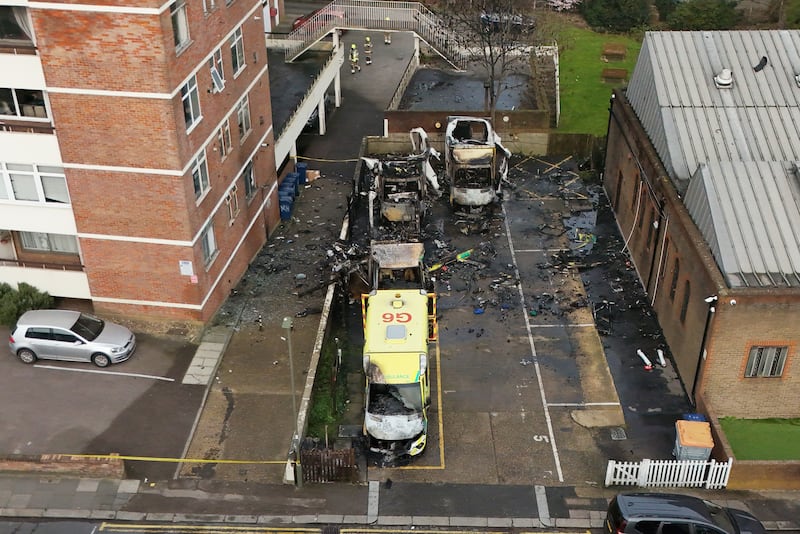 Firefighters at the scene in Highfield Road, Golders Green, London, after an apparent arson attack on four ambulances belonging to the Jewish Community Ambulance service in London. The Metropolitan Police confirmed the incident is being treated as an antisemitic hate crime. Picture date: Monday March 23, 2026. PA Photo. Photo credit should read: Jonathan Brady/PA Wire Global shares continue to slide downwards
Global shares slid on Monday while US bond yields hit eight-month peaks as the US and Iran traded escalating threats and Israel planned for “weeks” more fighting, sending oil prices on another roller-coaster ride.
The 48 hour deadline set by US president Donal Trump for Iran to reopen the Strait of Hormuz ends at 11.44pm night.
Iran on Sunday said it would strike the energy and water systems of its Gulf neighbours if Trump followed through with a threat to hit Iran’s electricity grid within 48 hours, extinguishing any hope of an early end to the war, now in its fourth week.
The Morgan Stanley Capital International (MSCI) broadest index of global stocks ticked 0.6 per cent lower on Monday, adding to over 7.4 per cent of losses for the month.
Japan’s benchmark Nikkei fell 3.5 per cent and nerves finally hit China, where blue chips headed for their heaviest beating since US tariffs hit markets last year.
European shares opened lower, falling to a four-month low, led by the defense sector, as a spike in crude prices prompted investors to factor in potential inflation pressures with the Middle East conflict intensifying. The pan-European stocks index was last down 1.75 per cent.
S&P 500 futures slipped 0.6 per cent, while Nasdaq futures lost 0.7 per cent
Oil prices were again choppy with Brent last up 0.8 per cent at $113.20 a barrel, more than 55 per cent higher for the month so far. U.S. crude gained 0.9 per cent to $99.15.
Near-term supplies have been aided by the US allowing Iranian and Russian oil to be sold from tankers, but the growing risk of longer-term shortages was lifting futures down the curve. September Brent, for instance, was up $2 at $93.90, suggesting high prices were here to stay.
BREAKING 🔴🔴
An IRGC terror group in the UK, called Ashab al-Yamin takes responsibility for torching 4 ambulances belonging to a Jewish volunteer EMT services in Golders Green, London last night.
The terrorists are on the loose.
The UK is dealing with a serious problem. pic.twitter.com/z728w4R17d
— Open Source Intel (@Osint613) March 23, 2026
European stocks slumped, with the Stoxx Europe 600 Index on course for a correction from its February record high, as the conflict in the Middle East escalated.
The Stoxx Europe 600 was down 1.5 per cent by 8.21am in London, leaving it more than 11 per cent below its February peak and in technical correction.
The Stoxx Europe 600 is an aggregate of 90 per cent of stocks from Europe’s biggest companies.
Sectors retreated across the board, with industrials and mining shares among the biggest laggards.
The region’s shares fell after Iran carried out fresh strikes across the Persian Gulf hours before US President Donald Trump’s deadline to reopen the Strait of Hormuz expires.
“Trump’s ultimatum is aggravating the situation and is clearly being reflected in equity markets,” said Aneeka Gupta, director of macro-economic research at Wisdomtree – Bloomberg.
Dutch authorities have foiled a planned attack on a synagogue in Heemstede, where multiple explosive devices were discovered in close proximity to the site.
This attempted attack comes amid a wave of recent incidents targeting Jewish institutions in the Netherlands and across… pic.twitter.com/8U5u0QCSAr
— European Jewish Congress (@eurojewcong) March 22, 2026
Iran threat marks major escalation in crisis
The Middle East energy wars are on the cusp of a dangerous escalation, with potentially catastrophic consequence, Mark Weiss writes from Jerusalem.
Iran has responded to president Donald Trump’s 48-hour ultimatum to open the Strait of Hormuz to all shipping with a series of counter threats.
The Islamic Revolutionary Guard Corps (IRGC) said that should the US strike, the strategic waterway would not be reopened “until our destroyed power plants are rebuilt”. If energy facilities are targeted, companies with US shares will be “completely destroyed” and energy assets in countries that host American bases will be “lawful” targets for Iranian strikes, the IRGC said in a statement.
You can read his analysis here.
Ireland faces weeks more disruption to energy markets that at a minimum will be “more severe” if the war in the Gulf persists, the International Energy Agency (IEA) has told the Government.
A paper given by the IEA’s top energy economist to the State’s energy affordability taskforce on Thursday said huge volumes of oil and gas will not be produced by Gulf countries this month even assuming flows gradually resume towards the end of March.
With storage filling in the Gulf and no capacity to ship oil out, or with facilities impacted by Iranian attacks, it warned that “if flows do not start to resume in late March, the impact will be more severe”.
Here’s political correspondent Jack Horgan-Jones’ report
This is a deeply shocking antisemitic arson attack.
My thoughts are with the Jewish community who are waking up this morning to this horrific news.
Antisemitism has no place in our society.
Anyone with any information must come forward to the police. https://t.co/P5J1ETaEsE
— Keir Starmer (@Keir_Starmer) March 23, 2026
Iran warns it will mine the Strait of Hormuz if attacks persist
An attack on Iran’s southern coast and islands will lead to Gulf routes being cut with the laying of sea mines, the country’s Defence Council said on Monday according to state media.
The US is considering plans to occupy or blockade Iran’s Kharg Island, the country’s main oil export hub, to pressure Tehran to reopen the Strait of Hormuz to all shipping, according to Axios.
“Any attempt to attack Iran’s coasts or islands will cause all access routes in the Gulf (…) to be mined with various types of sea mines, including floating mines that can be released from the coast,” the statement read.
“In this case, the entire Gulf will practically be in a situation similar to the Strait of Hormuz for a long time (…) One should not forget the failure of more than 100 minesweepers in the 1980s in removing a few sea mines.”
The Defence Council recalled that non-belligerent states can only pass through the Strait of Hormuz by coordinating passage with Iran – Reuters
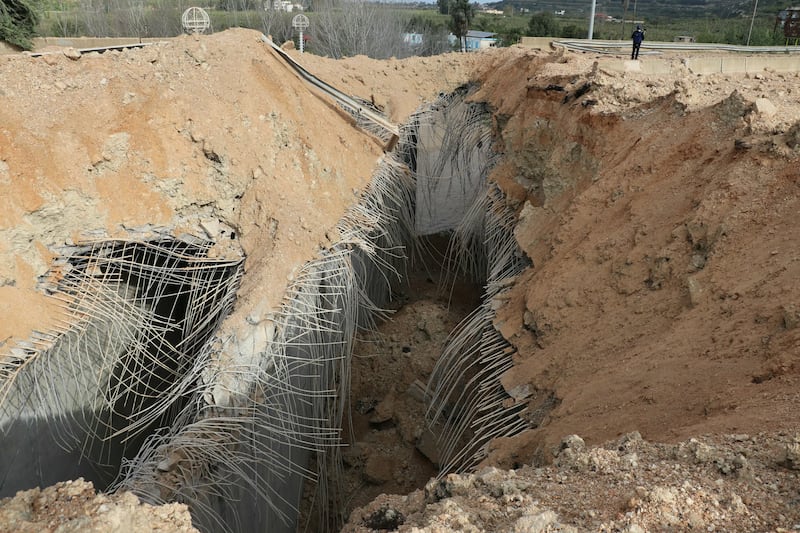 A man stands near the crater the day after an Israeli airstrike targeted the Qasmiyeh Bridge, located on a main highway linking villages in the Tyre district with others farther north. (Photo by Kawnat HAJU / AFP via Getty Images) / Ukraine targets Russian oil and gas facilities
While the rest of the world is focused on Iran, Ukraine has conducted massive drone attacks on Russian oil facilities overnight.
Its attack on Russia’s Baltic Sea port of Primorsk, one of the country’s key oil export hubs, has damaged a fuel tank, according to local authorities.
However, Nasa satellite imagery and social media would suggest the damage was much more extensive than that with multiple fires burning at the refinery.
Air defences destroyed more than 50 drones over the region overnight, Alexander Drozdenko, governor of the Leningrad region, said in a Telegram post early on Monday. Efforts to repel the attack were continuing, he said.
Primorsk is one of Russia’s main seaborne crude export terminals. The port has previously been targeted by Ukraine, including attacks in 2025 that temporarily disrupted loadings.
Ukraine has not commented on the incident so far. The country has stepped up its attacks on Russian oil and gas infrastructure since the start of the Iran war with a view to depriving Russia of revenue from surging energy prices.
Four Jewish ambulances burned in suspected anti-Semitic attack in London
An arson attack on four ambulances belonging to a Jewish community ambulance service in north London is being treated as an “anti-Semitic hate crime”, the Metropolitan Police says.
Four Hatzola ambulances were found on fire after the London Fire Brigade was called to Highfield Road in Golders Green at around 1.40am.
Hatzola is a large non-profit, volunteer Jewish organisation that provides people emergency medical response and transportation to hospitals for free.
The fire brigade said multiple cylinders in the vehicles exploded and caused windows to break in an nearby block of flats.
Six fire engines and about 40 firefighters were sent to contain the blaze.
Nearby houses were evacuated as a precaution, and about 30 people have been taken to a local shelter.
There were no injuries, police said, and all fires have been put out. There have been no arrests so far, they added.
Government cautious over the length of fuel relief
A tax rebate scheme for hauliers, a double fuel allowance payment and a reduction in excise duty to cut fuel prices at the pumps are all expected to be agreed by the Government on Monday, but the measures due to be announced on Tuesday will initially be in place for only a number of weeks.
The Coalition will this week have to manage the public’s expectations of how long they can expect such relief to last, while also being blunt that it “cannot shield people from the full impact of the war”, a Government source told Irish Times political correspondent Ellen Coyne. You can read her report here.
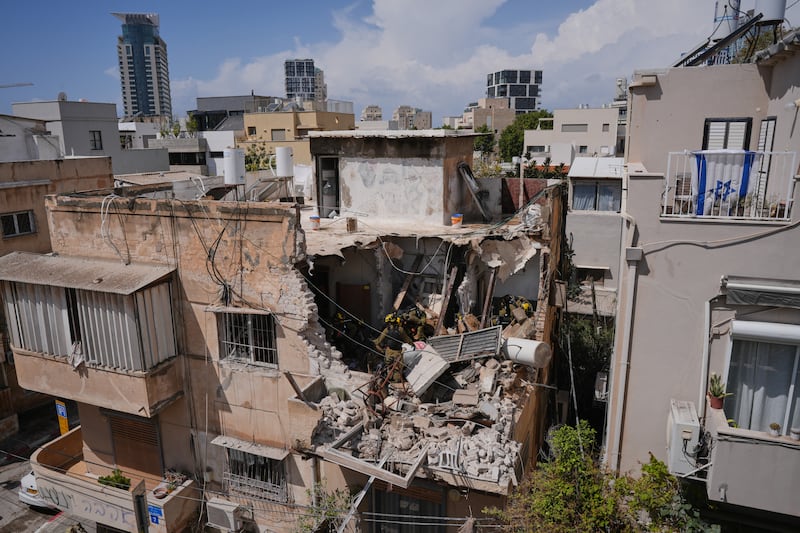 Israeli officials inspect an apartment building struck by an Iranian missile in Tel Aviv, Israel on Sunday. Photograph: Maya Levin/AP British cabinet set for emergency meeting over Strait of Hormuz
Keir Starmer is set to convene an emergency Cobra meeting on Monday after a call with Donald Trump to discuss reopening the Strait of Hormuz.
In a conversation on Sunday night, the British prime minister and the US president agreed reopening the strait was “essential” to stabilise a global energy market that had seen oil prices rocket since Trump began his joint campaign with Israel against Iran.
The 20-minute call, described by sources as “constructive”, followed a week in which Trump had heavily criticised Starmer’s response to the crisis amid the president’s demand for other nations to send ships to open the strait.
Other nations have so far resisted his demand, with the UK thought to be unlikely to send vessels because of the high level of risk in the strait and an unwillingness to be drawn into the wider war.
But Tehran’s unsuccessful attempt to strike the UK-US base on Diego Garcia with ballistic missiles has raised concerns that much of Europe could be within range of Iranian weapons.
While the strait remains effectively closed to most shipping, the impact on the global energy market and the global economy is set to continue.
Facing the threat of higher inflation and concerns about disruption to fuel supplies, Starmer will convene his top ministers at a Cobra meeting on Monday afternoon.
Stock markets fall in early trade
Share markets slid in Asia in early trade while US bond yields hit eight-month peaks as the United States and Iran traded escalating threats and Israel planned for “weeks” more fighting, sending oil prices on another roller-coaster ride.
Iran said on Sunday it would strike the energy and water systems of its Gulf neighbours if US president Donald Trump followed through with a threat to hit Iran’s electricity grid in 48 hours, extinguishing any hope of an early end to the war, now in its fourth week.
Trump warned Iran had two days to fully open the vital Strait of Hormuz, which is effectively closed for most vessels with little prospect of naval protection for shipping.
Japan’s Nikkei fell 3.8 per cent, bringing losses for March so far to over 13 per cent. South Korea’s market shed 5.2 per cent, making a 12 per cent drop for the month.
MSCI’s broadest index of Asia-Pacific shares outside Japan lost 2.5 per cent, while Chinese blue chips dropped 1.9 per cent. – Reuters
Iran vows to retaliate if its power stations are attacked
Iran will retaliate to an attack on its electricity sector by targeting Israel’s power plants as well as power plants supplying US bases with electricity in regional countries, a statement by the Revolutionary Guards on Monday said.
The statement seemingly retracted earlier threats to desalination plants in the region, which are crucial for providing drinking water in Gulf countries.
“The lying … US president has claimed that the Revolutionary Guards intends to attack the water desalination plants and cause hardship to the people of the countries in the region,” the statement shared on state media said.
On Saturday, US president Donald Trump warned that Iranian power plants would be targeted if Tehran failed to “fully open” the Strait of Hormuz to all shipping within 48 hours.
“We are determined to respond to any threat at the same level as it creates in terms of deterrence … If you hit electricity, we hit electricity,” the Revolutionary Guards said. – Reuters
IEA open to releasing more oil stocks
The International Energy Agency (IEA) is consulting with governments in Asia and Europe on the release of more stockpiled oil “if necessary” due to the Iran war, executive director Fatih Birol said this morning.
“If it is necessary, of course, we will do it. We look at the conditions, we will analyse, assess the markets and discuss with our member countries,” Birol told the National Press Club in Canberra.
IEA member nations agreed on March 11th to release a record 400 million barrels of oil from strategic stockpiles to combat the spike in global crude prices. The drawdown represented 20 per cent of overall stocks.
There would not be a specific crude price level to trigger another release, Birol said.
“A stock release will help to comfort the markets, but this is not the solution. It will only help to reduce the pain in the economy.”
The IEA chief began his world tour in Canberra as the Asia Pacific is at the forefront of the oil crisis, he said, given its reliance on oil and other crucial products such as fertiliser and helium transiting the Strait of Hormuz.
He described the crisis in the Middle East as “very severe” and worse than the two oil shocks of the 1970s, as well as the impact of the Russia-Ukraine war on gas, put together.
The war on Iran had taken 11 million barrels of oil per day from global supply, more than the two prior oil shocks combined.
“The single most important solution to this problem is opening the Hormuz Strait,” he said.
“The depth of the problem was not well appreciated by the decision makers around the world,” he said of his decision to begin speaking publicly three weeks into the war. – Reuters