
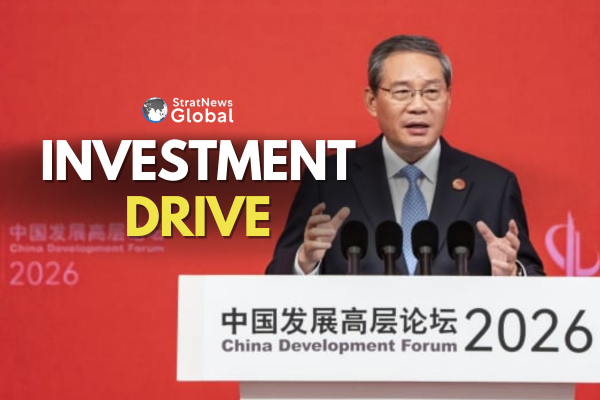
China has pledged to further open its economy to foreign businesses and pursue more balanced trade, as it seeks to ease global concerns following a year of tariff disputes with the United States and the European Union.
Speaking at the China Development Forum in Beijing, Premier Li Qiang said the country would expand imports of high-quality goods and work towards more balanced global trade, according to state media.
The remarks come after China reported a record trade surplus of $1.2 trillion in 2025, a figure that has raised concerns among major economies over trade imbalances and industrial overcapacity.
While Li did not directly address the surplus, his comments signalled an awareness in Beijing that such imbalances could strain international relations, particularly at a time of fragile stability in global trade ties.
Efforts to improve relations have also been delayed, with US President Donald Trump postponing a planned visit to Beijing amid the ongoing Iran conflict.
Central Bank Seeks To Reassure
In a separate address, central bank governor Pan Gongsheng argued that global imbalances should be viewed more broadly, taking into account services and financial flows alongside goods trade.
He noted that while China holds the world’s largest goods surplus, it also runs a significant services deficit. Pan also stressed that China has no intention of gaining a competitive advantage through currency depreciation.
Push To Attract Foreign Investment
China is also attempting to reverse a decline in foreign direct investment, which fell 5.7 per cent year-on-year in January after a 9.5 per cent drop across 2025.
To address this, Beijing has expanded incentives across 200 sectors, focusing on advanced manufacturing, green industries and high-tech development.
Li assured that foreign companies would be treated on par with domestic firms, aiming to restore investor confidence.
Global Firms Signal Continued Interest
Senior executives from major multinational companies, including Apple, Samsung Electronics, Volkswagen, Siemens, BASF and Novartis, attended the forum, reflecting continued corporate interest in the Chinese market.
Financial institutions such as HSBC, UBS and Standard Chartered also participated, highlighting the forum’s role as a platform for engagement between China and global business leaders.
(with inputs from Reuters)