

Türkiye’s benchmark 2-year treasury yield rose sharply by over 400 basis points to above 44.7% on Monday, while the credit risk default (CDS), the country’s sovereign risk premium, also climbed past 300, with both reaching their highest levels since June 2025 as a massive sell-off swept global markets amid Hormuz tensions.
The movement reflected broader concerns over rising inflationary pressures driven by surging energy costs, particularly after an escalating showdown between the U.S. and Iran over the Strait of Hormuz, with both sides threatening to target energy infrastructure as the war enters its fourth week.
More to Read

Energy shock fuels inflation risks, tests disinflation path
As a major energy importer, Türkiye faces rising inflationary pressure from higher energy costs, putting its disinflation program at risk. The country’s annualized net energy deficit, recorded at $46.4 billion in January, could widen further, adding pressure to the current account balance, which stood at $32.8 billion.
Besides the risks stemming from a widening current account deficit, rising costs are also weighing on nearly all sectors, triggering broad-based price increases and feeding into persistent inflationary pressures across the economy.
According to the Central Bank of the Republic of Türkiye’s (CBRT) estimates, every $10 increase in Brent crude adds 1.2 to 1.6 percentage points to headline inflation and widens the current account deficit by $1.2 billion to $2.6 billion. Since the war began on Feb. 28, Brent prices have risen by over $30 per barrel, hovering around $105 per barrel on Monday.
Policymakers had already moved to address rising inflation risks stemming from energy markets, raising funding costs to 40% in early March from a 37% policy rate to further tighten monetary conditions. They also paused a rate-cut cycle that had continued for five consecutive meetings since July 2025 and adopted a more hawkish tone, signaling caution over the inflation outlook.
Türkiye’s inflation had already accelerated before the war, due to food inflation, due to bad weather conditions, ticking up to 31.5% after consecutive months of downward trend.
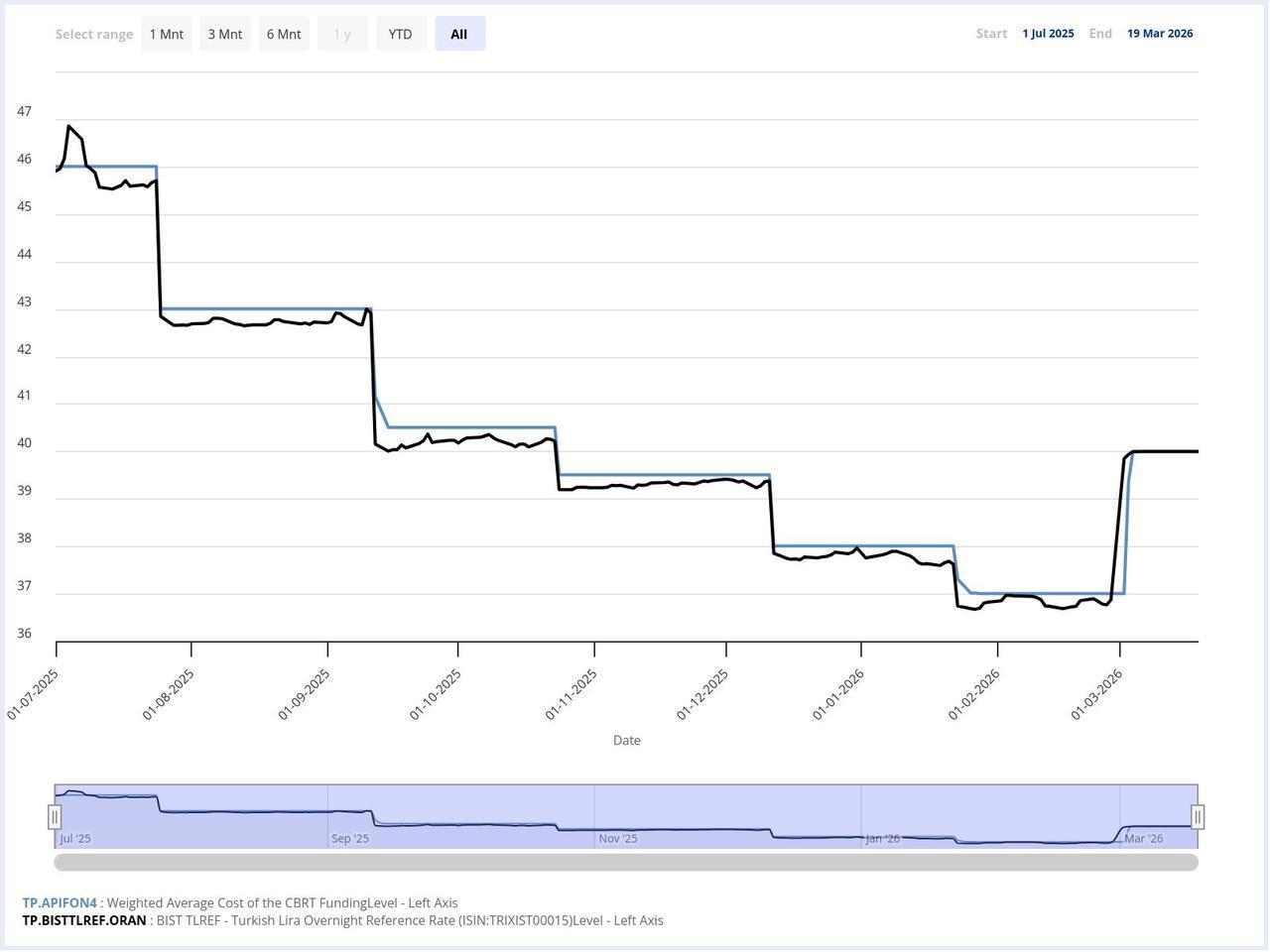

Chart illustrates the trajectory of CBRT funding costs and the Turkish lira reference rate from July 1, 2025 to March 19, 2026. (Chart via CBRT)
Foreign investors post record bond outflows
Türkiye’s benchmark stock index, the BIST 100, fell over 3% to 12,632.41, while the banking index sank nearly 7% at its intraday low. The move followed a global rout that began in Asian markets on Monday and spilled over into European stocks, with bond yields also surging to multi-month highs.
However, markets reversed sharply after U.S. President Donald Trump said he had ordered a five-day delay to planned strikes on Iran’s energy infrastructure, citing “positive and constructive” talks. Brent briefly eased to around $100 per barrel, down 10%, triggering a sharp global rebound.
As of 3:50 p.m. local time, the BIST 100 was hovering around 13,050 points, near its Friday close, while the banking index remained in negative territory, down 2.5% on the day.
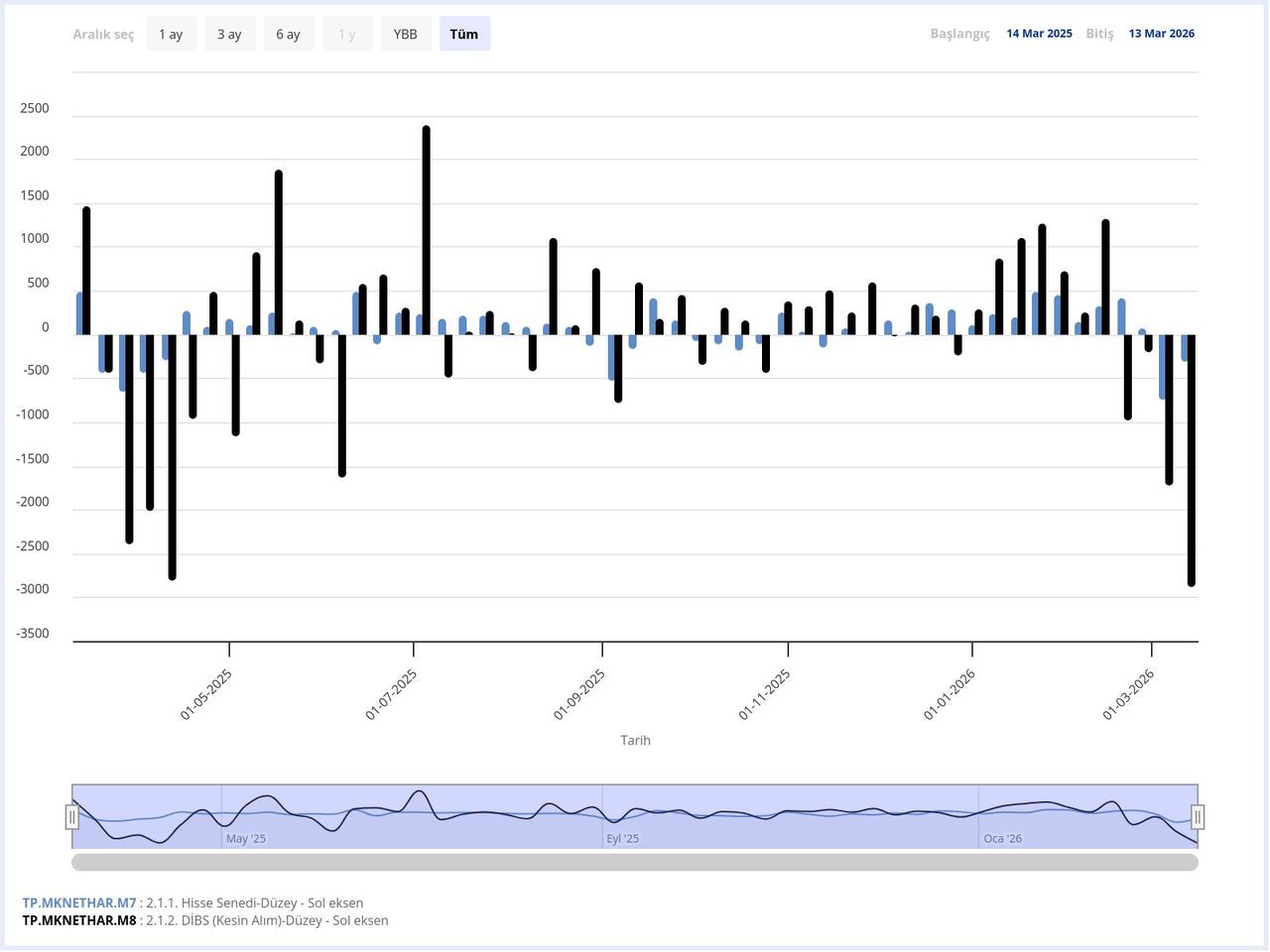
Column chart shows foreign investor flows in Turkish equities and government bonds from March 14, 2025 to March 13, 2026. (Chart via CBRT)
Despite the temporary relief, central bank data showed that foreign investors sold $2.9 billion in Turkish bonds in the week of Mar. 13, marking a record outflow and bringing total net sales during the period to $4.6 billion. They were also net sellers in equities, offloading $322 million in the same week, with total outflows in the first two weeks of March exceeding $1 billion.
During the same period, the central bank was also affected negatively, with gross reserves of the Turkish central bank declining from 210,3 billion to 189,6 billion, while net lose in reserves reached $24.5 billion as spaw-excluded net reserves dropped to $54.3 billion

March 23, 2026 04:42 PM GMT+03:00