
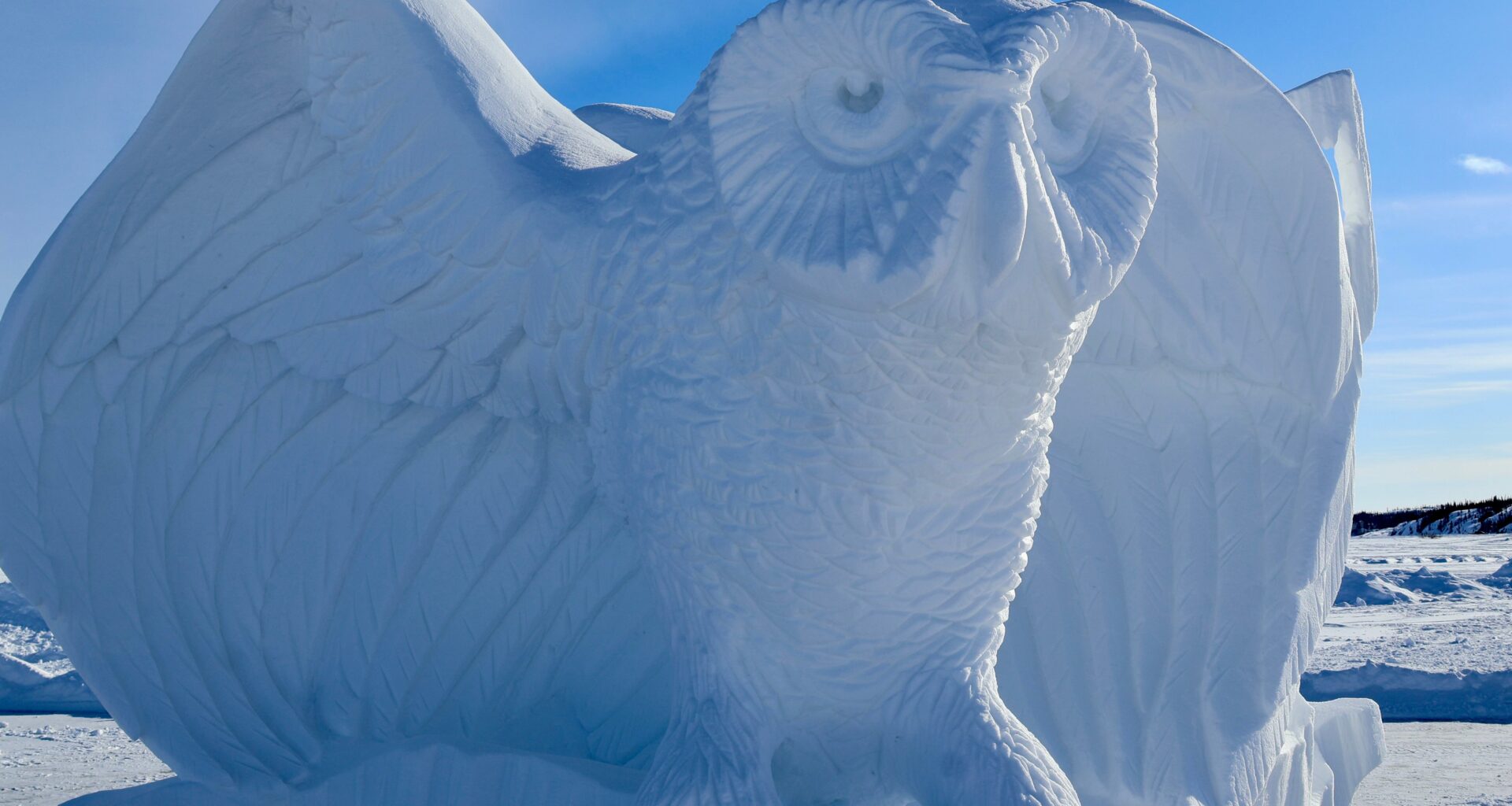
If a team of people spends days creating a snow sculpture, is it OK if you ask Gemini to bring that sculpture to life?
An influencers’ trip to Yellowknife – arranged by Google to advertise its Pixel phones and Gemini artificial intelligence – is a window into some questions raised by the rapid advance of AI.
On platforms like TikTok and Instagram, the influencers showed off the phones’ ability to take night shots of the northern lights.
They then turned their attention to the sculptures that form a part of each year’s Snowkings’ Winter Festival on Yellowknife Bay.
The results are showcased in a highlight reel produced by a new Google Canada Instagram account.
Advertisement.
Advertisement.
In one AI video posted by influencer Shevon Salmon, a sculpture titled Tom – created by a team from Spain and bearing a resemblance to Tom Waits – stops being a static piano player and begins to play the instrument in front of him.
Gemini’s video of the sculpture titled Tom.
Lizzie Peirce’s post featured a Gemini video derived from the sculpture Winter Sky or Ciel D’Hiver.
In another, posted by Lizzie Peirce, an owl in a separate sculpture is made by Gemini to gracefully beat its wings.
Some of the people who created the sculptures can see the attraction – but on the whole, they’re unimpressed.
“I actually like the visual effect of it – it’s interesting how it brings the sculpture to life,” wrote Zuzana Riha, who created the owl alongside Patricia Leguen.
Advertisement.
Advertisement.
Their sculpture is titled Winter Sky or Ciel D’Hiver. The original also featured a segment devoted to the northern lights, which the Gemini video eradicated to focus on the owl.
Despite the effect, Riha said she was “disappointed” the video did not credit the sculptors nor the event or the time it took to create.
“AI is also starting to hijack art in a way that blurs the line between what’s real and what isn’t, which can be confusing for people and concerning for artists,” Riha continued.
“As an artist, it’s a little unsettling to think about how this could impact our futures. At the same time, I can see how it might spark interest and present the work in a fresh, engaging way on a different platform.
“I think it’s cool that it’s been shared on an influencer’s page with such a large following – but still, the lack of credit is disappointing. I think anyone who posts AI should provide proper context and disclosure.”
In a caption superimposed on the video, influencer Peirce wrote: “Remember when I said I made something crazy at the Snow Castle? This was a snow sculpture and how Gemini made it come ALIVE.” Google Canada was tagged.
“As a professional sculptor, I hate AI,” wrote Leguen, Riha’s team-mate.
“It is like AI and the influencer are more important than the actual sculpture and the sculptors who carved it.
Advertisement.
Advertisement.
“AI is so invasive these days that most people cannot even tell if something is real or not. It is very sad, especially when it comes to art.”
Google did not respond to repeated requests for comment.
Questionable practices
Artificial intelligence is moving into daily life at an extraordinary pace.
Models like Gemini, ChatGPT and Claude, which could hold basic conversations a couple of years ago, are now powerful enough to be adopted by some businesses. Multiple tech companies have attributed recent large-scale layoffs at least in part to the ability of AI to do work previously performed by humans.
It’s easy to find examples of AI wading into the world of humans’ cultural contributions. High-profile musicians worry about AI assimilating their work. Last week, a large publishing house pulled a horror novel over suspicions that the author used AI on a large scale to create it. Various news groups are suing big tech companies over the use of reporters’ work to train AI models.
The snow sculpture videos demonstrate this happening on a smaller – and more personal – scale. To some sculptors, an AI tool readily available on most phones is instantaneously stripping their ownership of the work.
“Those pieces take hours and hours and hours. Then to provide a prompt to completely remove it from the context it was created in, or that the artist was trying to communicate? There’s something a little bit uncomfortable about that,” said Cat McGurk, a Yellowknife-based snow sculptor.
McGurk said they gave the influencers a short introduction to snow sculpting while they were visiting, without fully realizing what the group was in Yellowknife to do.
Advertisement.
Advertisement.
“I thought it was pretty funny that they chose to animate the Tom Waits sculpture,” said McGurk, “because he’s notoriously against computers and the internet.”
(In 2004, for example, Waits said: “This is what’s wrong with the world. Everything is explained now. We live in an age when you say casually to somebody ‘What’s the story on that?’ and they can run to the computer and tell you within five seconds. That’s fine, but sometimes I’d just as soon continue wondering. We have a deficit of wonder right now.”)
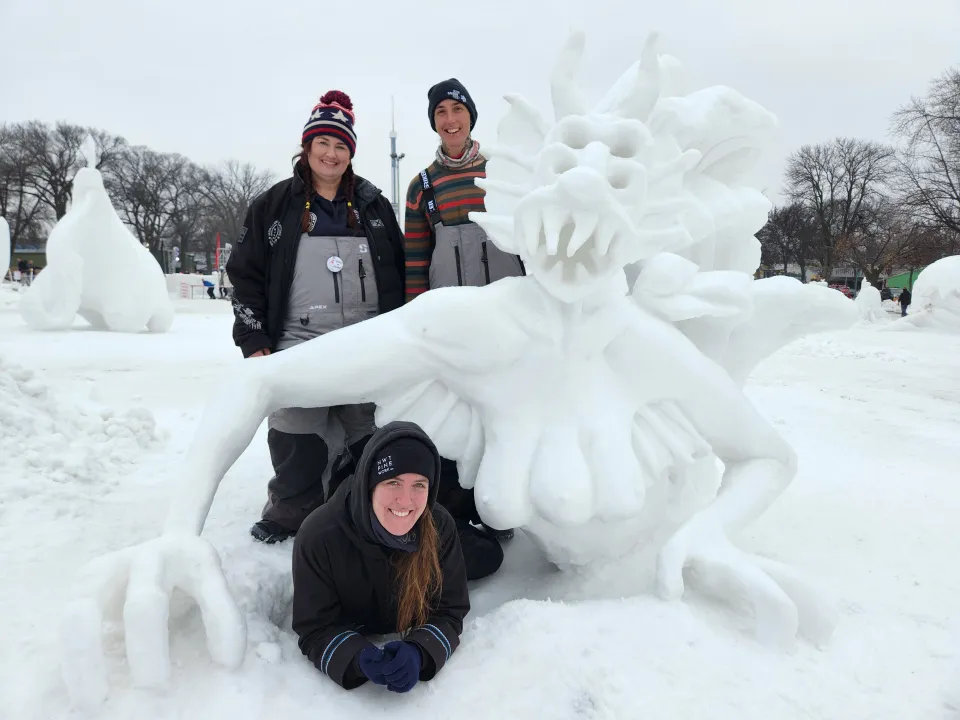 Kelly Thune and Niki Mckenzie, back left to right, and Cat McGurk, front, pose with their sculpture The Evolution of Folklore at the Minnesota State Snow Sculpting Competition in 2024. Photo: Submitted by Cat McGurk
For McGurk, questions about AI – even within the niche world of snow sculpting – extend beyond Gemini altering the finished product.
“I’ve seen sculptors using AI to develop their models or concept drawings for competitions and symposiums. I think it’s a questionable practice,” McGurk told Cabin Radio in an interview last week.
There are limited places available at big sculpting events, they said, and competitors are often chosen based on the plans they submit, including renderings.
“To have some sculptors be able to do that within a matter of minutes, whereas other people are taking hours to work on these things … that becomes a disadvantage to the people who are not using that tool,” said McGurk.
“I don’t know what that really means. I guess it really depends on how you feel philosophically around art and AI. Is that your art, then, that you’re submitting to this competition, or is that a product that has been developed by a non-sentient thing?”
Listen: A Yellowknife snow carver on the politics of art
Advertisement.
Advertisement.
McGurk noted AI exists behind a paywall – the best models with the most usage cost hundreds of dollars a month – which introduces barriers to access.
On the other hand, they compared the onset of AI to the popularization of the internet in the 1990s.
“Because for sure, I use the internet to look at reference images that I would never have been able to see 70 years ago. I would not have access to those images and the information that I use to develop my sculptures,” McGurk said.
“All that reference material is stuff I could only find in books, which may not be accessible to me because they’re not physically available or because they’re too expensive.”
Ultimately, McGurk concluded: “It’s maybe more likely that AI develops consciousness and we recognize it makes its own art before we can answer the question of whether or not it’s a tool that artists can use to make art.”
Winning the AI tourism race
The Google visit to Yellowknife is a boon for NWT Tourism, the government-backed agency that promotes the territory to tourists worldwide.
Having the city be considered a worthy backdrop for flashy tech is a win in that light.
“We’re happy to know that they chose Yellowknife and the Northwest Territories. We’re pretty excited about that,” said Donna Lee Demarcke, NWT Tourism’s chief executive officer.
Advertisement.
Advertisement.
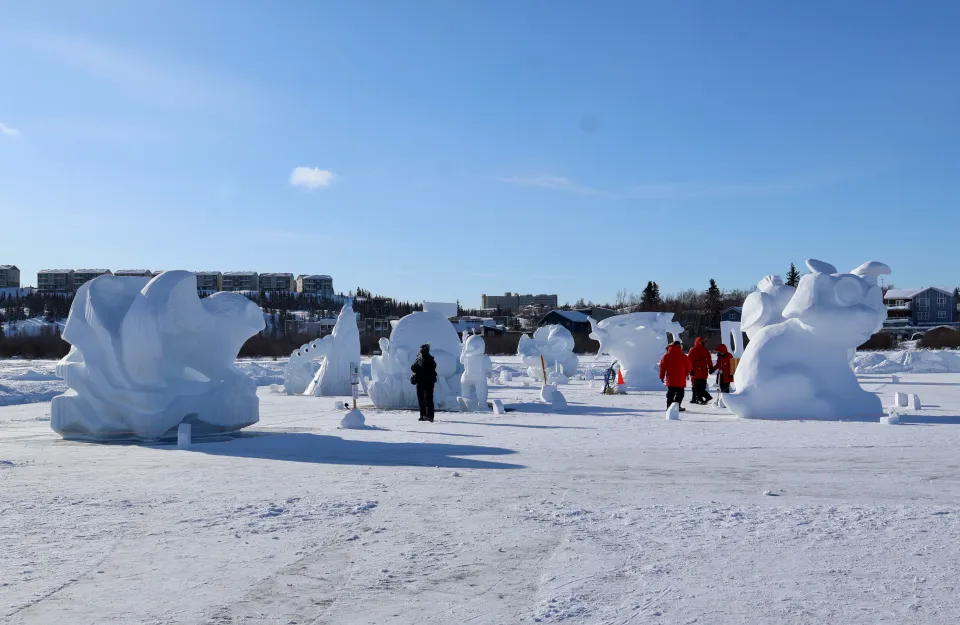 Snow sculptures on display as part of the 2026 Snowkings’ Winter Festival’s International Snow Carving Symposium. Emily Blake/Cabin Radio
Demarcke thinks a lot about AI – not necessarily through the lens of culture, but making sure the territory is represented when people ask Claude or ChatGPT where their next vacation should be. That’s a concern the tourism industry didn’t have a few years ago.
“We know people are using AI to search for destinations, so NWT Tourism is really working hard to make sure we are being found in that space,” she said.
Ten or 15 years ago, this work took the form of search engine optimization, the act of using the right keywords and approaches to have your website rank highly in Google searches.
Demarcke describes the AI equivalent as “having the right stories and the right content embedded in those stories” so an AI helping to book a trip highlights the NWT to the user. (In many cases, the person initiating the chat may never even see a list of search results – just the options the AI selects to put forward.)
“Our job is making sure we have accurate, up-to-date information on our website. It’s making sure we’re having conversations and answering questions on social media with accurate information, really good content, so that when the AI is scouring the web, we have as much information out there as possible,” said Demarcke.
“It’s all moving really, really fast, and it’s a big job to try to keep up to it. But we’re doing our best with the tools that we have.”
‘We don’t need AI to enhance the aurora’
Still, Demarcke acknowledged the “strange” feeling of advertising the NWT to robots instead of humans.
In the North, that feeling might be amplified as many of the activities are inherently traditional: crafting, canoeing, fishing, hunting, and various cultural events that demand a deep respect for their integrity.
Advertisement.
Advertisement.
Is there a conflict there? Or can those things – thousands of years old – coexist with tour operators using AI to get people to visit?
“One of the things we have to be a little cautious about is that our destination is spectacular in and of itself. We don’t actually need any tools to elevate any type of experience,” said Demarcke.
“We don’t need AI to enhance the aurora. We want to be really cautious to make sure that some of those tools aren’t being used to showcase our destination as anything different than what it is.
“So there’s a little bit of conflict there. But there’s some good in [AI]. It’s allowing people some access to our destination that maybe they didn’t have before. That’s a good thing. And then it’s just up to us to make sure we’re showing who we truly are.”
In pictures: This year’s snow sculptures
Speaking of what things truly are, McGurk wants the original sculptors to at least be credited when an AI video transforms their work.
Beyond that, they are prepared to admit the videos might have a place, even if they are fundamentally altering the nature of art.
“I find sculpture to be more of a conversation than other visual art forms,” McGurk said.
“Once you put it out in the world, you don’t have a lot of control or influence over how people interact with it – and because it’s a three-dimensional piece of work, it can be seen from multiple perspectives. For people to use AI to animate those sculptures seems like a continuation of that conversation.
“But I don’t know whether or not I like it.”
Related Articles