
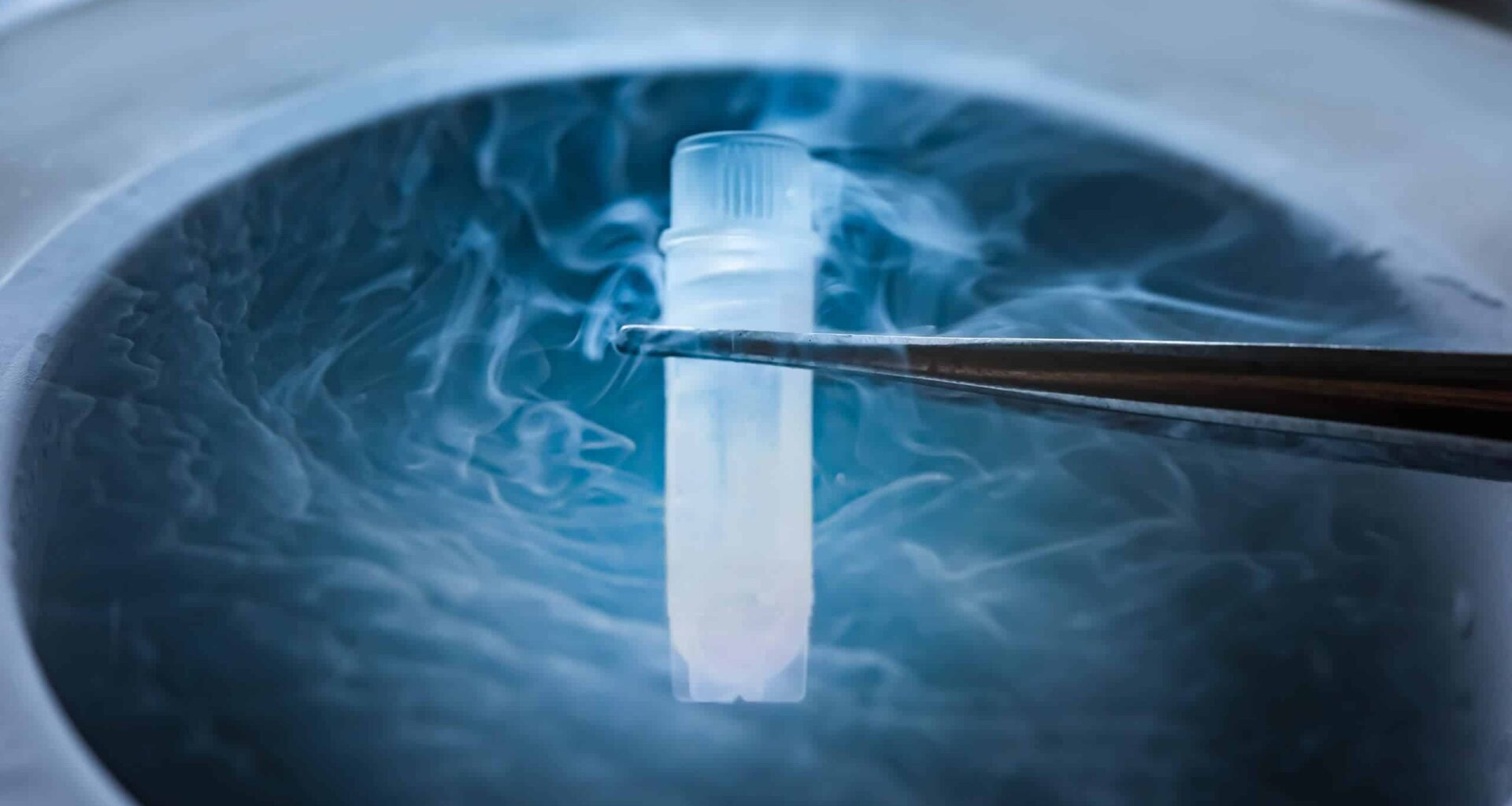
A team in Germany has shown that mouse brain tissue can regain measurable signs of activity after being preserved in a glass-like state at extremely low temperatures and then thawed. The work marks a technical advance for cryopreservation, the effort to store living tissue without destroying it in the process.
Freezing usually ruins brain tissue. Ice crystals puncture cells and distort the fine structure that neurons need to send signals. In this study, the researchers used vitrification to prevent crystal formation by replacing much of the water in the tissue and cooling it into a glass-like state. When they rewarmed the samples, mouse brain slices and some hippocampal tissue taken from whole brains regained several basic functional properties.
The study does not show anything close to reviving an animal after freezing—let alone a person. It does not restore behavior, consciousness, or a living brain in a functioning body. What it does show is narrower but still important: some preserved brain circuits can resume electrical activity after complete shutdown in the vitrified state.
No Ice Crystals
 Mouse brain section scan. Credit: Wikimedia Commons
Cryopreservation appeals to transplant medicine for an obvious reason: it could let doctors store organs for much longer instead of racing against the clock. It has also become a talking point in the longevity world, where some people see it as a bet on future medicine. But freezing is brutal on living tissue.
“If brain function is an emergent property of its physical structure, how can we recover it from complete shutdown?” asks Alexander German, a neurologist at the University of Erlangen–Nuremberg, according to Nature.
His team began with thin slices from the mouse hippocampus—a brain region central to learning and memory. After vitrification, storage, and rewarming, the slices still showed intact membranes and preserved synaptic structure under microscopy. The researchers also measured mitochondrial respiration, a sign of cellular energy use, and found a modest decline under the best conditions. They concluded that most of that drop came from toxicity linked to the protective chemicals rather than from the cooling and rewarming process itself.
The bigger question was whether the tissue still worked. The answer was partly yes. The rewarmed slices retained neuronal excitability, basic synaptic transmission, and long-term potentiation (LTP), a long-lasting strengthening of synapses that researchers widely use as a cellular model for learning and memory.
“The key point for us was not just that some cells survived, but that the tissue retained core features of function after rewarming, including neuronal excitability, synaptic transmission, and long-term potentiation, which is a central cellular mechanism underlying learning and memory,” German told IFLScience.
×
Thank you! One more thing…
Please check your inbox and confirm your subscription.
Not Yet, Whole Brain
After the slice experiments, the team tried something harder: vitrifying the whole mouse brain in place. That meant delivering protective chemicals through the blood vessels while dealing with the blood-brain barrier, which makes it difficult for substances to enter brain tissue evenly.
The whole-brain experiment proved much more difficult. As the researchers pumped protective chemicals through the brain, water escaped too fast and the tissue shrank. They tried to soften that effect by introducing the chemicals step by step and rehydrating the brain along the way. The approach worked only part of the time. In the final protocol, just one of three brains was in good enough condition for functional testing.
Even then, the researchers examined only the neuron type that performed best in earlier slice work, granule cells in the dentate gyrus of the hippocampus. That means the paper does not show that all brain cell types survive equally well, or that large-scale brain function remains intact after the process.
Outside experts see the work as a real advance, but not a near-term path to suspended animation. “Alex German’s study is impressive in that it is the first work to show any recovery of electrophysiological function (e.g. ‘brain waves’) from a brain that had been vitrified (turned to glass) and then rewarmed,” Ariel Zeleznikow-Johnston, a neuroscientist not involved in the study, told IFLScience.
Deep Pause
 Not yet, Fry. Credit: Futurama
The most immediate applications are likely in research, not human preservation. Better brain-tissue storage could help labs preserve samples in a state closer to living tissue, spread experiments across time and place, and perhaps reduce the number of animals needed.
Medical use is a much harder target. Larger brains and organs are tougher to load with protective chemicals, more prone to uneven cooling and rewarming, and more vulnerable to chemical toxicity and mechanical stress. Those are not side issues. They are central barriers that still stand between this study and any serious claim about reversible human cryopreservation.
So the new study does not show that identity, memory, or consciousness can be stored and restored in a whole, frozen animal. For now, the achievement is preserving enough structure that some circuits can work again after the brain has been turned, briefly, into glass.
The findings appeared in the journal PNAS.