
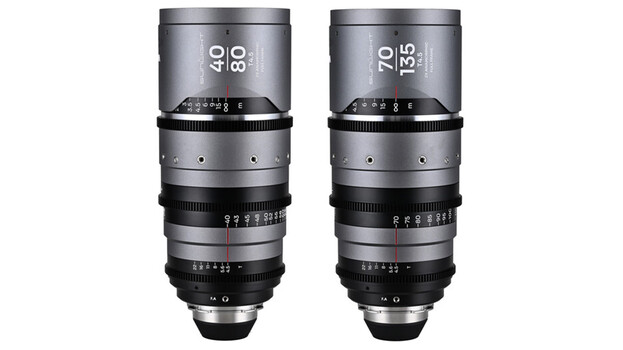
Recently, I got a chance to have a look at the brand-new Laowa Sunlight 2x FF Anamorphic Zoom Series and thought I’d share a thought or two.
Why shoot anamorphic? When I was just beginning as a filmmaker, that question was simple. Back then, films were captured on, well, film. There were no high-resolution sensors to pine after. Just real film negative whirling through the camera. The width of the 35mm negative was standard. If captured natively, you’d get something akin to a 1.33:1 aspect ratio. But if you wanted something in full widescreen glory, or 2.39:1, you’d do one of two things. Either you’d crop into the image, placing black bars at top and bottom to generate a widescreen final image — the most straightforward method. Or you’d capture with anamorphic lenses. These lenses essentially squeezed the full widescreen image into a taller container. In camera, the image captured looks distorted — unusually tall. But once desqueezed in post, you have a final result that desqueezes to 2.39:1 (or whatever your desired aspect ratio was). It was essentially a way of getting more “resolution” for widescreen final delivery. Instead of just using the center crop of the negative, you were using the whole surface area. So if you wanted to shoot an expensive action scene with amazing cinematic detail, you’d shoot anamorphic.
But in the modern age, where we have 4K, 6K, 8K, 12K, even 17K sensors and we are still mostly projecting 2K DCPs (or sometimes 4K), there is more than enough resolution in modern cameras to handle just cropping into the middle of the sensor and still have plenty of detail to spare. So essentially, the main reason for anamorphic lenses to exist in the first place is something of a thing of the past.
Yet they persist. Why? Well, after so many years in the filmmaking firmament, the look of anamorphic is somewhat baked into the audience’s understanding of a certain kind of cinematic look — so much so that certain irregularities associated with anamorphic lenses, the oval-shaped bokeh, the bright horizontal flares that announce themselves with a bullhorn, have all become associated with a certain type of film. So modern DPs often shoot anamorphic lenses, even in the digital world, not because they need the detail, but because they want the imperfections.
Of course, whether or not that is worth it to you is a matter of taste. Those imperfections come at a cost. First, as previously stated, you’ll need to consider monitoring. The image arrives squeezed. If you want to see what your final image will look like while on set, you’ll need to have a way to desqueeze it. Ideally, you are shooting with a high-end camera that includes the ability to show the desqueeze in camera. Otherwise, as was the case in my testing the Venus Optics Laowa Sunlight 2x Anamorphic Zooms, you may find yourself shooting with a cinema camera that lacks anamorphic support. Ahem, yes, I’m talking about you, Nikon ZR. So you’ll need to rig out your camera with an external monitor that does have the ability to show a proper desqueeze during capture, so that you can be intentional and precise in your compositions.
Speaking of rigging, many anamorphic lenses I’ve worked with are also rather heavy when compared to their spherical brethren. The Laowa Sunlight anamorphics are no exception, coming in at 2.6–2.8 kg. They may not strictly need lens support if you are mounting to a larger and sturdier camera body. But in my opinion, I’d definitely opt for lens support if you have the choice. The lenses felt like they were pushing the envelope on my Nikon Z9. On the ZR, which is more like mounting a camera to a lens as opposed to mounting a lens to a camera, I was getting nervous. So just to be on the safe side, I’d suggest using these lenses over 15mm rods with lens support to offset some of the inherent weight.
The weight distribution feels relatively balanced. In the marketing materials, Laowa shows many users operating these lenses handheld, but I think they are really more optimized for a more formal production approach rather than a run-and-gun scenario. Speaking of weight distribution, the natural balance is all the more impressive when one considers that these lenses have their anamorphic elements towards the front of the lens. For anamorphic shooters, this is the desired placement, as it provides optimal results while retaining that anamorphic character.
This is definitely a lens set made for high-end production work in a team environment. I love zooms because they often mean I can move faster. That’s definitely true of these lenses as well. Punching in from 40mm to 80mm or 70mm to 135mm without having to mount a new lens definitely speeds production. Of course, at the heavier weight and fully manual in operation, these are definitely not lightweight lenses to bring around on your run-and-gun content creation trip. Rather, these are a set of lenses you would mount to a proper studio camera or on a fully staffed set to help you speed along at a more rapid pace — especially on something like a multicam set where you can quickly adjust shot size without needing to move sticks.
The added weight of the Sunlight zooms is also the result of one of their key features. This set of two lenses are not only anamorphic, but anamorphic zooms — the first ranging from 40mm to 80mm, the second ranging from 70mm to 135mm. So it is easily conceivable that one could go an entire production with only these two zooms in tow. While the added weight does make run-and-gun filmmaking less likely, the broad zoom range makes these an excellent choice for tripod-mounted rigs where your operator can easily zoom in or out and recompose quickly rather than calling for a lens change.
They have a maximum aperture of T4.5, so they aren’t the fastest lenses in the world. But this is a very reasonable T-stop for anamorphic shooting. I tended to shoot them at T/5.6. Focusing anamorphic lenses is a new level of skill beyond working with spherical lenses, and a deeper T-stop is going to be your friend. But once you’ve nailed your focus, these lenses create a beautiful image. The lenses also offer an additional back focus adjustment lever to help you further dial in your sharpness.
They are parfocal, meaning your focus will stay consistent when you zoom in or out. They are 2x anamorphic. So if we take 40mm just as an example, that basically means that vertically they feel like a 40mm focal length, while horizontally they feel like a 20mm lens in terms of width. When at 80mm, it seems 80mm vertically and 40mm horizontally, and so forth. “2x” refers to the squeeze ratio. A 2x anamorphic on a 16:9 sensor yields a native recorded aspect ratio of about 3.56:1 after desqueeze. Obviously wider than even 2.39:1, this means you’ll be cropping off the sides of your image (unless you just want something amazingly wide). If you had a 4:3 sensor, 6:5, 1:1, or an open gate option (again, I’m looking at you, Nikon firmware department, thinking about the ZR), you can achieve different desqueeze ratios depending on your lens and camera combination.
Native aspect ratio on a 16:9 sensor.
Speaking of coverage, the Laowa Sunlight anamorphic zooms cover full frame. In testing on the ZR, I noticed that you have heavy vignetting on the outer edges at 40mm. But remember, you are cropping into the center of the image to get to 2.39:1, so that vignette is going to be invisible in your final image. Just the same, when you zoom to 50mm, even the crop on the super-wide image goes away and stays away throughout the rest of the range.
The lenses have a 77mm filter thread. I found the barrel of the lens (a 105mm diameter) a solid size to accommodate my matte box. As a matched pair, the focus, zoom, and iris rings are identical across both lenses. So once you are rigged up on set, swapping one lens for the other doesn’t require any adjustments to your FTZ connections.
I am a big fan of the image quality of Laowa lenses, and the Sunlight anamorphics are no exception. On the highly subjective scale of clinical to character, I’d put them towards the clinical side. I find many Laowa lenses tend towards clinical perfection over character wonkiness, which many would consider a good thing. In my round of lens tests a few weeks ago, I felt as if the Laowa Sunlights tended to skew a bit warmer than the other lenses I own. Personally, I like this. Definitely the best-performing lens in my little unscientific lens test.
They come in blue, amber, silver, or clear flares, depending on your preference. The set I tested had the blue flare. Personally, I think I prefer the neutral silver simply from a versatility standpoint, but the blue is possibly the most pleasing to the eye. Like most anamorphics, you will get the taller-than-usual oval-shaped bokeh as you rack focus. In terms of distortion, these lenses tend towards pincushion rather than barrel distortion. Either is easily corrected in post, and which you prefer is a matter of taste.
Focus breathing is present in these lenses. I wouldn’t say it is a serious issue, though. Check out the following two shots focused near to far to see the shifts in the outer edges of the image.
Focusing from near to far to test focus breathing.
They have a nice minimum focus distance. I found it very easy to frame up tight close-ups of details, eyes, or other elements.
The set can get everything from wides to super tight closeups.
The lenses seem built to last. They are sturdy and feel substantial. They look as though they would hold up to the demands of production beyond my own short-term test. The kit they arrived in was well considered. In addition to the two lenses, the kit arrived with all the necessary hardware required to make minor adjustments to fit the lenses to your system. The pair I shot were Z mount, which is why I opted to try them out with the ZR. The lenses also come in PL, E, RF, and L mount.
ProsAnamorphic characteristicsZoom rangeImage qualityUniform gears across setChoice of flare colorBuild qualityParfocalMinimum focus distanceAnamorphic elements in frontConsWeightNot super-fast aperture (common with anamorphic lenses)Requires additional rigging and monitoring considerations
Conclusion
The Laowa Sunlight 2x FF Anamorphic Zoom Series retails for $5,999 individually or $10,999 for the set. That’s a solid value in the cinema lens market for the lenses’ unique skill set. If you are working on a set that demands high efficiency and a unique look, these are definitely worth checking out.