
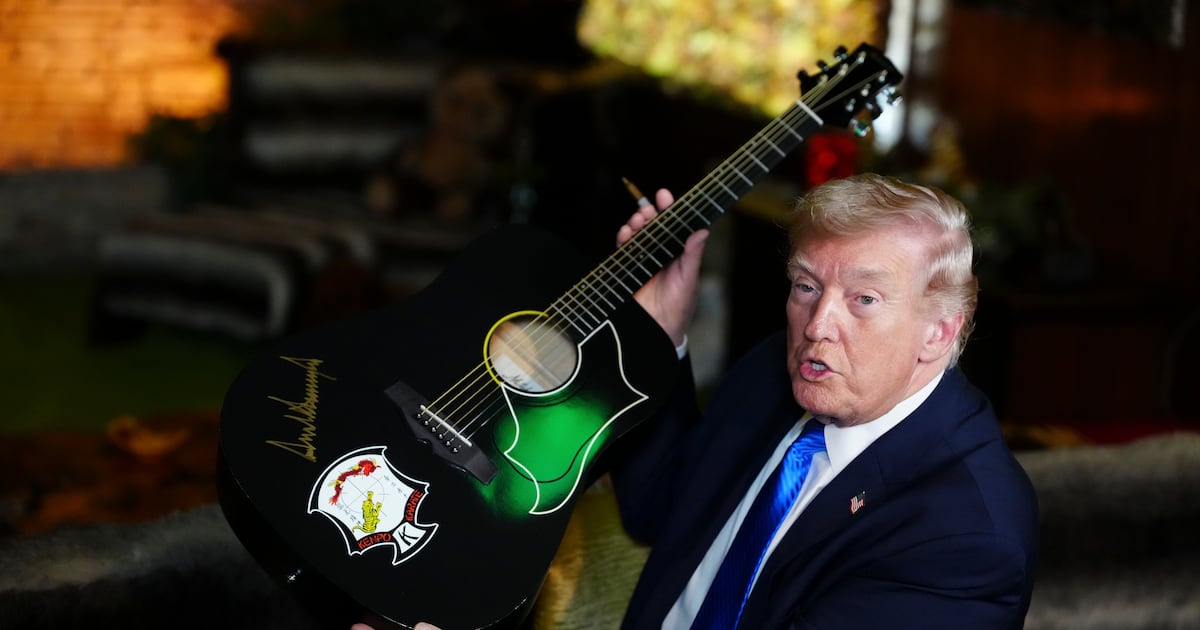
Although he was a noted Nixon supporter in the early 1970s, Elvis Presley largely kept his political views private throughout his messy final years of that messy decade. But on Monday, The King found himself shimmering through the thoughts of one Donald J Trump during a presidential day trip to Memphis in which the Iran war, US domestic crime and Graceland all merged into a surreal kaleidoscope of sound and vision.
As was reported globally all day on Monday, the president offered upbeat forecasts of new negotiations between the US and Iran, causing eye-catching market trades and a sharp decrease in oil prices. Trump’s optimism was dismissed through flat, even mocking contradictions from the Iranian regime even as the Israeli military campaign on Lebanon and Iran continued.
It was, in short, another day of hallucinogenic imagery as the US president began his Monday by predicting he might soon run the Strait of Hormuz himself – “Maybe me. Me and the ayatollah, whoever the ayatollah is, whoever the next ayatollah is” – and concluded it by touring the ghostly, perfectly preserved mansion in Memphis, where time has stood still since the sweltering August day in 1977 when Elvis left the building.
Trump was chiefly in Memphis to update the public on the success of the administration’s Make United States Safe Again campaign, with attorney general Pam Bondi, secretary of defence Pete Hegseth and White House deputy chief of staff for policy Steven Miller all tagging along for company and a few very brief words.
A last-minute decision was made to take in a tour of Graceland before returning to Washington. Given the extraordinary events of the past three weeks and the tremulous international mood, there was something profound, lonely and unforgettable about the film roll of Trump touring the Presley home. Trump is no sentimentalist. But he is an American whose formative decades were the 1960s and 1970s.
And even he seemed to feel the aura as he was given a private tour of the Presley household, with its quirks and innovations – the fancy bread warmer; the carpeted ceiling in the Jungle Room; the private staircase from boudoir to kitchen for when The King felt the wee-hours call of the refrigerator; his GI helmet; his Gibson guitar and his gold telephone. For half an hour anyway, Trump was just like any other besotted American tourist, albeit it one who could turn to the amassed media before knowingly asking his tour guide: “Does Elvis get treated better than me?”
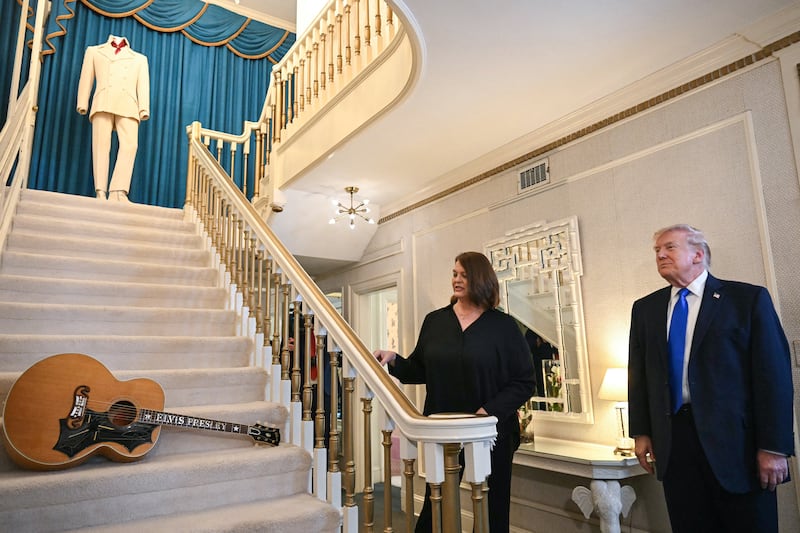 US president Donald Trump at Graceland on Monday. Photograph: Saul Loeb/AFP via Getty Images
It was hard to know what to do with any of this except to wonder what the Iranians – not just the surviving hardliners in the Islamic Republic regime, but the 91 million citizens – would think if they could see those images. In the space of four months, tens of thousands of citizens have been slaughtered by the regime, and president Trump and key figures of the administration encouraged others, in the wake of the initial bombing campaign that killed the Ayatollah Ali Khamenei, to seize their chance for liberation. Now, Trump appeared to be declaring imminent victory and touring one of the Deep South’s sacred touchstones.
A series of Monday polls predictably reflected America’s general lack of enthusiasm for high fuel prices and the possibility of US military personnel on the ground in Iran. But in Memphis, through a long series of speeches dominated by the president, it was possible to thread together the key points that the Trump administration will use in advance of the midterms.
If Trump can manufacture a relatively swift exit from Iran, and if the fuel prices and inflation drop, then the administration will, in the coming months, offer the blunt comparison of Republican strength through safe cities and decisive foreign action against Democratic weakness and indecision.
“We built the greatest military in the world,” Trump said.
“We are showing it now with Venezuela, with Iran. Our country is now respected all over the world. A year and a half ago, we were a laughing stock.”
Turning to the decision to bring Ice agents to help staff US airports where passengers are facing hours of waiting in line to pass through security checks because of the congressional funding impasse, Trump linked the turmoil with his push for new voting identification regulations in advance of those November elections. He confirmed that the Ice agents deployed at the airport would still seek to apprehend anyone they felt merited arrest.
“They should never have been allowed to enter our sacred ground,” he said in a long, familiar tirade about undocumented immigrants.
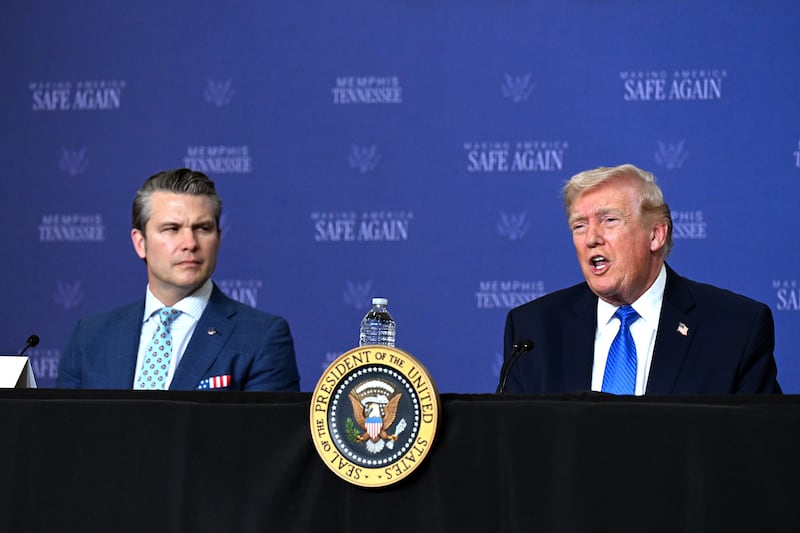 US secretary of defence Pete Hegseth with president Donald Trump in Memphis on Monday. Photograph: Roberto Schmidt/Getty Images
He added: “11,888 murderers. In any event, the Democrats are being blamed by the American people for the catastrophe going on right now in our airports. We want the public to know we are not going to let them out of this trap they created for themselves. Think of it. We are talking about two separate items but they are really the same. Voter ID is part of homeland security. And proof of citizenship is proof of homeland security. I think they should be welded in. Republicans to not settle with Democrats and let them out of this hole.”
Once in Graceland, Trump displayed that uncanny facility of his to compartmentalise in extremis. It may have helped that earlier, in Memphis, he had slipped in a single, significant line that seemed to credit Hegseth as the lead voice among the choir advocating the bombing of Iran – “And Pete, I think you were the first one to speak up and you said: let’s do it.”
[ Elvis Presley’s Irish roots proven by legal documentOpens in new window ]
But at any rate, the president allowed himself to become caught up in the musty poignancy as he toured the rooms full of exhibits of Elvis’s gargantuan 20th-century life. Towards the end, Trump was asked about the possibility that in the “very distant future” pilgrims would tour Mar-a-Lago in the same way they continue to flock to Graceland.
“Well, I don’t know,” he said, sounding a rare elegiac note.
“That’s just something I could never say … Wouldn’t it be terrible if it’s, ‘Oh yes. Oh yes. Headlines: Trump says …’. Nah. Whatever. That’s a special place too. All I know is that all my life I’ve heard about Graceland. I’ve watched Elvis. Surprisingly, because I was around when Elvis was in his semi-prime at least, for some reason I didn’t know him. But I knew just about everybody else. I knew all of them. But I don’t know why with Elvis – he was a little bit locked into Vegas, right? But he was a very special guy.”
Then, to the background sound of Love Me Tender, the president of the United States signed a replica guitar, chuckled at the tour guide’s mention of Elvis’s karate exploits and was then struck by a new, intriguing thought.
“Okay. Was he really good? Could I have taken him in a fight?”