

A Galway-based student has led researchers to the discovery of a new planet after originally thinking she had spotted a large clump of dust.
Chloe Lawlor, a PhD student at the Centre for Astronomy at University of Galway’s Ryan Institute, made the discovery just seven months after her team found another new planet in the same region of space some 430 light years from Earth.
At about 5 million years old, the newly discovered planet, which they named WISPIT 2c, is considered young and still forming.
But it is believed to be already 10 times the size of Jupiter, the largest planet in the solar system in which Earth exists.
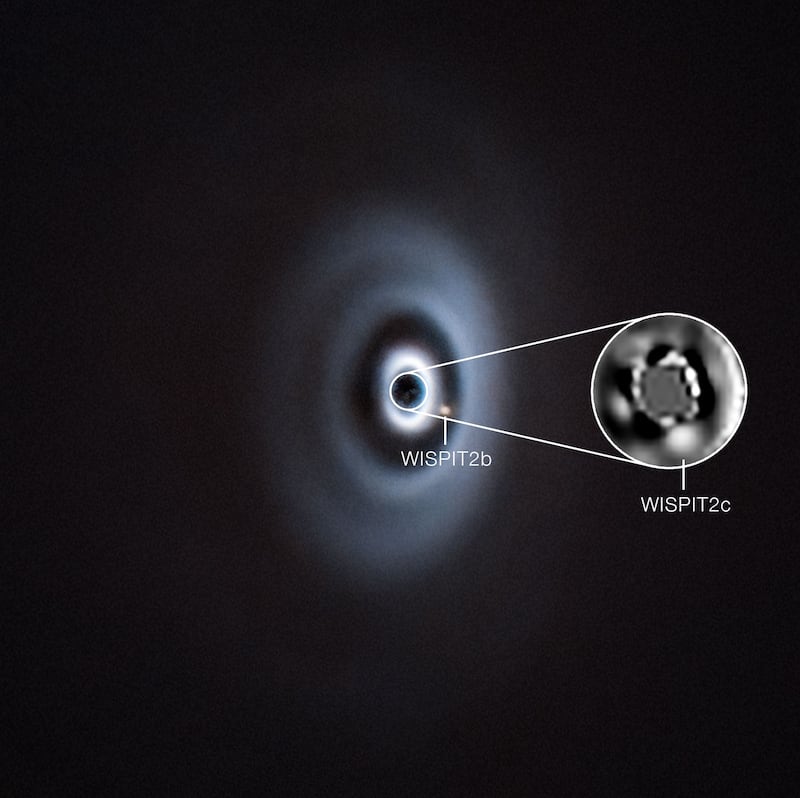 Very Large Telescope images of two planets (WISPIT 2b and the newly discovered WISPIT 2c) forming around the young star WISPIT 2. Photo credit: ESO/C. Lawlor, R. F. van Capelleveen et al
Its discovery follows that of WISPIT 2b last August. Both young planets are orbiting a young star named WISPIT 2.
Lawlor said that after finding WISPIT 2b, the team suspected there might be another celestial object in the area but she was still shocked to find a second planet.
“At first, we weren’t sure if it was a planet or a very large dust clump,” she said. “Carbon monoxide is one of the key signatures we are looking for in young giant planets.
“When we saw it clearly in the data, that was when we knew we had something significant.
“There was definitely an element of disbelief. I didn’t expect to be the one to find a second planet in the system.”
The find was made with the help of fellow researchers from the Netherlands and Germany and the use of the European Southern Observatory (ESO) facility in Chile’s Atacama Desert, where the appropriately named Very Large Telescope is located.
Although WISPIT 2c is twice as big as the previously detected WISPIT 2b, it orbits four times closer to its host star, which makes it extremely difficult to detect with ground-based telescopes.
However, the ESO facilities allow several telescopes to be linked to act as one giant instrument, and that enabled the team to observe regions very close to the star.
“We very quickly made follow-up observations using the Very Large Telescope Interferometer, an incredible set-up where multiple telescopes can be connected to form a large virtual telescope,” Lawlor said.
“This allowed us to take what we call a spectrum, which is essentially a chemical fingerprint, revealing the elements and molecules in an object’s atmosphere.”
WISPIT 2 is only the second known young and still forming multi-planet system and it is thought it may resemble the young solar system.
“It will become an important laboratory to study planet formation,” Lawlor said.
Prof Frances Fahy, director of the Ryan Institute, said the discovery was a remarkable achievement.
“Discoveries like this capture the imagination and can inspire a whole new generation of astronomers,” she said.