
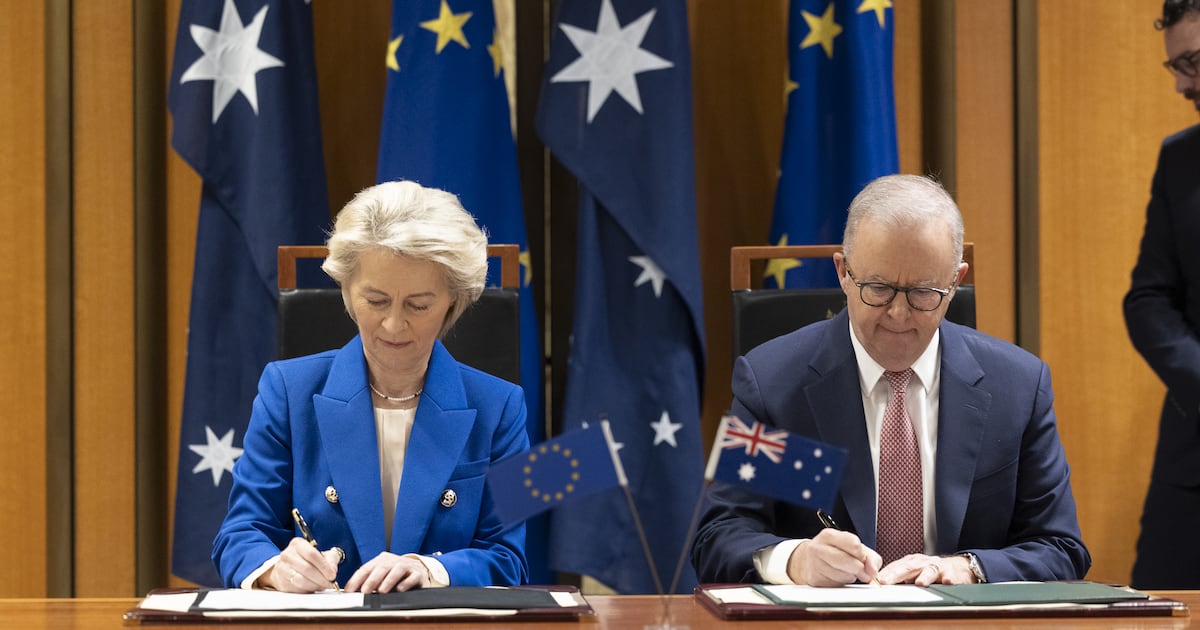
The EU has signed several big trade deals in recent months. In September, it inked a deal with Indonesia. In January, it finalised one with the South American bloc Mercosur. Later that month it signed what it described as “the mother of all trade deals” with India. And now it has secured one with Australia.
Context is everything. Since the US began imposing tariffs on the rest of the world, the EU has fast-tracked several outstanding agreements, ones that might have lingered in the negotiating phase for longer. Another motivation is to reduce the EU’s dependency on China which recently imposed control on critical mineral exports.
What does the latest one look like?
The deal signed in Canberra is said to be worth about A$10 billion (€6 billion) in additional trade for both sides and was described as a “win-win” by Australia’s prime minister Anthony Albanese and European Commission president Ursula von der Leyen. In practice, it eliminates more than 99 per cent of tariffs on EU goods exports to Australia, cutting €1 billion a year in duties for companies. It will also lower tariffs on imports of critical minerals, the EU said. EU trade chief Maros Sefcovic said he expects the bloc’s annual goods and service exports to Australia to jump by one-third over the next decade, up from €65 billion currently.
Which sectors benefit most?
Like most trade deals, there were winners and losers. European carmakers welcomed the deal as it raised the luxury tax threshold for EVs, exempting roughly 75 per cent of their exports to Australia. The deal also provides greater access for EU telecoms and financial service firms. In return, EU tariffs will be removed on imports of a wide range of Australian goods, including critical minerals, manufactured items and many agricultural products.
But farmers in both jurisdictions were critical of the changes to export quotas particularly those for beef and lamb. Australian farmers wanted more, European farmers wanted less. Previous trade talks between both sides collapsed in 2023 on the issue of meat exports.
What will be the biggest impact for Ireland?
The amount of Australian beef allowed into the EU is set to increase more than tenfold in the next decade and that’s seen as a big negative for Ireland. “This is another deal with a large exporting nation with lower production standards and significant economies of scale,” said the president of the Irish Farmers’ Association (IFA) Francie Gorman. Farmers here vehemently opposed the Mercosur deal for much the same reason. The cumulative impact of these deals is not being properly assessed and farmers feel they are being used as a sacrificial lamb, he said.
“The Australians walked away from an offer of 23,000 tonnes of beef in 2023. Now we are hearing that the EU Commission is likely to give further ground by offering an increase to 30,000 tonnes of beef and 20,000 tonnes of sheep meat as part of the revised draft,” Gorman said.
What else?
The trade deal comes paired with a defence partnership that opens a path toward Australia joining SAFE, the EU’s €150 billion defence procurement instrument. Again the context – fraying geopolitical relations, increased levels of protectionism – seems to be the guiding principle.