
Key points
Aughinish Alumina in Co Limerick supplies vast amounts of raw materials to Russian aluminium smelters, according to a new investigation.The project, by The Irish Times and the Organised Crime and Corruption Reporting Project (OCCRP), draws on confidential documents, customs data and transport records along with satellite imagery and financial records. The smelters supply aluminium to a Moscow-based trading company which in turn supplies Russia’s military industry.The aluminium is purchased by dozens of arms companies that make weapons for Russia’s war in Ukraine, including tanks, cruise missiles and bombers.Exports of alumina from Ireland to Russia have surged in recent years, despite Russia’s stagnating civilian economy.Aughinish and the Russian smelters are owned by Rusal, a company with deep connections to the Kremlin and Moscow’s arms industry.The Irish Government has lobbied extensively to keep Rusal free of sanctions, despite the key role of alumina in the Russian arms industry.Alumina is not sanctioned by the EU. Aughinish states that the alumina it produces is a basic commodity that is “vital for countless civilian industries”.Conor Gallagher looks at what happens to alumina made in Aughinish, Co Limerick after it is exported to Russia. Video: Enda O’Dowd
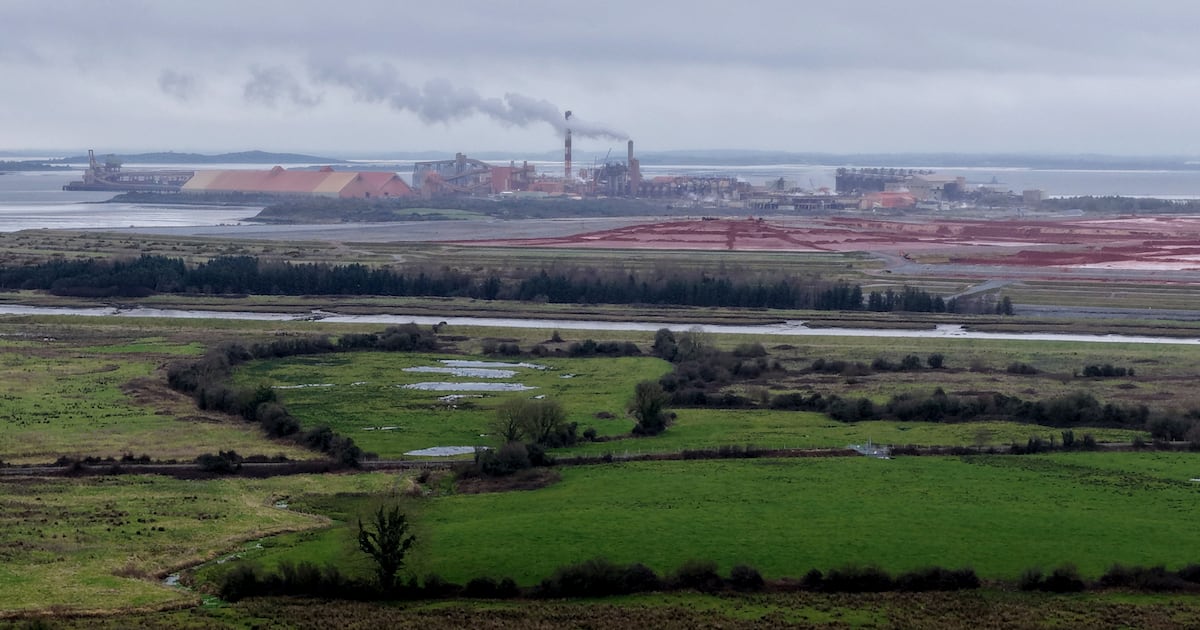
The hulking industrial behemoth of Aughinish Alumina stands in stark contrast to its surroundings. On one side of the plant is a butterfly reserve. On the other is a nature walk through a forest of yellow furze.
The large facility – located a 40-minute drive west of Limerick city – sits amid these natural surroundings, spewing metallic-tasting smoke from its chimneys.
Other than workers coming and going in the morning, there’s not much traffic. The vast majority of what comes in and out of Aughinish passes through by sea via the plant’s private jetty next to the port of Foynes on the Shannon estuary.
Twice a day, ships dock here, importing bauxite from mines in Guinea and Brazil to the Co Limerick plant, and exporting finished alumina – the raw material for aluminium – to ports around Europe.
The company and the Irish Government point out that alumina is vital to civilian industries across Europe, including aircraft and car manufacturers, forming an important link in the global supply chain of manufacturing and industry.
But that raw material has other uses. Much of the alumina produced in Aughinish goes to Russian smelters where it is turned into aluminium.
An investigation carried out by The Irish Times in co-operation with the Organised Crime and Corruption Reporting Project (OCCRP) has found that this material is then sold to a Moscow-based trading company that supplies aluminium to Russia’s sprawling military industry.
These Russian arms companies produce many of the weapons that have caused thousands of civilian deaths in the country’s four-year war on Ukraine, including tanks, cruise missiles and combat aircraft.
Aughinish is owned by the Russian metals conglomerate United Company Rusal, or simply Rusal for short. Management at the Co Limerick facility are Irish, as are most of its employees, and the Irish Government has expended significant diplomatic capital in the US to protect the jobs and money Aughinish generates for the local economy.
The company itself notes that alumina is a “basic commodity”, which is not sanctioned by the EU. But the use of the raw material in wartime Russia shows the challenges of standing against military aggression while protecting the manufacturing of a commodity produced for peaceful purposes and used by other industries in a globally connected world.
Governments have maintained that, despite being owned by a Russian company that ships large amounts of the product made in Co Limerick to that country, Aughinish is not supplying Moscow’s war machine.
The plant is “not in any way connected to a war machine”, said Patrick O’Donovan, Limerick TD and Minister for Culture, in April 2022 during a Dáil debate about the plant’s connections with Russia.
“It is not connected, as some people might want to suggest, to any sort of Russian empire,” he continued, adding that Aughinish provides the EU with up to 30 per cent of the alumina required for aircraft and car manufacturing.
The evidence unearthed by this investigation shows, however, that alumina produced in Aughinish is being transported to Russian smelting plants which in turn supply dozens of Russian arms companies, including those producing weapons of war used in Ukraine.
What is bauxite?
Bauxite ore is extracted from mines before being used in the manufacture of aluminium. It is first refined into alumina before being smelted into aluminium and used in the manufacture of everything from tinfoil to cars and weapons of war.
Shipped to Ireland
Bauxite destined for Aughinish Alumina, Co Limerick is mined in locations in Guinea and Brazil before being shipped to the Irish facility.
Shannon Estuary
Aughinish, a former island and now peninsula, is located close to the Shannon-estuary towns of Foynes and Askeaton. Huge amounts of distinctive red-coloured bauxite residue is stored as so-called ‘red mud’ on 450 acres of land near the Aughinish Alumina plant. This has raised environmental concerns and local objections over many years.
Aughinish Alumina
Aughinish Alumina is the largest alumina refinery in Europe and owned by Rusal, a company founded by Russian oligarch Oleg Deripaska. It is a major employer in the area, with more than 400 workers directly employed and many hundreds more also making a living from the facility.
Ireland → Russia
The bauxite is refined in the Limerick plant and alumina is then exported to Russia on ships to Novy Port, which is near the western Russian city of St Petersburg.
Novy Port → smelters
The refined alumina is taken from the port by train to massive smelters, where it is turned into high quality aluminium. The two biggest recipients are the Sayanogorsk and the Krasnoyarsk aluminium plants.
The trade
Aluminium product is purchased by a trader called ASK, which has extensive links to Rusal. ASK then sells aluminium to sanctioned weapons manufacturers who make missiles, tanks, helicopters and other weapons of war used in the Ukraine conflict by Russia. The companies are marked on the map as red dots. Financial records do not definitively show whether specific Irish alumina is making its way into Russian weapons. But, they do show vast amounts of Irish alumina is being smelted into aluminium by Rusal, which then sells it to the ASK. The trader, in turn, supplies huge amounts to Russian weapons companies.
Russia → Frontier
The full-scale Russian invasion of Ukraine began on February 24th, 2022. More than 100,000 Ukrainian nationals fleeing the war have been granted temporary refugee status in Ireland since 2022. An estimated total of nearly two million people have been killed, wounded or are missing on both sides of the conflict since 2022.
The investigation was carried out in co-operation with the OCCRP, a network of journalists, and European publications including iStories, a media outlet founded by investigative journalists from Russia, and The Guardian in the UK.
The investigative project analysed confidential documents, customs data and transportation records along with satellite imagery and financial records, to trace the passage of materials from Guinea and Brazil, through Ireland, and on to Russian smelters.
Once the raw bauxite arrives at Aughinish by ship it goes through the Bayer process. This uses huge amounts of heat, pressure and caustic soda to turn bauxite into alumina, producing the red mud that surrounds the plant.
 Conor Gallagher discusses the Aughinish investigation
The finished alumina is then loaded back on ships and exported overseas.
Satellite and shipping data shows much of the material produced in Co Limerick is transported to smelters in Russia, which are also owned by Rusal. There, it is transformed into aluminium.
Between 2020 and 2024, Russian imports of Irish alumina surged, rising from 394,430 tonnes to 826,584 tonnes, before declining slightly last year, according to export data from the Central Statistics Office (CSO).
Aughinish also sells substantial amounts of alumina to other countries, but since the war, Russia has become by far its biggest customer. In 2020, Russia accounted for 23 per cent of the Limerick plant’s business. Last year that figure was 68 per cent, according to the CSO.
Most EU states have drastically reduced their exports to Russia since the start of the war. Ireland is one of three exceptions. Exports of all Irish goods to Russia jumped from €539 million in 2021 to a record €836 million last year, according to figures provided by Eurostat, the statistical office of the EU.
The demand for Irish alumina increased in recent years despite Russia’s stagnating civilian economy. This is driven in part by Rusal losing access to its alumina plant in Ukraine, which is located near the war’s front line.
The Irish alumina arrives in Russia at Novy Port, near St Petersburg, where it is loaded on to trains and transported almost 5,000km east to Rusal-owned smelters in Siberia. A large portion of the material is transported to the Rusal smelter in Krasnoyarsk, one of the biggest aluminium manufacturing plants in the world.
Sayanogorsk, another Rusal smelter located about five hours’ drive south, also receives large amounts of alumina from Aughinish, with smaller amounts going to the Bratsk and Rusal Ural smelters in recent years.
Russian customs data shows that in 2024, the Krasnoyarsk smelter received about 480,000 tonnes of Irish alumina, worth about $250 million (€217 million in current conversion rates), three times as much as it received in 2020. Sayanogorsk received 369,000 tonnes of Irish product in 2024, a 45 per cent increase on 2022 figures.
On its website, Krasnoyarsk states it is the only smelter in Russia that can produce high-purity aluminium, a vital component used in advanced engineering in the manufacture of fighter jets and missiles.
The smelters obtain alumina from various sources but, in the case of Krasnoyarsk, the main supplier is Aughinish. In 2024, it received two-thirds of its alumina supply from the Limerick plant, the leaked records show. Sayanogorsk received about a third of its alumina from Aughinish that year.
At this point, as far as open source data available publicly goes, the trail goes dark. There is no public record of where the finished aluminium ends up.
However, leaked confidential financial data obtained by the investigation shows a large amount of the aluminium from Krasnoyarsk – and smaller amounts from the other three plants – is sold to a Moscow-based metals trader called Aluminium Sales Company (ASK), which is strongly connected to Russia’s defence industry.
According to the leaked data, ASK paid OK Rusal, the trading arm of Rusal, 51.5 billion roubles (€543 million) for aluminium from Rusal smelters between 2022 and 2024. It also shows ASK paid the smelters at Krasnoyarsk and Bratsk separately for transport and storage services, indicating it was buying aluminium directly from Aughinish-supplied smelters.
ASK is one of the main suppliers of aluminium to Russian military companies, according to the leaked financial records. About 35 per cent of the trader’s total revenues – 28.4 billion roubles between February 24th, 2022, and April 1st, 2025 (€299.3 million according to current exchange rates) – comes from businesses fulfilling defence contracts for the Russian state.
The investigation identified 107 defence companies as ASK customers, of which 40 are subject to EU sanctions. According to Andriy Yusov, an official from the main directorate of intelligence in Ukraine’s ministry of defence, 18 of these customers are responsible for manufacturing weapons directly used in deadly attacks on Ukraine.
The companies include Votkinsk Machine Building Plant which manufactures intercontinental and medium-range ballistic missiles, including the infamous Iskander-M missile. Advanced missiles such as the Iskander killed 682 Ukrainian civilians last year, a 28 per cent increase on the number killed in 2024.
Another ASK customer, Uraltransmash, makes howitzers for the Russian army, while NPK Uralvagonzavod uses aluminium to produce the T-72 tanks that formed the vanguard of the 2022 invasion.
The records obtained by the investigation detail financial transactions, meaning they do not definitively show whether the specific alumina being produced in Aughinish is making its way into Russian weapons.
However, they do show vast amounts of Irish alumina is being smelted into aluminium by Rusal, which then sells it to the ASK trading company. The trader, in turn, supplies huge amounts of aluminium to Russian weapons companies.
Aluminium smelters mix alumina from various sources to make the finished product, with the ratios being continuously adjusted to ensure the desired properties, according to metallurgical processes expert Kristian Etienne Einarsrud.
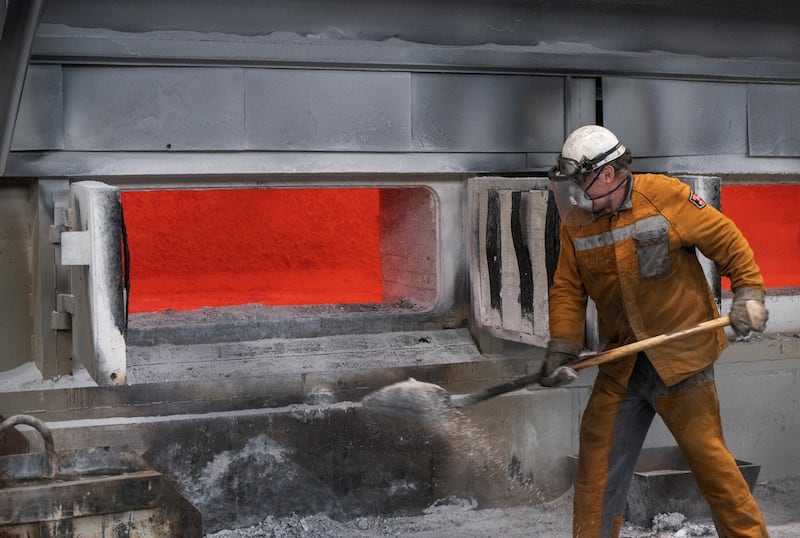 An employee works at a furnace at the Krasnoyarsk Aluminium Smelter (KrAZ) of Rusal in the Siberian city of Krasnoyarsk. Photograph: Alexander Manzyuk/Reuters
“In general, smelters operate continuously with the alumina that is available, typically stored in large silos at the smelter. These silos are filled regularly, and the origin of the alumina may vary over time depending on price and availability, which effectively leads to on‐site blending of aluminas from different refineries,” he said.
Is it possible alumina from Ireland is being diverted into a supply chain that only supplies the civilian market? Einarsrud said he has never come across such an approach.
“There is no widespread industrial practice of assigning specific alumina ‘batches’ to specific metal ‘batches’,” he said.
All of this makes it highly likely Irish-made alumina is being used to make the basic materials for Russian military equipment.
The size of the Co Limerick facility offers some idea of the role it plays in that wider industrial world. A helicopter or drone is needed to grasp the scale of the plant, which sits on 1,300 acres and covers most of Aughinish Island in the estuary.
Just under 500 acres of this land is taken up by the bauxite residue disposal area which contains millions of tonnes of “red mud”, Aughinish’s principal waste product, according to Environmental Protection Agency documents.
The operation is so big that in the mid-2000s, Aughinish opened its own power plant, which produces 115 megawatts in excess energy, according to a 2021 planning application from the company – enough to power more than 100,000 homes.
Even with its own power supply, Aughinish, the largest alumina plant in the EU, uses up to 15 per cent of the total daily gas demand in Ireland to produce its product.
By any metric, Aughinish is a success story of Irish industry and employment.
Aughinish Alumina began production in 1982 after the Government convinced the aluminium giant Alcan to open a facility on the Shannon at a time of high unemployment in the region. The plant immediately created 800 jobs. Its arrival was warmly welcomed locally.
But since it opened, Aughinish has never been far from controversy. It has been alleged that its waste products contaminated local farms and caused serious health issues for the local population, allegations the company strongly denies.
Then, in 2006, Aughinish came under Russian ownership, specifically the ownership of Rusal, which at the time was controlled by Oleg Deripaska, a close associate of Russian president Vladimir Putin.
Despite the controversies, successive governments have stood behind and supported Aughinish, financially and politically. Authorities have provided millions of euro in grants and tax breaks to the plant, while also easing environmental restrictions.
The biggest assistance has come in the form of protection from sanctions over the past 12 years. Irish governments have lobbied the US and EU extensively to make Aughinish exempt from measures introduced to target Russia following the attacks on eastern Ukraine in 2014 and the full-scale invasion of the country in 2022. So far, Ireland has been successful.
The material and the weapons
More than 100 Russian military companies have purchased aluminium from ASK since 2022, of which 40 are EU sanctioned. These include:
Arzamas Instrument-Making Plant: in 2023 and 2024 Arzamas purchased €618,224 worth of aluminium from ASK, the company that is supplied by Rusal smelters, which are in turn supplied by Aughinish, according to leaked ASK financial documents. It manufactures gyroscopes for various missiles, including the Kh-101 cruise missile, which has been extensively used by the Russian air force in strikes against Ukraine. Another version, the Kh-102, is capable of carrying nuclear warheads. ODK-Ufa Engine-Building Production Association: between 2023 and 2024, ODK-Ufa purchased €459,437.37 worth of aluminium from ASK, the leaked records show. The company manufacturers engines for Russian Sukhoi combat and bomber jets. According to the Swiss government department responsible for international sanctions, its engines “are integral to those frontline fighter jets”. The company has also been commissioned by the Russian government to develop engines for its latest “super-manoeuvrable” high-speed jets. The Votkinsk Plant: located in the Russian republic of Udmurt, the Votkinsk Plant purchased €164,251 worth of aluminium from ASK in 2023 and 2024. It manufactures the Iskander-M ballistic missile, which has a range of 500km and can travel up to seven times the speed of sound, making it almost impossible to shoot down. It has been used by Russia to destroy high-value Ukrainian targets, including advanced military technology supplied by the West. It is also regularly used against civilian infrastructure. The plant also manufacturers intercontinental ballistic missiles designed to carry nuclear warheads. Extensive links
Rusal and ASK, the trading company it sells aluminium to, have more than a client-customer relationship. The investigation uncovered evidence that the two companies have extensive links.
Leaked 2020 data shows more than 20 of ASK’s employees, including its director general Nikolai Dolgenko and the head of its commercial department, Ivan Platov, previously worked for Rusal. The two companies share registered addresses in Moscow, Volgograd and Bratsk, while ASK previously owned land in Krasnoyarsk now owned by Rusal.
Leaked financial records also show ASK received loans from Rusal companies over the years, including $2.4 million from Rusal Ural. The trading company also supports the Russian military in other ways. The company’s financial records from 2024 show it donated €871,042 to a charitable foundation, Care for Siberia. This charity shares its name with a foundation the Russian ministry of defence described as an organisation “created by businessmen” to pay bonuses to Russian soldiers in Ukraine for actions such as destroying Ukrainian tanks.
According to Alex Prezanti, a UK barrister and sanctions expert, the use of an intermediary trading company such as ASK “is a classic way of insulating a company with EU trade interests from potential EU sanctions”. If Rusal were selling directly to weapons manufacturers, “it would be easier to coalesce 27 member states to sanction it”, he said.
Further evidence of links between Rusal and Moscow’s military industry can be found in a leaked document obtained by Dossier Center, a Russian investigative outlet which lists businesses involved in Russia’s defence industry. The list includes various Rusal companies, including Krasnoyarsk and OK Rusal, as well as ASK.
Rusal is the largest aluminium manufacturer outside China. Given its size, it is considered a key strategic asset by the Russian government. But nowadays it tends to avoid any public mention of its links to the Russian war machine, including on its website and in its annual reports.
This was not always the case. In 2010, Rusal’s director of sales called the Russian defence industry a vital customer and proposed even closer links in future, according to Russian media reports.
For Ukraine, which sanctioned Rusal in 2022, there is little doubt the company provides key support to the Russian military. According to court documents in Ukraine, the higher anti-corruption court in Kyiv ordered the seizure of assets belonging to Rusal and its joint owner Deripaska in 2023.
“Rusal supplies aluminium products to Russian enterprises [that are] part of the defence complex, which directly develop, produce and supply military equipment, weapons and ammunition for the needs of the Russian armed forces,” the court ruled.
Rusal and ASK did not respond to repeated requests for comment and a detailed list of queries.
In a statement, a spokesperson for Aughinish Alumina said its product was not classified by the EU as a dual-use product, one that has both civilian and military applications and is typically subject to export controls.
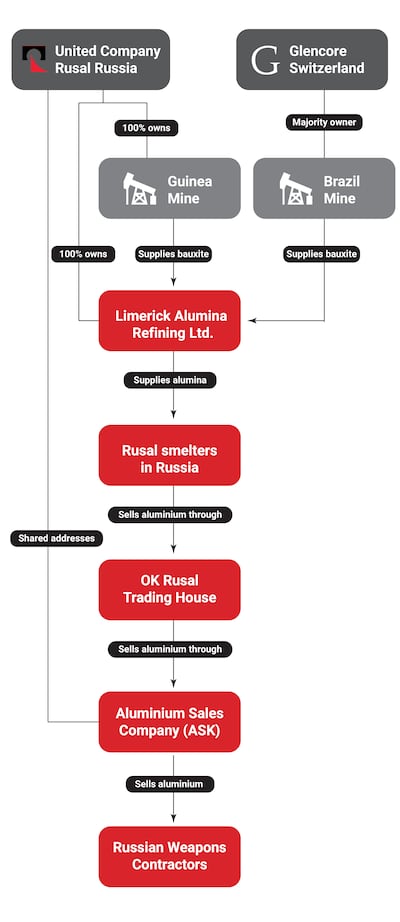 Rusal and Aughinish Alumina – where the Limerick plant fits into the web of companies. Illustration: Paul Scott and OCCRP
“We particularly underline the fact that both alumina and aluminium are an internationally recognised basic commodity, the very nature of which means they serve broad general purpose societal needs and vital for countless civilian industries,” the company said.
“We believe, that any attempt to state the contrary is flawed and seeks to create a biased narrative. Especially singling out one company for criticism in this manner discredits legitimate and vital business operations supporting thousands of workers, contractors and families, bringing economic value,” it added.
“We operate in strict compliance with all applicable European Union laws, including sanctions, export control measures and trade regulations. We uphold a strong commitment to lawful and responsible business practices and continuously monitor regulatory developments to ensure the highest standards of compliance.
“The company implemented a robust sanctions compliance and due diligence framework covering its entire supply chain. We reserve the right to take legal action if the intended publication contains inaccurate information or presents the information in a biased manner.”
Sprawling web
Aughinish Alumina Ltd sits at the bottom of a sprawling web of companies. It is 100 per cent owned by Limerick Alumina Refining Ltd, which, in turn, is entirely owned by United Company Rusal.
Rusal also entirely owns the smelters in Krasnoyarsk and Bratsk and the bauxite mines in Guinea that provide the raw materials to Aughinish. This means almost all of the aluminium production chain, from bauxite to finished aluminium, is under Rusal’s control.
The majority (56.88 per cent) of United Company Rusal is owned by EN+ Group, a Russian metals giant founded in 2002 by Deripaska, while Viktor Vekselberg, another heavily sanctioned Russian oligarch, owns 25.52 per cent through his company Sual Partnership.
Today, Deripaska owns 44.95 per cent of EN+, with various other shareholders including the mining and commodity company Glencore holding the rest. This makes him by far the biggest individual shareholder in EN+, and by extension Rusal and Aughinish.
As the founder of Rusal, Oleg Deripaska has long been a central part of Aughinish’s story. Born in a village in a poor area of southern Russia, he rose through the Soviet business world before making his fortune in aluminium following the collapse of the Soviet Union.
“I started my business in a unique time – one country was gone and the other had not yet appeared,” he once said.
“The first gave me the opportunity to get a wonderful education; the second to succeed.”
In addition to yachts, mansions and private aeroplanes, he also began purchasing various companies that would later supply arms to Russia for its invasion of Ukraine.
According to the Swiss government department responsible for international sanctions, Deripaska controls the conglomerate Russian Machines, which manufactures the BTR-80 armoured personnel carriers used in the invasion.
Like many oligarchs, Deripaska has had a volatile relationship with Putin over the years. He was once known as “Putin’s favourite industrialist”. Leaked US diplomatic cables from 2006 described Deripaska as “among the two to three oligarchs Putin turns to on a regular basis”.
This inevitably brought him into conflict with the US government. In 2018, Deripaska and many of his companies, including Rusal, were hit with sanctions by the US office of foreign assets control (Ofac) – the US department of the treasury unit that imposes economic sanctions – which alleged he had attempted to interfere in the 2016 US presidential election on behalf of Russia.
Lobbying
After frantic lobbying by the Irish Government, US authorities agreed to lift the sanctions on Rusal as long as Deripaska reduced his stake in the company to less than 50 per cent. Aughinish was able to continue in business, with Deripaska remaining its largest single shareholder.
“There was a fear and a national interest in ensuring that these sanctions which were imposed on Oleg Deripaska didn’t result in the closure of the plant overnight,” Ireland’s former ambassador to the United States Dan Mulhall, who led the Irish lobbying campaign, told The Irish Times.
“I set about lobbying the US system. It took a long time but they listened to us and they eventually made some adjustments, which they were criticised for, but I think they were adjustments that were well intentioned and did solve the problem for Aughinish.
“Deripaska distanced himself from the company sufficiently to satisfy Ofac in Washington. Obviously there were people who said it was a smokescreen but it was done and Ofac, who are not an exactly a pushover, accepted it.”
Despite the sanctions, Deripaska maintained significant interests in the West, including a €55 million super yacht called the Clio and various villas. This forced him to walk a tightrope when Russia launched its full-scale invasion of Ukraine in 2022.
When the invasion started, he called for peace and said the war was a tragedy for Russia and Ukraine, though he stopped short of condemning the Kremlin for the invasion.
A short time later, a Russian court ordered the seizure of Deripaska’s $1 billion Imeretinskiy hotel complex and marina in Sochi after the Kremlin had reportedly asked him to tone down his criticism of the war.
In 2024, Deripaska called for an immediate ceasefire, again drawing criticism from pro-Putin factions. Despite these occasional condemnations of the war on social media, some of which were later deleted, he has also been placed under EU sanctions relating to the conflict.
These 2022 sanctions significantly affected his net worth but it has since recovered; according to Forbes, Deripaska is now worth €3.45 billion, making him one of Russia’s richest men.
He did not respond to requests for comment.
Irish support
Ireland’s support for Aughinish is not surprising and goes beyond just jobs, says Mulhall. The closure of the plant would have left the State “with huge environmental consequences”, as it would be forced to clean up the large red mud deposits that pose a risk to the Shannon estuary’s fragile ecosystem.
In 2018, the plant entered into an agreement with the Environmental Protection Agency to pay up to €28 million over the course of 35 years to clean up the plant, if it were to close. However, it is not clear if this would be enough money.
In 2018, the government said it spent €61 million cleaning up half a million tonnes of hazardous waste from the former Irish Steel plant on Haulbowline Island in Cork. Using these figures, the clean-up cost for Aughinish’s estimated 50 million tonnes of red mud would come to more than €600 million.
There are 400 people permanently employed in the plant and another 500 contract workers, says Seán Golden, chief economist with Limerick Chamber, the county’s business representative group. Another 1,000 jobs are employed in companies directly supporting the plant.
 Seán Golden, Chief Economist and Director of Policy at Limerick Chamber. Photograph: Alan Betson
“It’s always felt like the fabric of the Limerick community. Everyone knows someone that has worked there,” he says.
Golden estimates the plant is worth €150 million a year to the local economy.
Asked if people are concerned about Russian links, he points out that its senior management team is all Irish, it pays taxes in Ireland and is subject to Irish regulation.
“So while there might be some concern in some communities that I won’t speak for, I think if you scratch the surface a little it’s very much an Irish company,” says Golden.
The Government has stepped in to support Aughinish many times, including after Russia’s 2022 invasion of Ukraine when, despite the fresh sanctions against Deripaska, it again successfully lobbied for Rusal to be exempted.
“They have not been included in the sanctions regime on the basis of their strategic importance to Europe and that should be an important reassurance to them,” said Taoiseach Micheál Martin in March 2022, rejecting a call from the Ukrainian ambassador to Ireland Larysa Gerasko to shutter the plant.
It is not clear how much the Government is aware of Rusal’s connections to the Russian military industry.
According to records from the Department of Enterprise, Tourism and Employment, released under Freedom of Information rules, a briefing document was prepared for then tánaiste Micheál Martin in February 2023 in advance of his visit to Washington setting out “where Aughinish exports go since the war”.
An official wrote: “We are not proposing that the Tánaiste raises any of this with his US interlocutors. Rather, we want to make sure he is informed in case it is raised by their side.”
The department refused to release the briefing note itself. Another Freedom of Information request to the Department of Foreign Affairs revealed the existence of 14 records relating to Aughinish and Russia since 2024, including briefing notes and embassy communications.
The department refused to release all of these records for various reasons, including that release may “affect adversely the international relations of the State”.
The Department of Foreign Affairs did not respond to repeated requests for comment from the investigation over the course of a month.
Last week, the Department of Enterprise, responding on behalf of the Department of Foreign Affairs, said Aughinish supplies 30 per cent of the EU’s total alumina requirements. It said the general principle of EU sanctions is they should “not have a greater impact on a European member state than on Russia itself. The Aughinish plant is not subject to sanctions by the EU, nor has it been proposed by the EU for sanctions. Alumina is also not a sanctioned good, therefore its export to other countries, including Russia, is not restricted.”
The department said: “There has been no reliable trade data from Russia since 2022, meaning it can be difficult to ascertain where Russia is sourcing its tools and weapons from.
“Ireland remains unequivocal in its continuing support for Ukraine in light of Russia’s unjustified invasion.”
Aughinish has also been active in lobbying the Government and is in regular contact with officials. The Lobbying Register shows company representatives have met Government officials on 64 occasions since 2016, including 18 times since the 2022 invasion.
The Irish facility has also received financial support from the State and the EU. Company records show its holding company Limerick Alumina Refinery received €5.79 million in government grants between 2013 and 2023.
In 1993, to protect jobs at the plant during a worldwide aluminium downturn, the government exempted Aughinish from increases in energy taxes. Twenty-six years later, an EU court ruled this was illegal State aid and ordered the government to recoup €10 million from the company. An appeal by the government was dismissed.
Preferential treatment also took other forms.
In 2004, for the second time, the Environmental Protection Agency agreed to ease the terms of a pollution control licence for Aughinish after representations from the plant’s management.
Management claimed that major capital investment would be required to reduce emissions of nitrogen dioxide, which causes acid rain, and complained that the condition was “excessively onerous on Aughinish Alumina at this time”.
Alumina, bauxite and unprocessed aluminium are not subject to Russian export bans by the EU, despite them being designated critical raw materials by both the EU and Russia, including for the defence industry.
Resistant to corrosion and with an ability to absorb energy, aluminium is a key component in the production of drones, satellites, armoured vehicles, missiles, ammunition and military aircraft.
European Commission president Ursula von der Leyen has called for the EU to monitor, jointly purchase and stockpile critical materials, including alumina as a defence against powers hostile to the EU.
But there is no indication the materials will be included in the 20th EU sanctions package against Russia, which is being negotiated.
Part of the reason is European industries, including defence companies such as Airbus, rely on alumina from Aughinish – just as Russia does. Ukraine’s military uses many Airbus aircraft, meaning Rusal is part of a chain supplying both sides of the Russia-Ukraine conflict.
“EU policymakers have to draw a balance between potential impact of sanctions on Russia and potential impact of sanctions on their domestic economies,” says Prezanti, the UK sanctions expert.
“The best example of this is Russian oil. The EU and others could have unleashed a full embargo on Russian oil from day one, but instead opted for a price cap for fear of a spike in oil prices.”
He says the obvious course of action is to “sanction Rusal and any intermediaries they use”.
“That would essentially disable Aughinish’s operations and force Rusal to sell it off. Whether Ireland would be prepared to back this move is another matter,” he says.
Experts say banning the export of alumina to Russia would be more than symbolic.
“From a security and supply chain analysis perspective, the activities of the Aughinish plant can be seen as providing resource support for Russian military production, as its products may enter the supply chains of metallurgical companies linked to the defence sector,” says Oleksandr V Danylyuk, a Ukrainian lawyer and an associate fellow of military sciences at the London-based Royal United Services Institute.
Targeting Rusal “could potentially create a shortage of aluminium materials and alloys necessary for the reproduction of high-tech weapons in the Russian Federation”, he says.
The question for EU policymakers is whether this would hurt Europe more than it would hurt Russia.
Former Irish ambassador Dan Mulhall says Russian ownership has “obviously become more problematic in recent years given what is happening in Ukraine but we are where we are”.
“We don’t live in an ideal world. You wouldn’t necessarily want to be here if we could avoid it. But there you are.”
Investigations Unit
This project was produced by The Irish Times Investigations Unit. Maps and graphics: David Ayang, Nagore Uriarte Zarraga and Paul Scott. Main photographs and video: Alan Betson.If you have a story tip, contact us here.