
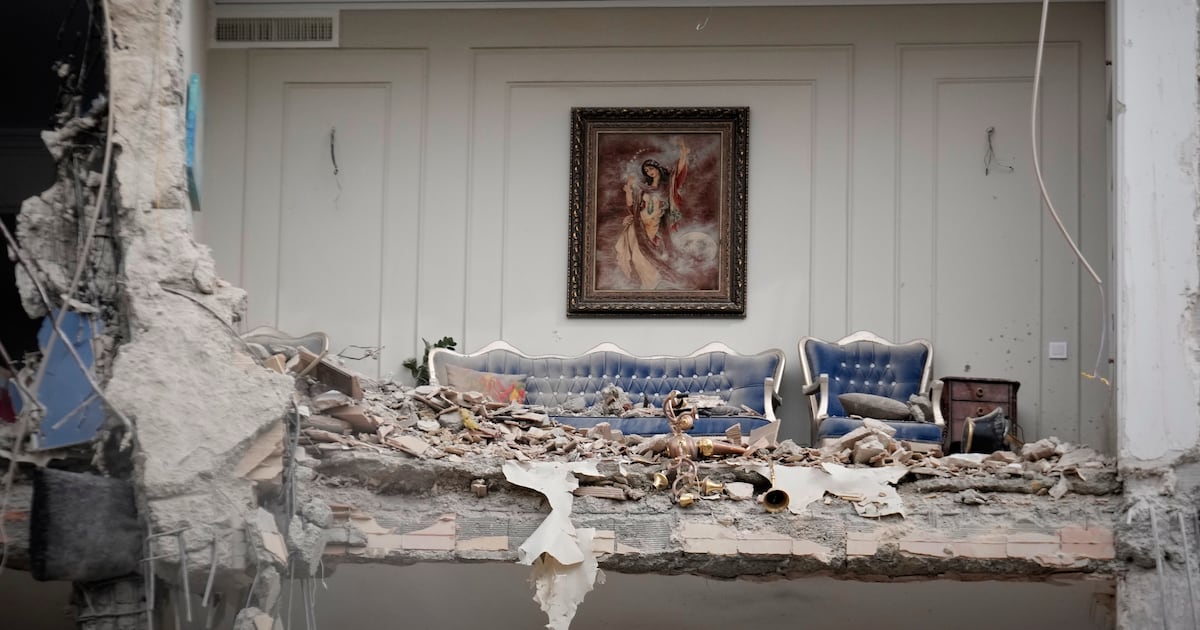
“In wartime, truth is so precious that she should always be attended by a bodyguard of lies,” said Winston Churchill. The truth inside Donald Trump’s tornado of piffle is that he wants to get out of the mess he created. All the other reasons he gives – from regime overthrow to regime alteration – are noise.
At this point, were Iran to open the Strait of Hormuz in exchange for being allowed to develop nuclear weapons, nobody could be sure Trump would turn it down. If Iran made him the inaugural winner of the Cyrus the Great peace prize, those odds would improve.
Here is what Trump expected when he started bombing Iran: its regime would collapse or unconditionally surrender within 72 hours. That was Plan A. Plan B did not exist, which means Trump is scrambling to get back to what existed before Plan A. His war aim is the status quo ante.
Had Plan B existed, Trump would have readied allies, put US minesweepers and marines in place, built up oil reserves and flooded the Gulf states with interceptors. “Nobody was even thinking about it,” he said on Iran lashing out at other Gulf states. Everybody was expecting Iran’s response except him. Indeed, Gulf rulers directly warned him against it before February 28th. Nor does it matter how carefully the deep state laid out the risks. What Trump will not hear did not exist.
He has now shifted into the self-cancelling carrot and stick phase of the war. Iran is acting impervious to both. One moment, Trump is threatening “an amount of strength and power that Iran has never seen or witnessed before”. Then, roughly 36 hours later, he declares that the US and Iran have been having “very good and productive conversations”. Few took the latter on trust. It is a strange situation where the world must await a statement from Iran to check whether there was any truth to what a US president said. Iran replied that no talks had taken place. Who were we to believe?
Nor can the world have faith in indirect talks between the US and Iran. Twice in the past year, Trump has struck during ongoing talks. At one end is Steve Witkoff, Trump’s envoy, a man who is not renowned for his poker face. After Vladimir Putin told Trump that Russia was not supplying Iran with targeting data, Witkoff said: “We can take them at their word.” At the other end, supposedly, is Abbas Araghchi, Iran’s foreign minister. He is a seasoned diplomat but there is no reason to assume he speaks for Iran’s Revolutionary Guards. Some around Trump believe that the conservative parliamentary speaker, Mohammad Bagher Ghalibaf, could be Iran’s Delcy Rodríguez. But this sounds like wishful thinking.
Either way, Trump will dial the invective up or down depending on Iran’s apparent negotiating position. The one offer Iran will never make is to give up its ability to disrupt the global energy markets. Yet that is the one thing Trump must have. Indirect talks are thus geared to swing from wild threat to outsized promise in line with Trump’s mood. Each time he is exposed as having made an empty threat that failed to push Iran into the desired concession, he will need to step up his threat level. This used to be known as the credibility gap. It does not take a seer to guess that at some point he will hint at using nuclear weapons. That would not mean he had any wish to use them. But loose lips can do worse than sink ships. The other option is to establish a US beachhead along Iran’s Strait of Hormuz shoreline. Mission creep would be almost destined to follow.
Trump could always walk away and leave others to clean up. As Richard Haass, a senior official in past Republican administrations, noted, that would amount to a “we broke it, you own it” inversion of Colin Powell’s Pottery Barn rule. But that would be a Pyrrhic exit. Iran could continue to hold global energy hostage until it is satisfied that Trump will not resume hostilities. Of course, he could promise not to start bombing again. But would Iran trust him?
It is too soon to capture the extent of the damage done to American power. But we can be sure that Gulf war III will intensify the global arms race, especially among America’s confidence-shaken allies. We are likewise at the start of an alternative energy boom. Nuclear power, solar panels and windmills do need critical minerals. But there is currently no Strait of Hormuz choking off green energy supplies.
What remains to be seen is how Trump will find a way out of this morass. He wanted to bring down Iran’s regime. Now he is lifting sanctions on Iran so that it can sell more oil. Amid the torrent of feints, hype, invention and bluster, Trump’s goal is now to set the clock back. With planning like this, who needs chaos? – Copyright The Financial Times Limited 2026